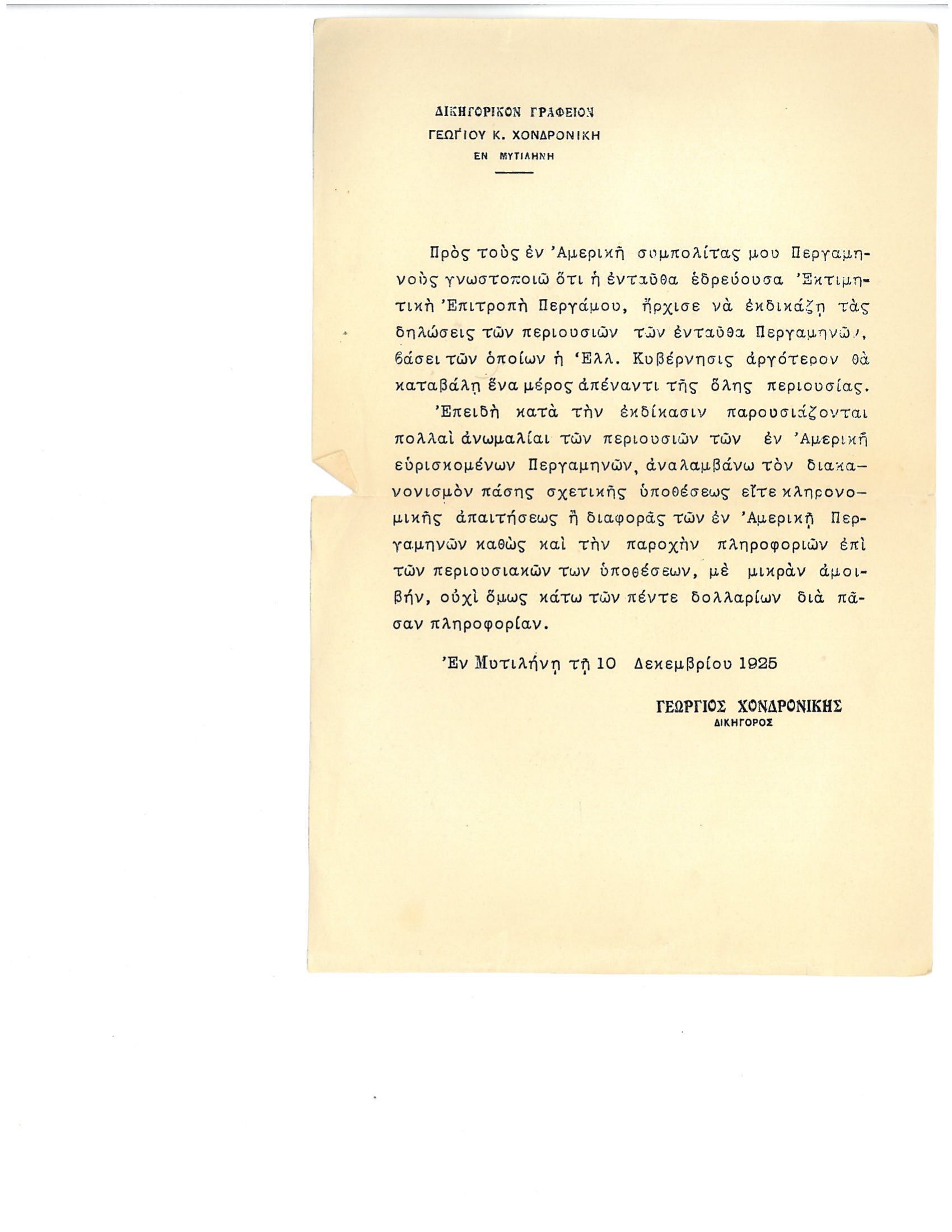
A printed circular letter from the Mytilene law office of Γεώργιος Κ. Χονδρονίκης (Georgios K. Chondronikis), dated December 10, 1925, addressed: “To my fellow-citizens the Pergamenes in America.” It announces that the Pergamon Assessment Committee (Εκτιμητική Επιτροπή Περγάμου), based in Mytilene, has begun adjudicating the property declarations of Pergamene refugees, “on the basis of which the Hellenic Government will later pay a portion against the total property.” The attorney offers paid case-handling and information services for Pergamene émigrés in America — “a small fee, however not less than five dollars for each piece of information.”
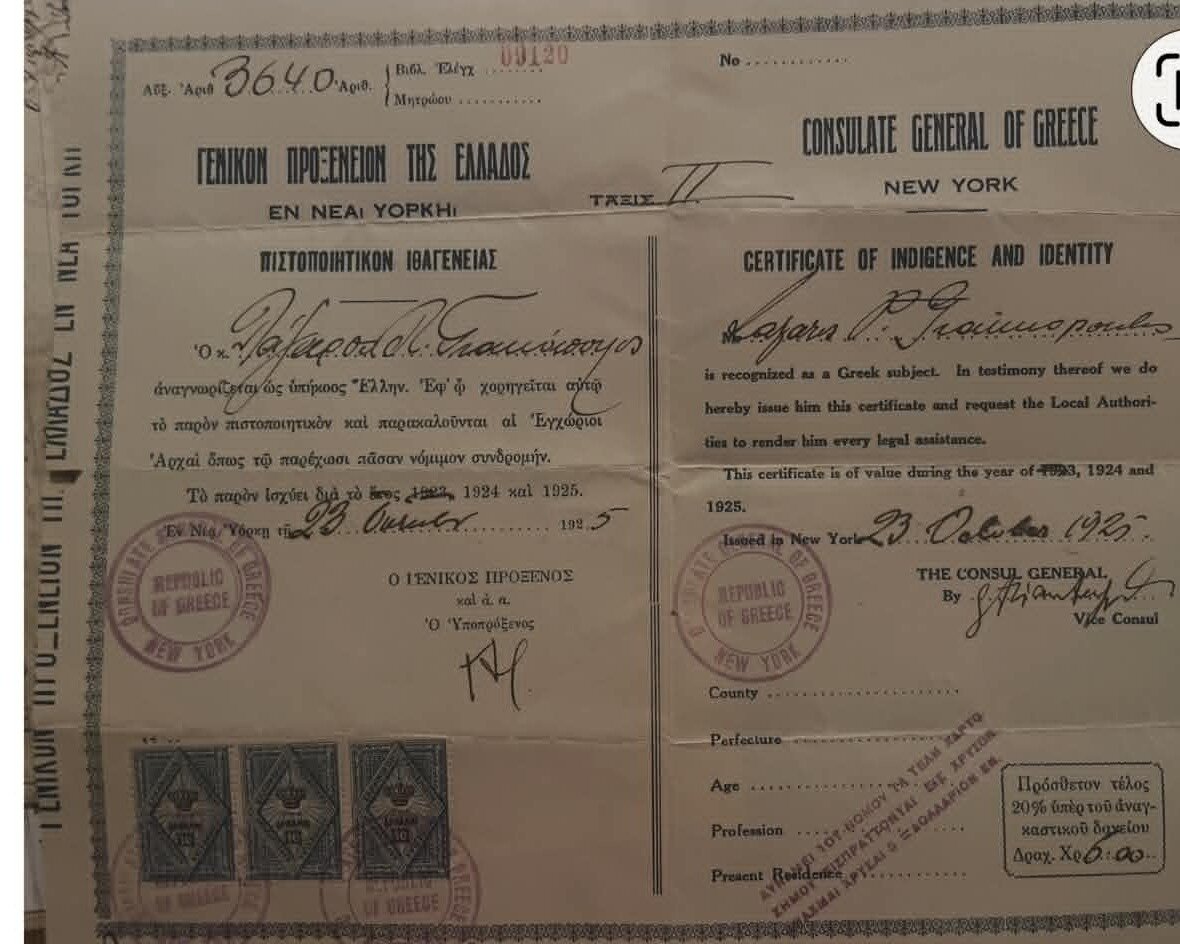
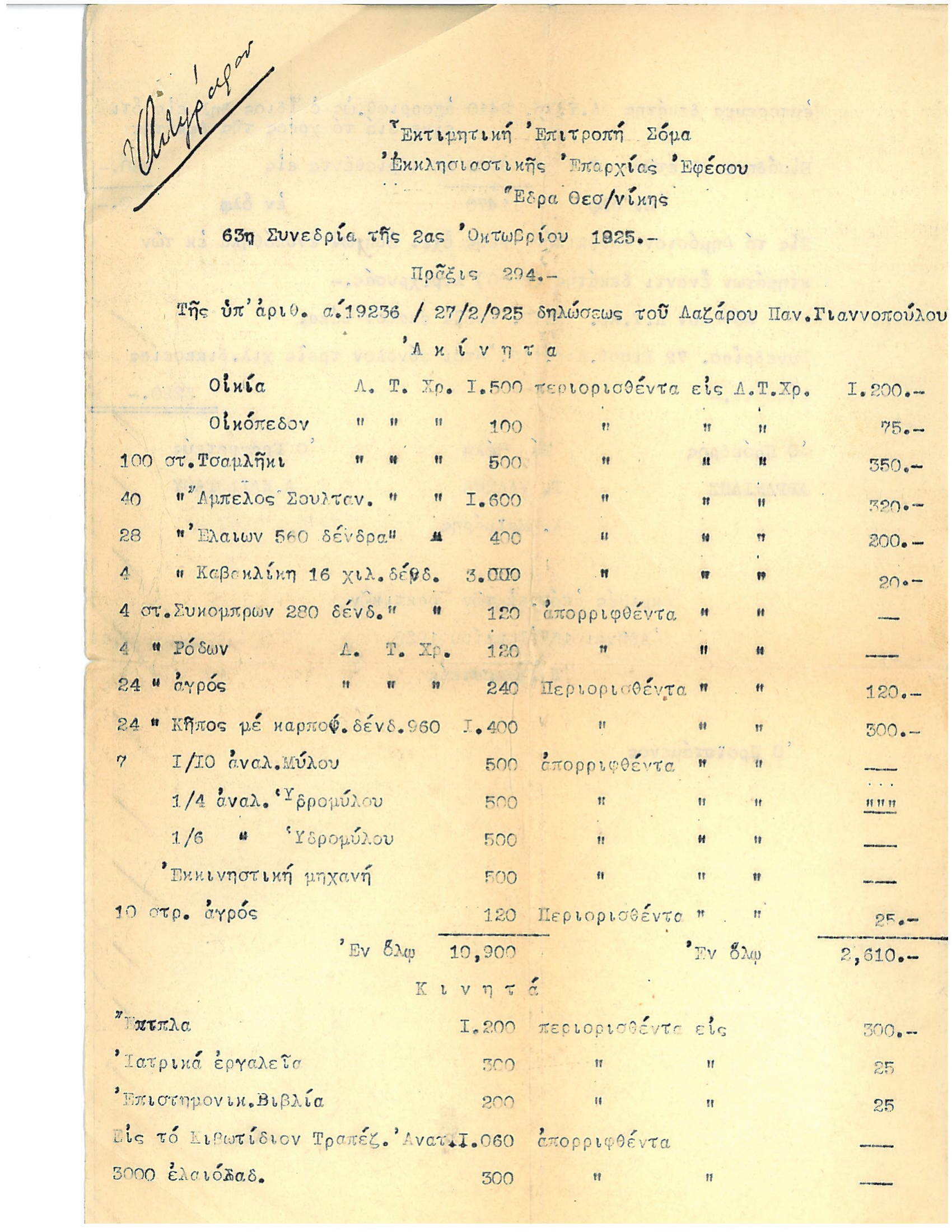
This is a Karamitrou-side document. Eftyhia was born in Pergamos / Bergama, and the circular almost certainly reached the Yannopoulos household through her Pergamene heritage — her father Sofianos Karamitrou’s lost Bergama property. It documents that by late 1925, the family in New York was pursuing refugee compensation through two parallel state tracks: the general Greek Refugee Compensation Committee (which had assessed Lazaros’s Soma-side estate at 3,330 Turkish gold pounds — roughly $2.5 million in today’s gold-equivalent wealth — in February 1925) and this town-specific Pergamon Assessment Committee for Eftyhia’s family’s losses.
The two-front strategy explains the volume of mid-1920s Mytilene-to-NYC correspondence in Lazaros’s papers, and the role of intermediaries like A. G. Sofianos in Piraeus (whose 1928 letter reports on the Karamitrou Pergamon track via the Greek Ministry of Agriculture). It also illustrates the broader infrastructure that grew up in 1920s Mytilene around Asia Minor refugee compensation: town-specific committees, freelance attorneys soliciting cross-Atlantic clients, and a steady ledger of dollar remittances flowing east from the American diaspora.