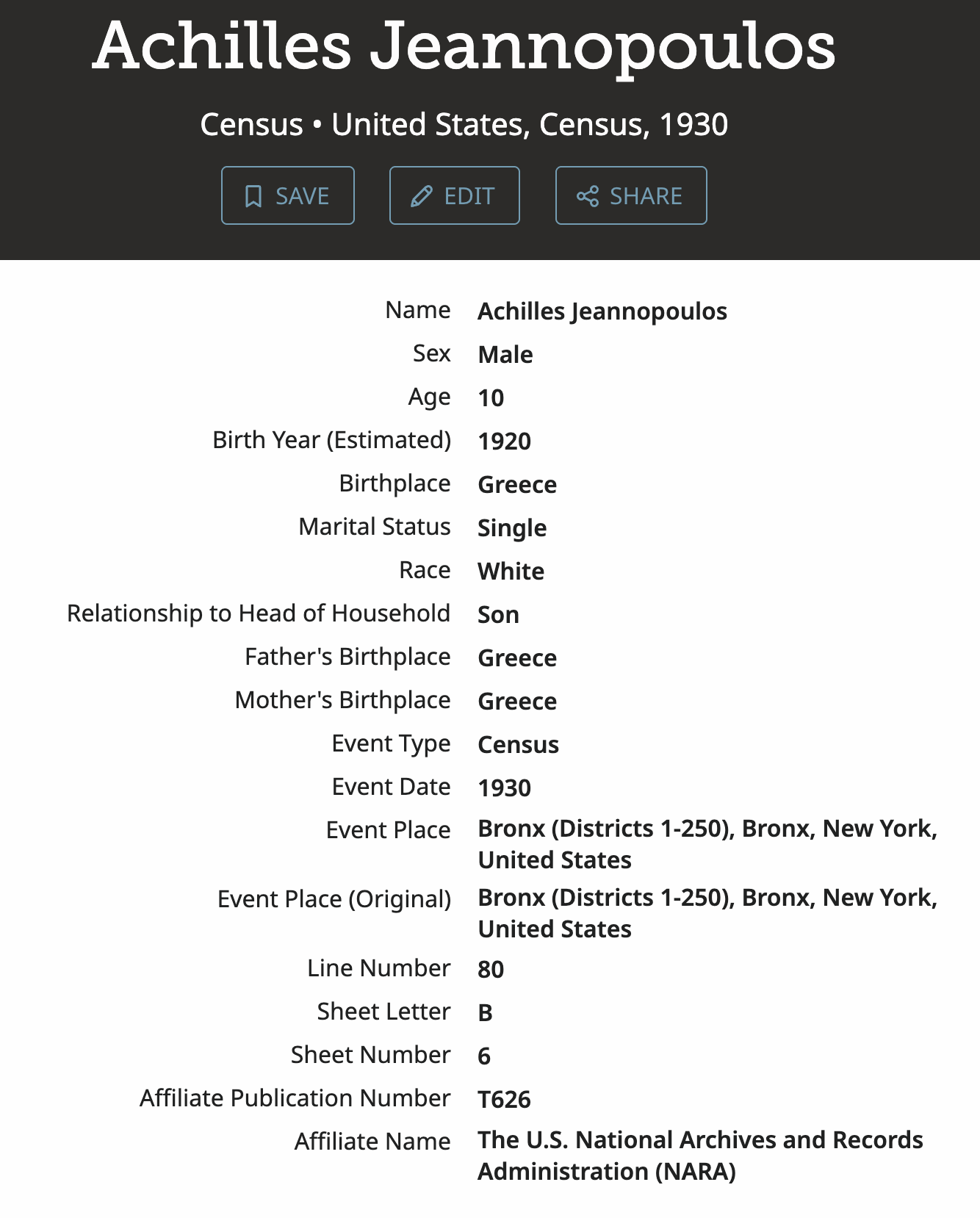
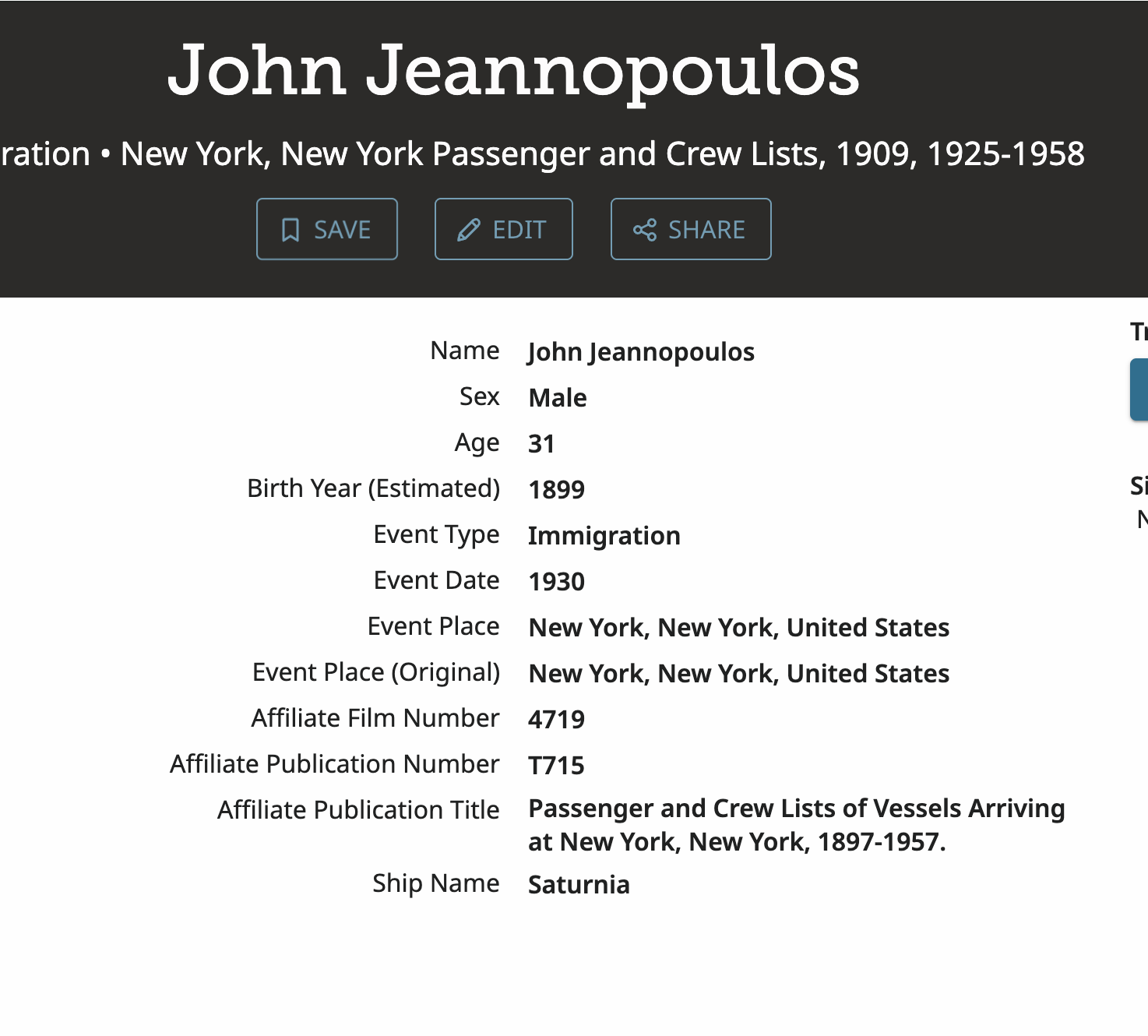
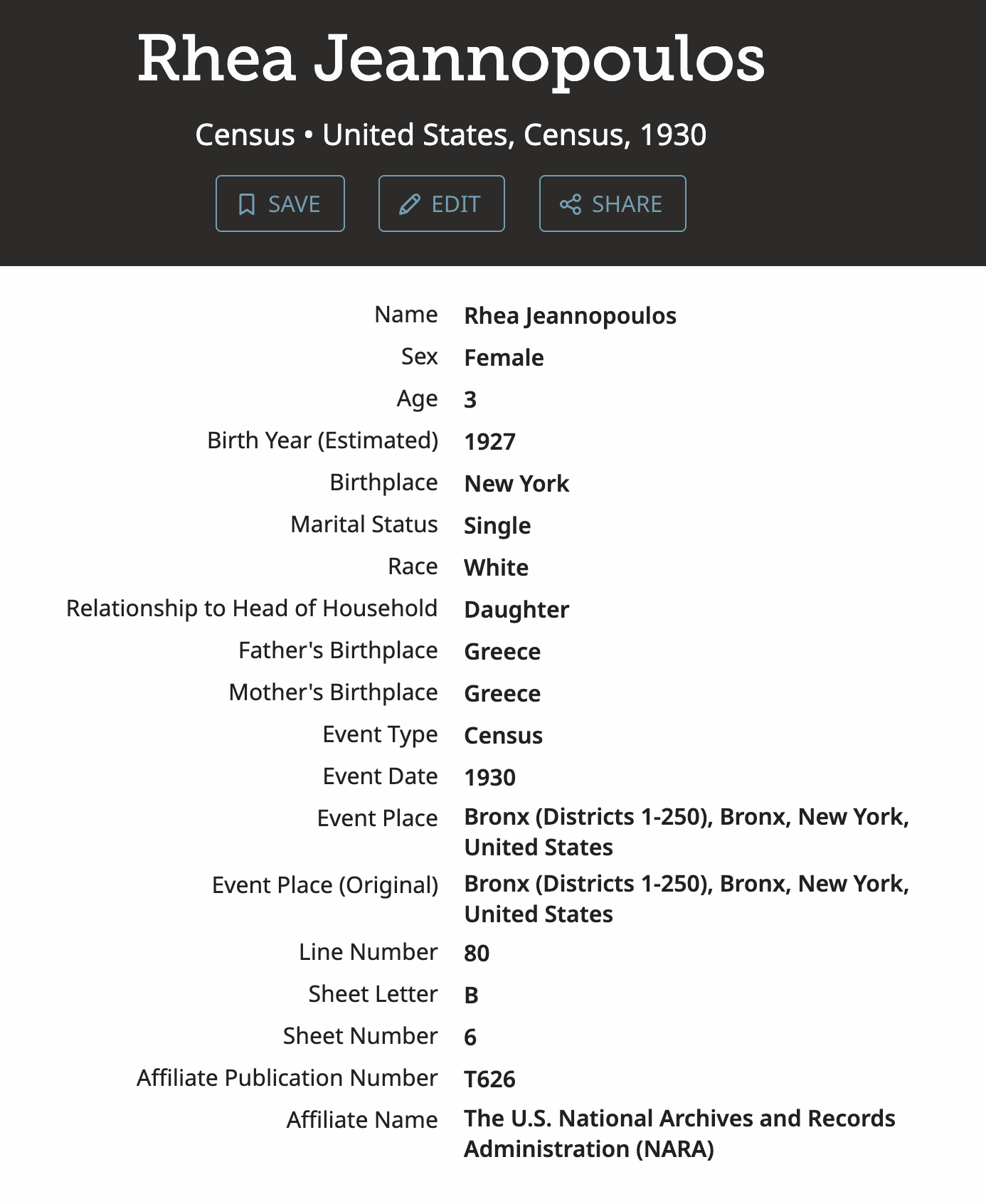
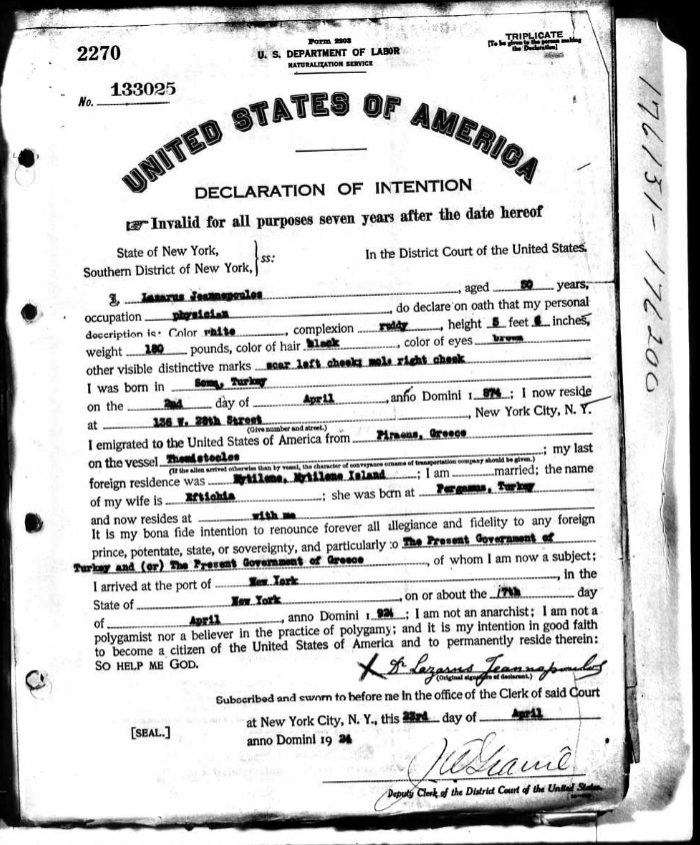
A handwritten Declaration of Intention — the first formal step in the US naturalization process — filed by Eftyhia Jeannopoulos at the District Court for the Southern District of New York. The Declaration of Intention is the document a non-citizen filed first to signal an eventual intent to apply for naturalization; the actual oath came years later in a separate filing (the Petition for Naturalization).
The record surfaces in Ancestry’s “New York, U.S., Naturalization Records, 1882-1944” collection.
Why she filed separately
Under US naturalization law before the Cable Act of 1922, the foreign-born wives of US citizens acquired American citizenship automatically through their husbands. After 1922 they had to apply in their own right. Lazaros didn’t naturalize until 1928 — well into the post-Cable-Act regime — so when he became a US citizen, Eftyhia did not automatically follow. To become an American she had to file her own Declaration of Intention, work through the residency requirements, and then file a Petition for Naturalization on her own. This document is the first step of that personal process.
The Cable Act framing is worth remembering: it was passed partly as women’s-suffrage-era progress (women were no longer legally subsumed in their husbands’ citizenship) and partly to give Congress more control over immigration. For Eftyhia in NYC in the 1930s it meant one more bureaucratic process to wade through — separately, in her late fifties or sixties, in a language she was still learning.
Open questions
- Exact filing date. The scan is faded; the year visible at top has not yet been transcribed cleanly. Likely some time between 1928 (post-Lazaros’s naturalization, when she’d need to start her own track) and 1944 (the database end-year).
- Whether she completed naturalization. The Declaration of Intention is the first step; the Petition for Naturalization is the second. A separate record should show whether she actually became a US citizen.
- Her stated US residence at filing. The visible address line is the 1928–1939 family Bronx address (per Lazaros’s same-period records) or her later Murray Hill address — the document would clarify which.
- The witnesses. Naturalization petitions required two citizen witnesses; the named witnesses would identify the family’s NYC social network at the time.