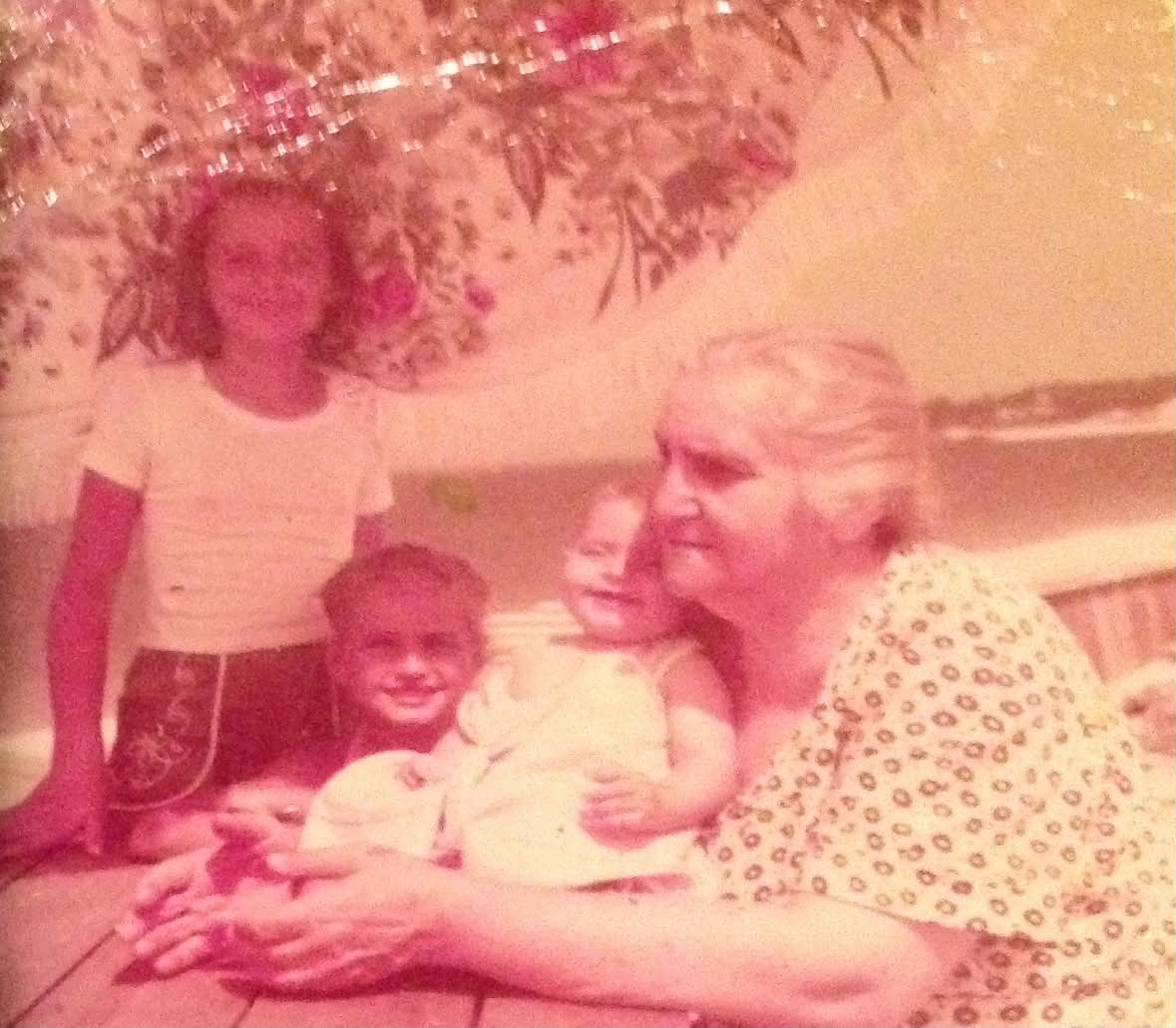
 Nene at the bungalow, with three of John Lazare’s daughters — Mya, Claudine, and (likely) the youngest Aline in her arms. The same Nene who carried the drawstring bag.
In her later years Eftyhia Karamitrou Jeannopoulos lived with her son Takis and his Polish-born wife Alina in a Washington Heights apartment building, in the same building as her son John’s family one floor away. The grandchildren called her Nene — the Asia-Minor diminutive for grandmother, not the Greek-mainland Yia Yia.
Her granddaughter Aline Pepe wrote a portrait of her years ago, quietly, just to have it written down. It came into the family record on May 24, 2026, when Aline shared it with Alex.
The bag
“Nene had fashioned a magical drawstring bag that filled the left side of her bra. Primarily, it held all her sewing supplies with its colorful threads. During the late 1960s when I was 12 or 13, like all young teens I wore bell bottoms. I practically lived in my favorite pair… I’d fallen, ripped them across the knee and as usual went to my Nene for help. She simply reached into her dress, pulled out the right colored threads and fixed those pants with me still in them… and off I went.”
Threads. Bandaids. Hair ribbons. Buttons. Charms. “It wouldn’t have surprised me if she pulled out a fishing lure if my Dad had lost one.”
And two kinds of candy. Peppermint and butterscotch.
The grandchildren took the peppermints. They rejected the butterscotch. “I never knew why she carried them.”
What the butterscotch was for
“Years after she had passed, as my Uncle Takis lay dying from cancer, a last ditch effort of Chemo had left him nauseous and unable to eat anything. He had grabbed onto my arm, and begged me to go get him something, which took me hunting store to store as I finally knew who those Butterscotch candies were for.”
She had been carrying them for him, every day, in the bra-bag, for the entire span of his adult life. None of the grandchildren had ever known. Takis had never asked aloud. She just kept them there in case. For decades.
When she died at the family’s beach house in December 1968, with Takis and John at her side, she was still carrying the bag.
The mastectomy nobody talked about
There is a second piece to Nene’s portrait that turns the bag from sweet to extraordinary. Aline accidentally opened the bedroom door too early one evening when her grandmother was getting ready for bed, and saw what Nene had been hiding her whole adult American life:
“The deep scar of a radical mastectomy as done in the 1930s or so, with no thought of aesthetics. What strikes me even today, is that this incredibly modest woman, didn’t grab her nightgown to cover her nakedness but to shield me from the sight of it. I kept her secret. I didn’t ask about it, or tell anyone what I’d seen.”
Aline closes the portrait by writing about archaeology — recent excavations in the Black Sea region of Turkey, of Bronze-Age women buried with shields, arrows, bows, and horses. The proposed historical basis for the Iliad’s Amazons. The legendary single-breasted warrior women who, in the ancient Greek etymology of amazon, sacrificed a breast to survive on their own terms.
“I never doubted it. I had all the proof I needed of amazing Amazonian strength and beauty, the night I saw my grandmother in her bedroom.”
The bag was for Takis. The scar was for nobody. The peppermints went to the children. The butterscotch waited.
Both of them now rest at Mt Olivet Cemetery in Queens, alongside Lazaros, in the same plot.