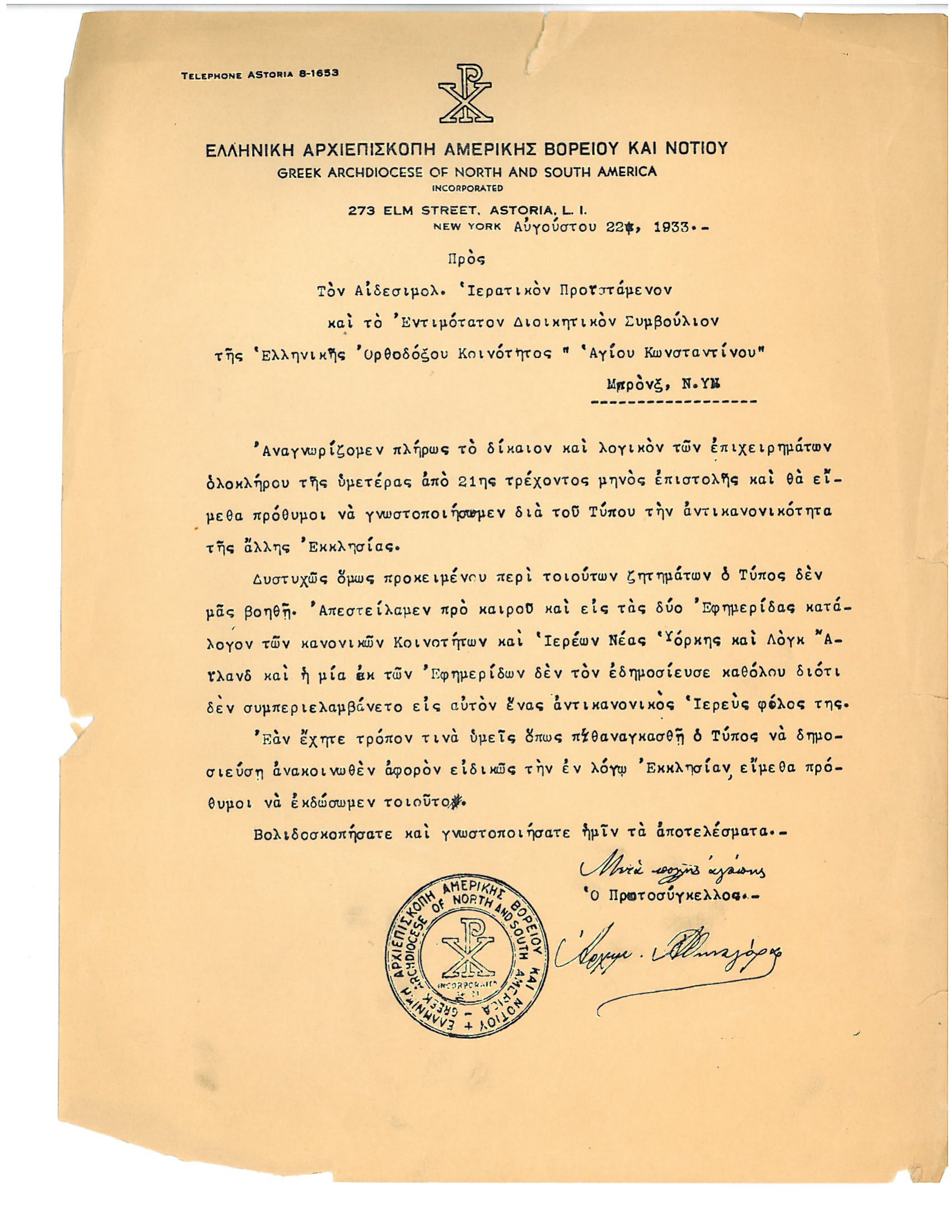
The Archdiocese caught running a press strategy. A letter from the Greek Archdiocese of North and South America, Incorporated, 273 Elm Street, Astoria, Long Island, dated August 22, 1933, addressed:
“To the Most Reverend Priestly President and the Most Honored Administrative Council of the Greek Orthodox Community of ‘Saint Constantine’ Bronx, NY.”
Signed “Ο Πρωτοσύγκελλος” — the Protosynkellos (the Chief Vicar of the Archdiocese) — over the Archdiocese’s embossed seal.
This is the document that names Lazaros’s Bronx parish definitively: Άγιος Κωνσταντίνος / Saint Constantine Greek Orthodox Community of the Bronx, the same name as his own son. The letter responds to a “Saint Constantine letter of the 21st of the current month” — a parish letter that does not survive in this archive — and acknowledges its arguments against a rival (“the other Church”) as “just and logical.”
The body lays out a coordinated press strategy between the Archdiocese and the Bronx parish to discredit the rival, anti-Athenagoras Bronx parish through the Greek-American newspapers:
“Unfortunately, however, when it comes to such matters the Press does not help us. We sent some time ago to both Newspapers a list of the canonical Communities and Priests of New York and Long Island, and one of the Newspapers did not publish it at all because it did not include an irregular Priest who is a friend of theirs.”
The Archdiocese asks the Bronx parish to find some way to pressure the press into publishing a communication specifically concerning the rival parish — “Probe and let us know the results” — and offers to issue such a communication.
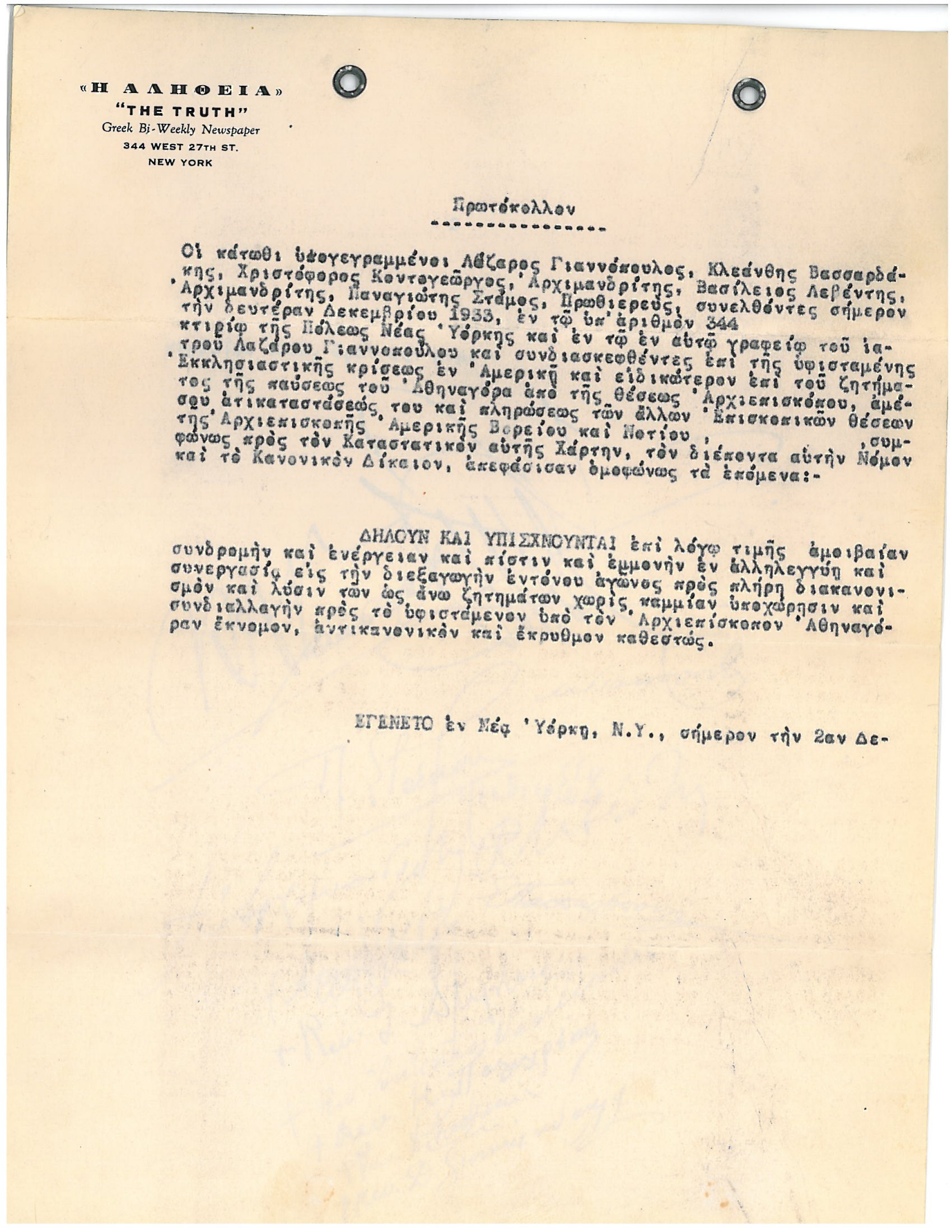
The letter places the church-politics fight in 1933 New York firmly inside the operational machinery: the Archdiocese under Athenagoras (installed 1930) was actively coordinating with allied parishes against dissident parishes through the Greek-language press, with selective publication and editorial sympathies on both sides. The campaign culminated in the December 11, 1933 anti-Athenagoras rally at Palm Garden (in which Lazaros was a New York organizing-committee member), but the August 22 letter shows the Archdiocese’s parallel campaign on its own side — Lazaros’s parish — was already well underway four months before that rally.