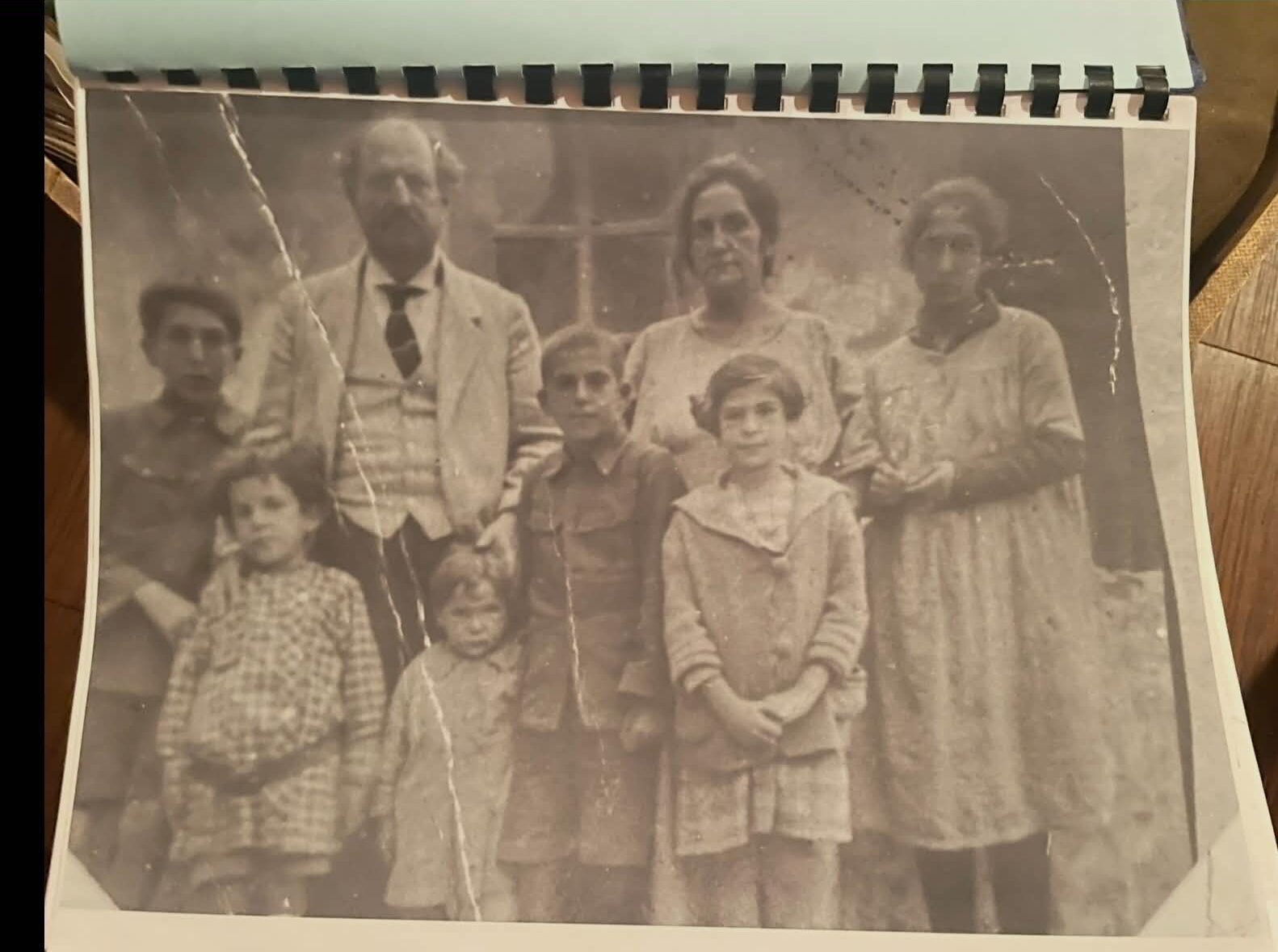
Lazaros lived sixty-eight years on three continents and inside two collapsing empires — and he documented the trip. The family record begins with him because so much of it survives in his own handwriting.
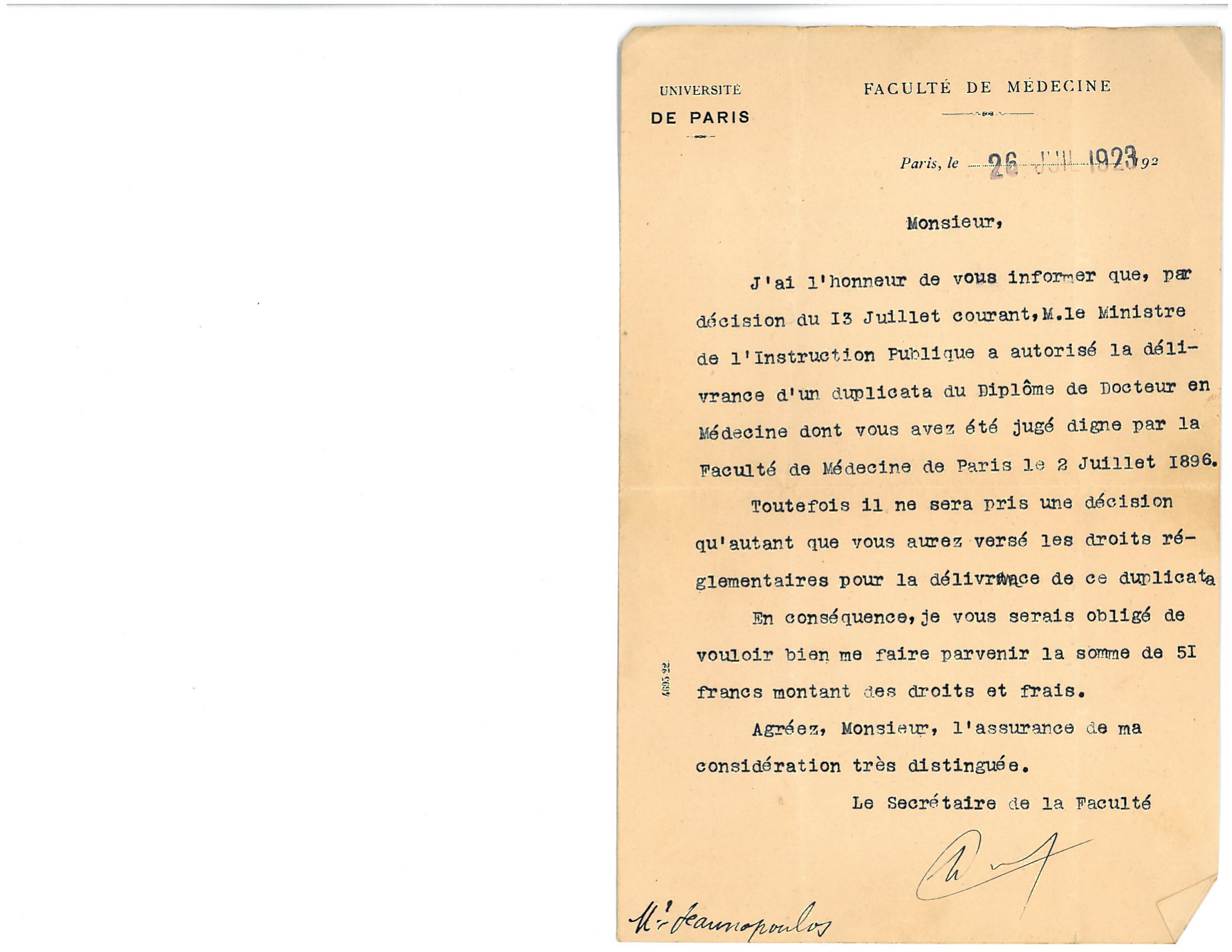
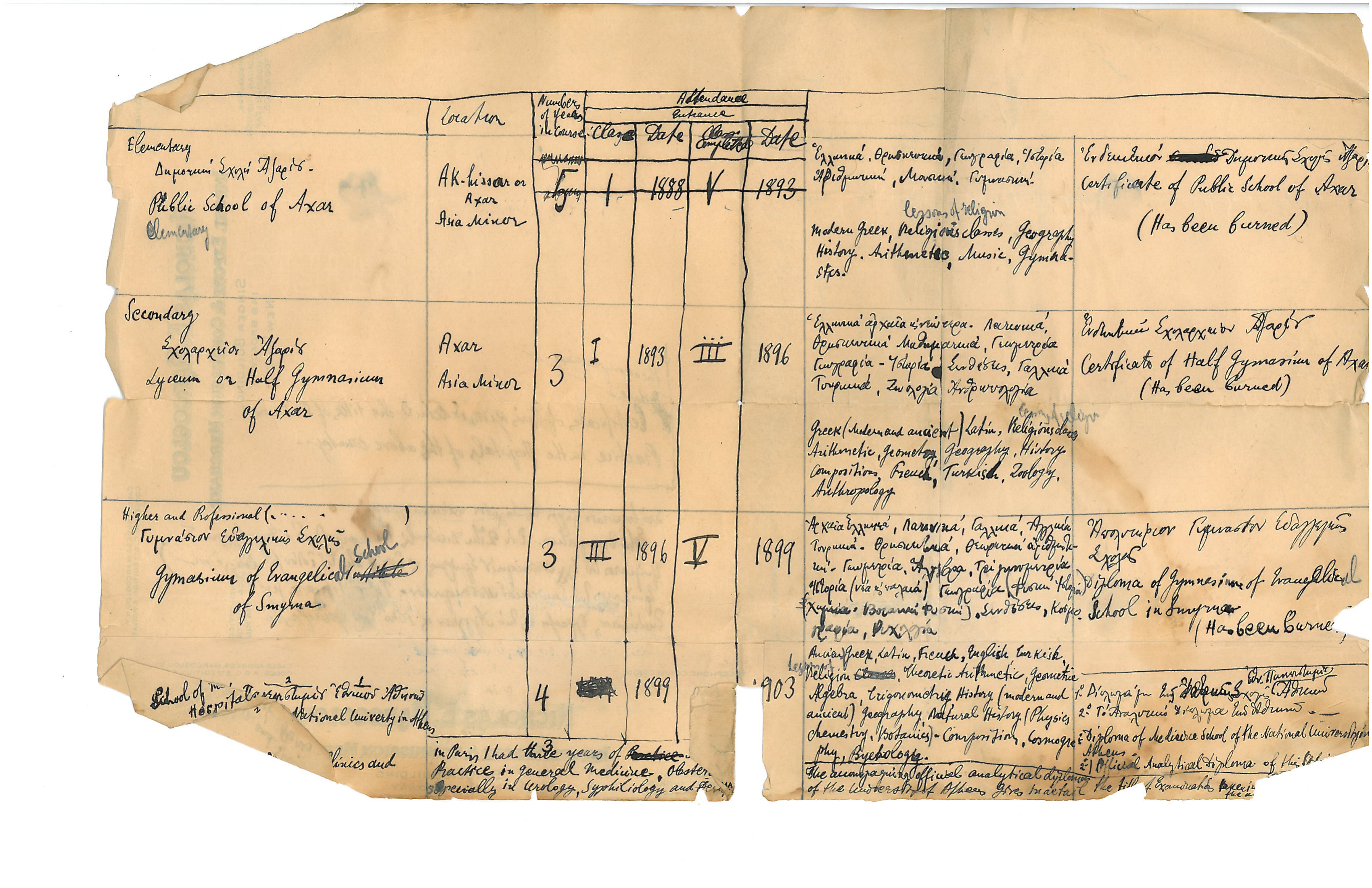
He was born around 1871 in Akhisar, Asia Minor, on the western edge of an Ottoman Empire he would outlive by half a century. His 1924 CV walks his education year by year: the Half-Gymnasium of Axar (1893–1896), the Gymnasium of the Evangelical School of Smyrna (1896–1899), an MD from the School of Medicine of the National University of Athens (1899–1903), and then three years of Paris postgraduate medical training in general medicine, obstetrics, urology, and syphilology. The Paris years are corroborated by a primary document: the 1923 Université de Paris Faculté de Médecine diploma duplicate authorization, the Faculty Secretary’s reply to a post-catastrophe request for a replacement of the original he had lost.
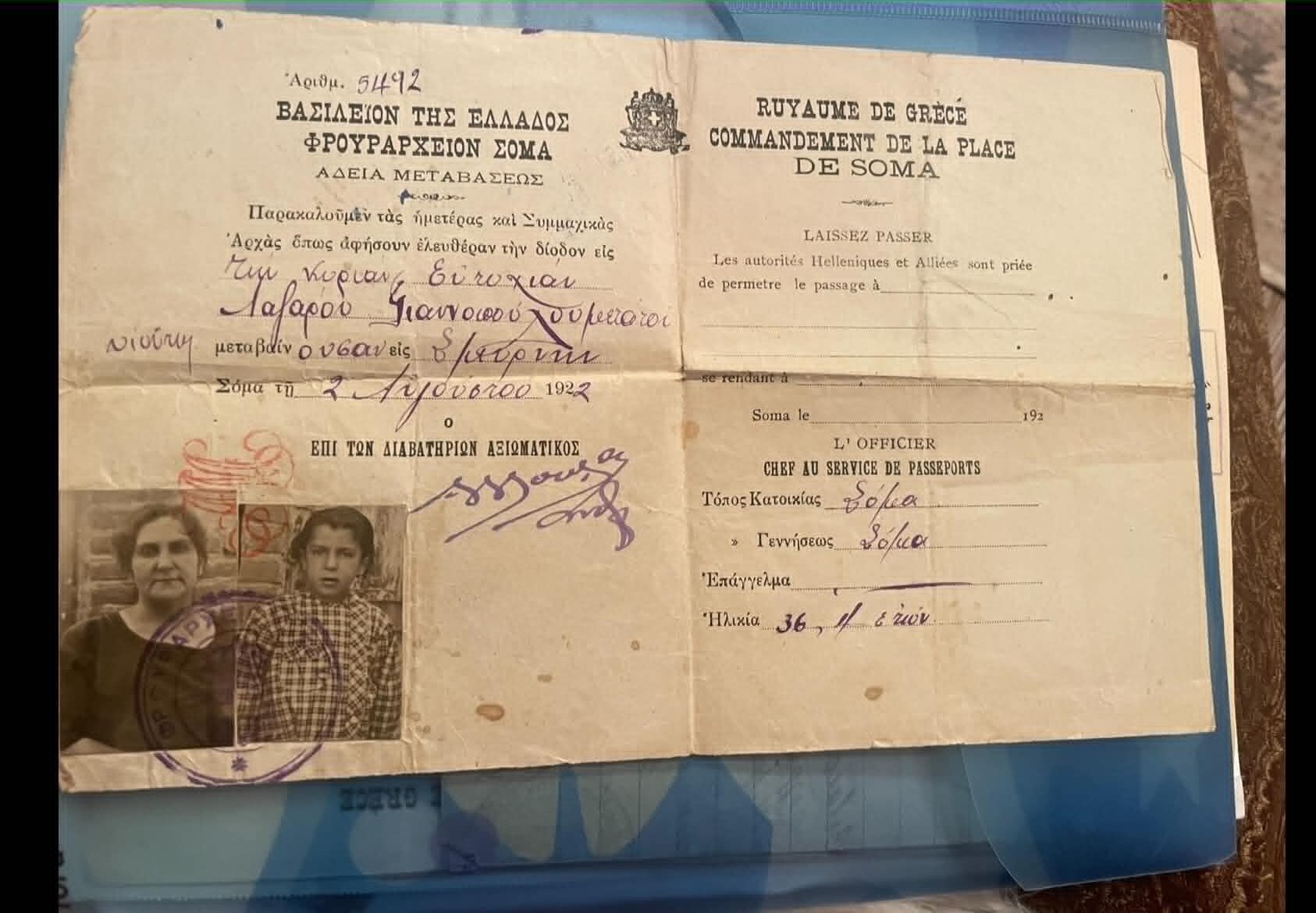
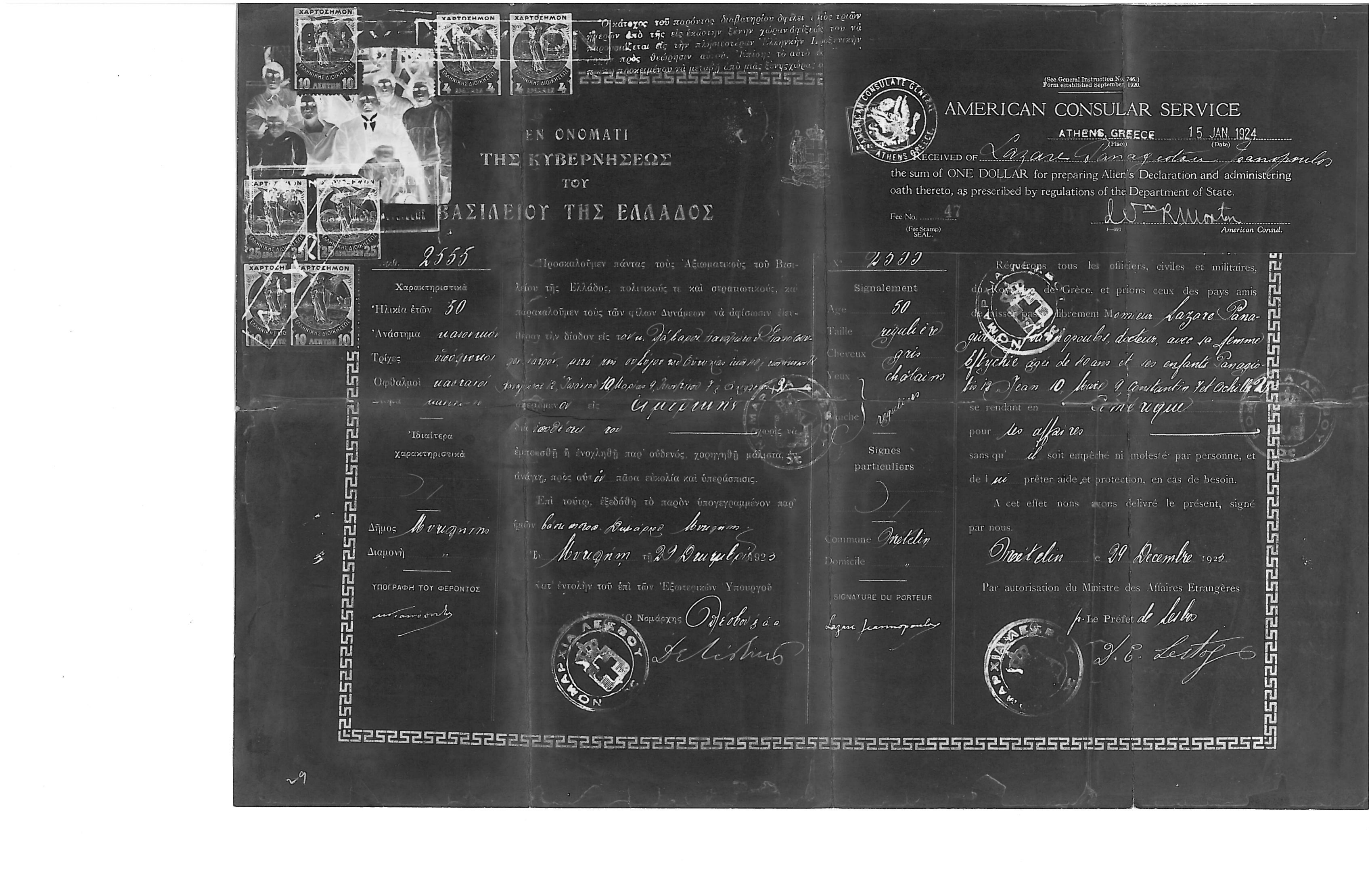
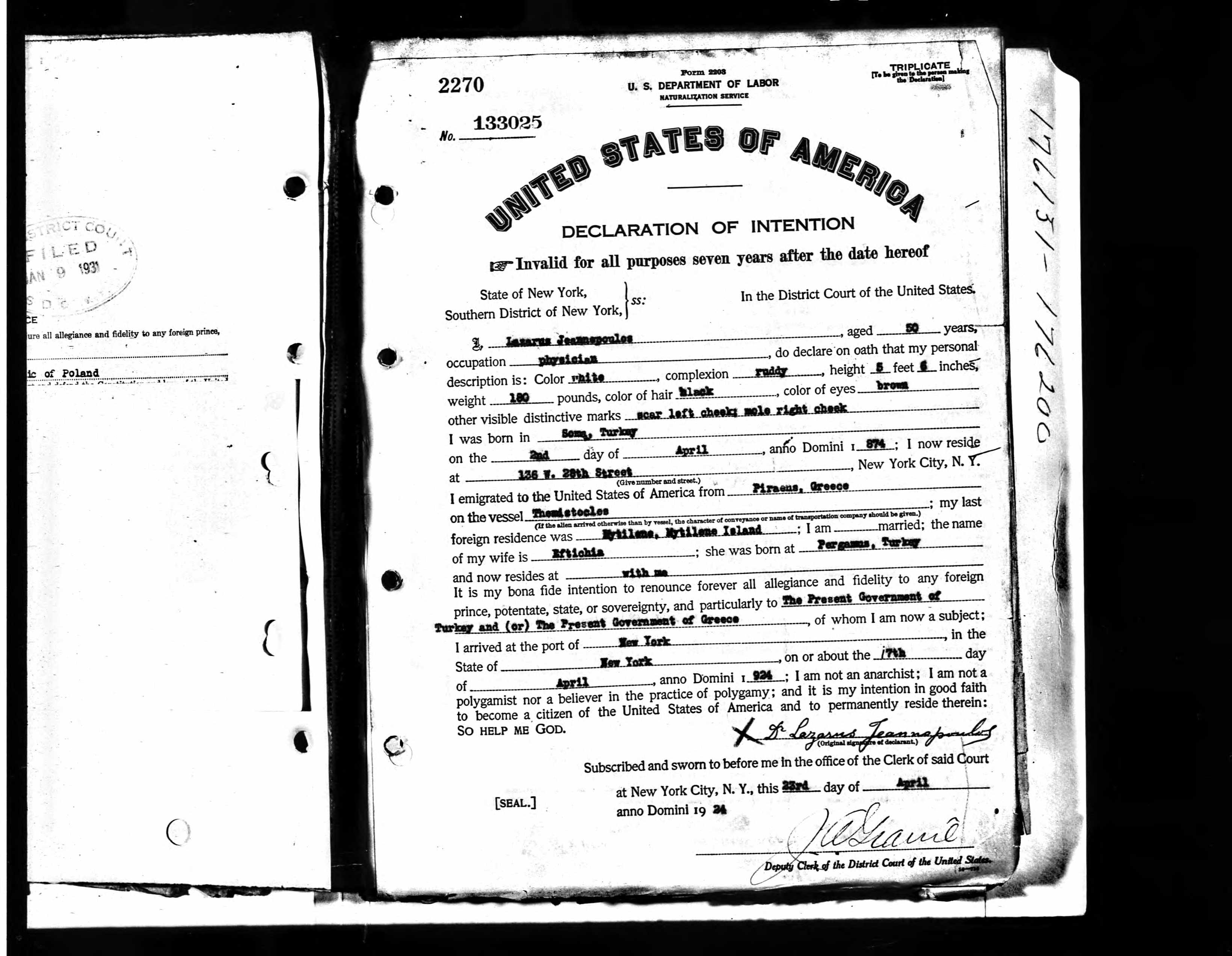
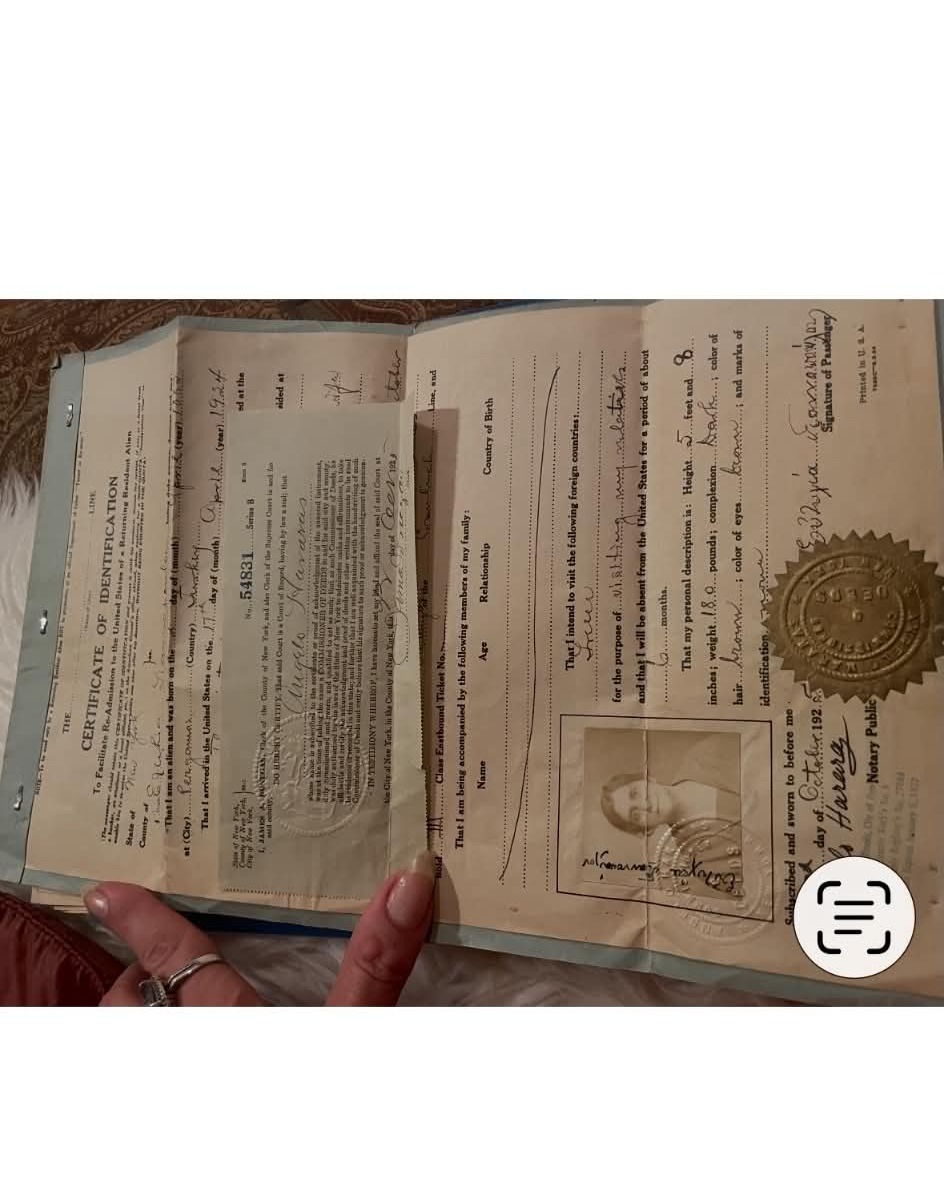
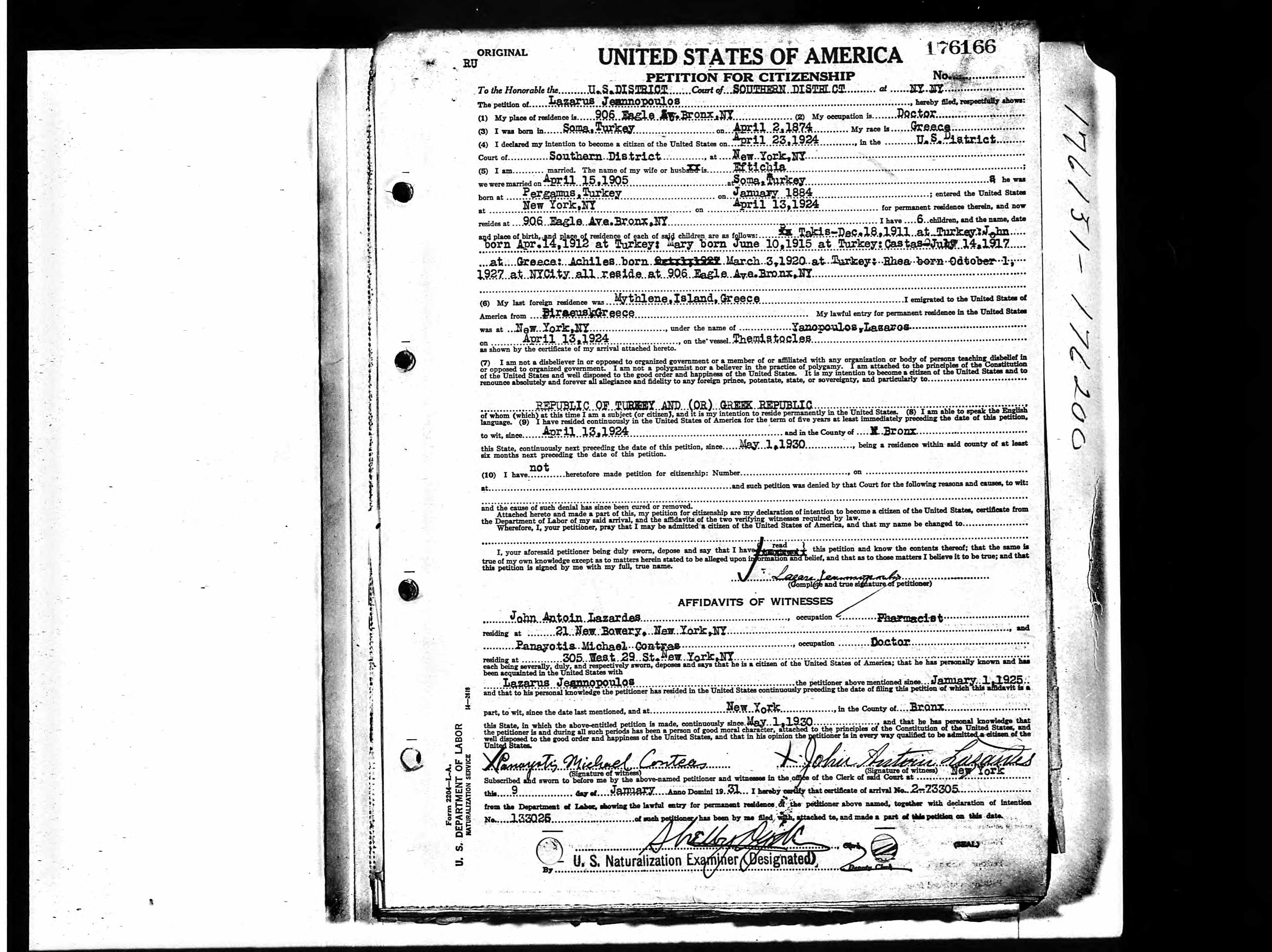
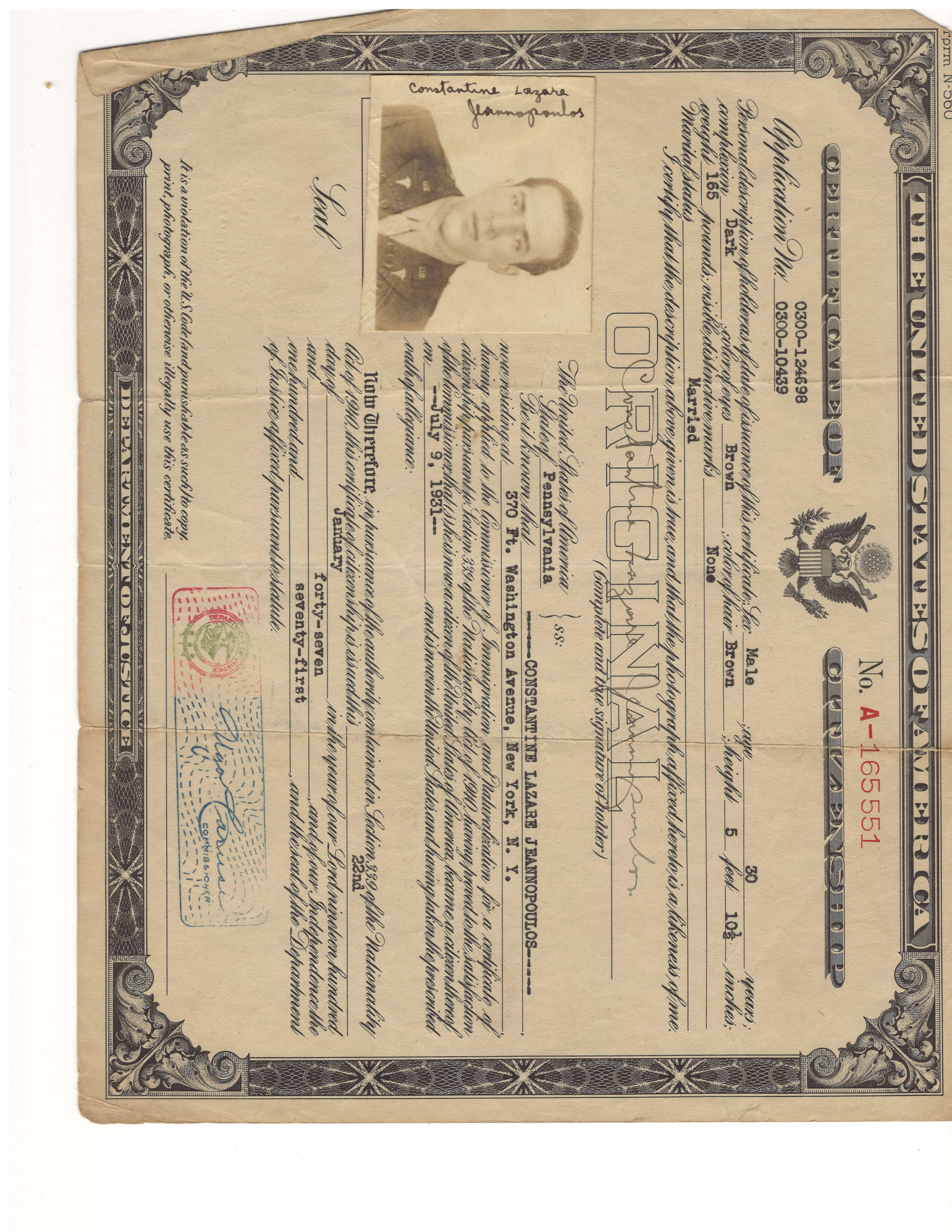
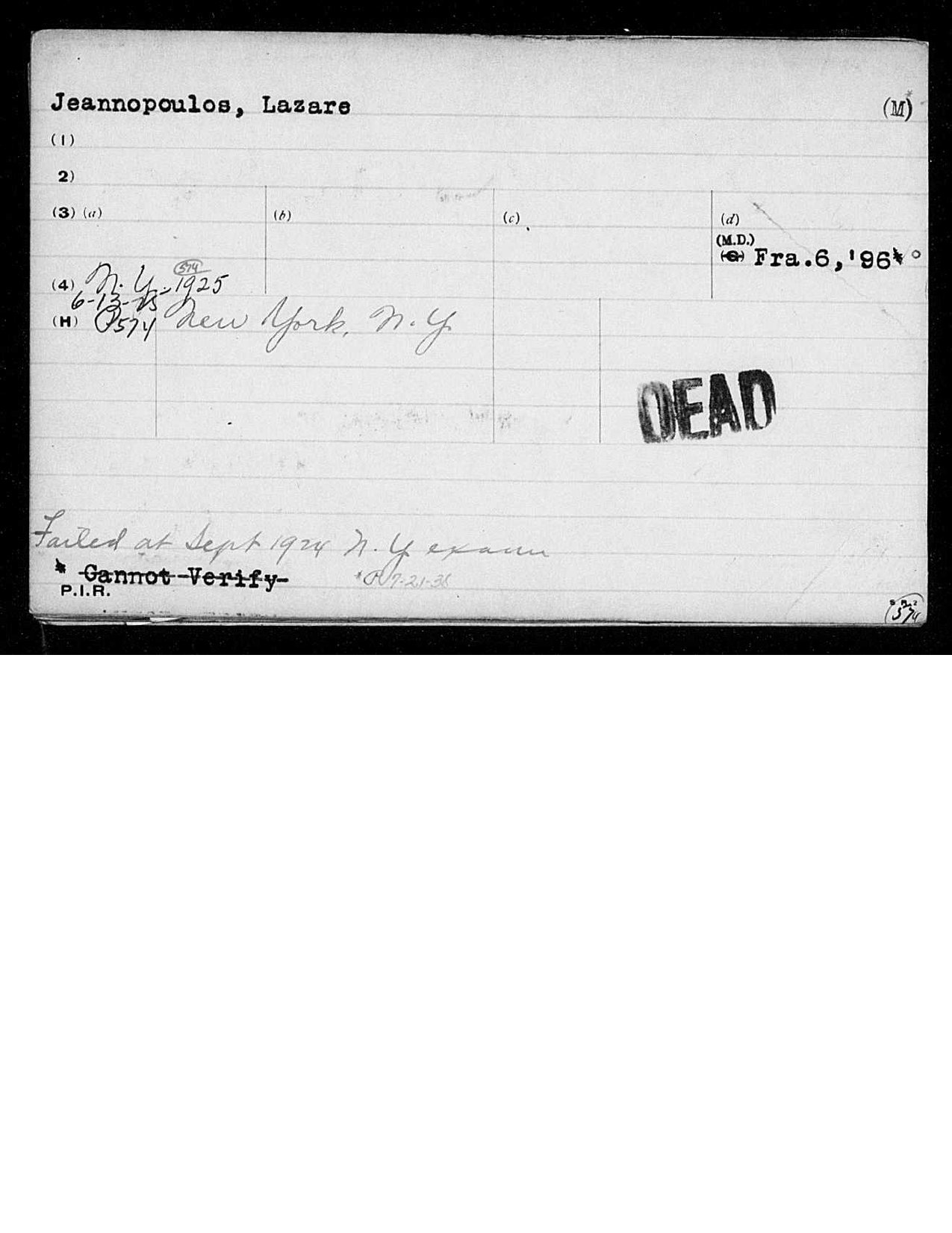
He then practiced medicine across the Smyrna region — Pergamos, Dikeli, Kinik, Kirkağaç, Akhisar, Soma — for some thirty years. By 1915, at about forty-four, he was already publishing in Athens as an exiled Asia-Minor-Greek, seven years before the catastrophe that would make the word official. In 1922, when he was about fifty-one, the catastrophe came anyway. He left Anatolia for Mytilene with Eftyhia, four surviving sons, and at least one baby daughter who would not survive the camps; an estate later assessed at ~3,330 Turkish gold pounds — roughly $2.5 million in today’s gold-equivalent wealth — stayed behind. After two years of refugee paperwork on Lesbos, the family sailed on the SS Themistocles, arriving New York on March 18, 1924. He naturalized in NYC on July 9, 1931, at about sixty (Certificate #3421529). Under US nationality law of the era, his minor children — including Constantine — became US citizens automatically through his naturalization. That single fact would later become the legal hinge of his descendants’ American record.
Early life — a documented chronology
Unusually for a man born in an Ottoman provincial town in the 1870s, Lazaros’s first half-century can be reconstructed from paper — most of it his own. His handwritten 1924 CV lays out his schooling year by year; his 1915 book narrates his arrests in the first person; the biographical paragraph reproduced with his 1926 book dates his public offices; and his 1939 death certificate records his parents. Together they give a sourced early-life timeline:
| Date | Event | Source |
|---|---|---|
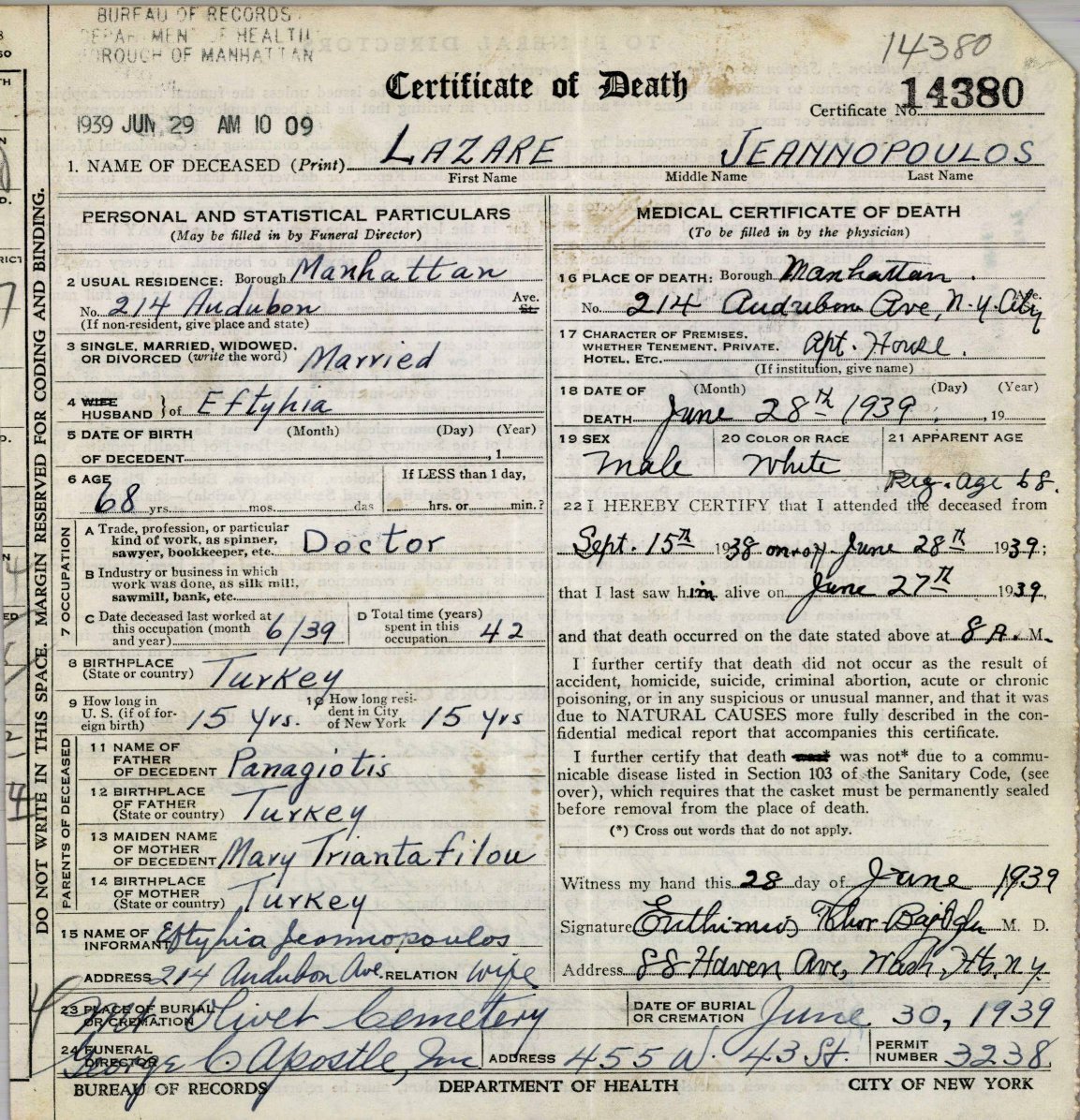
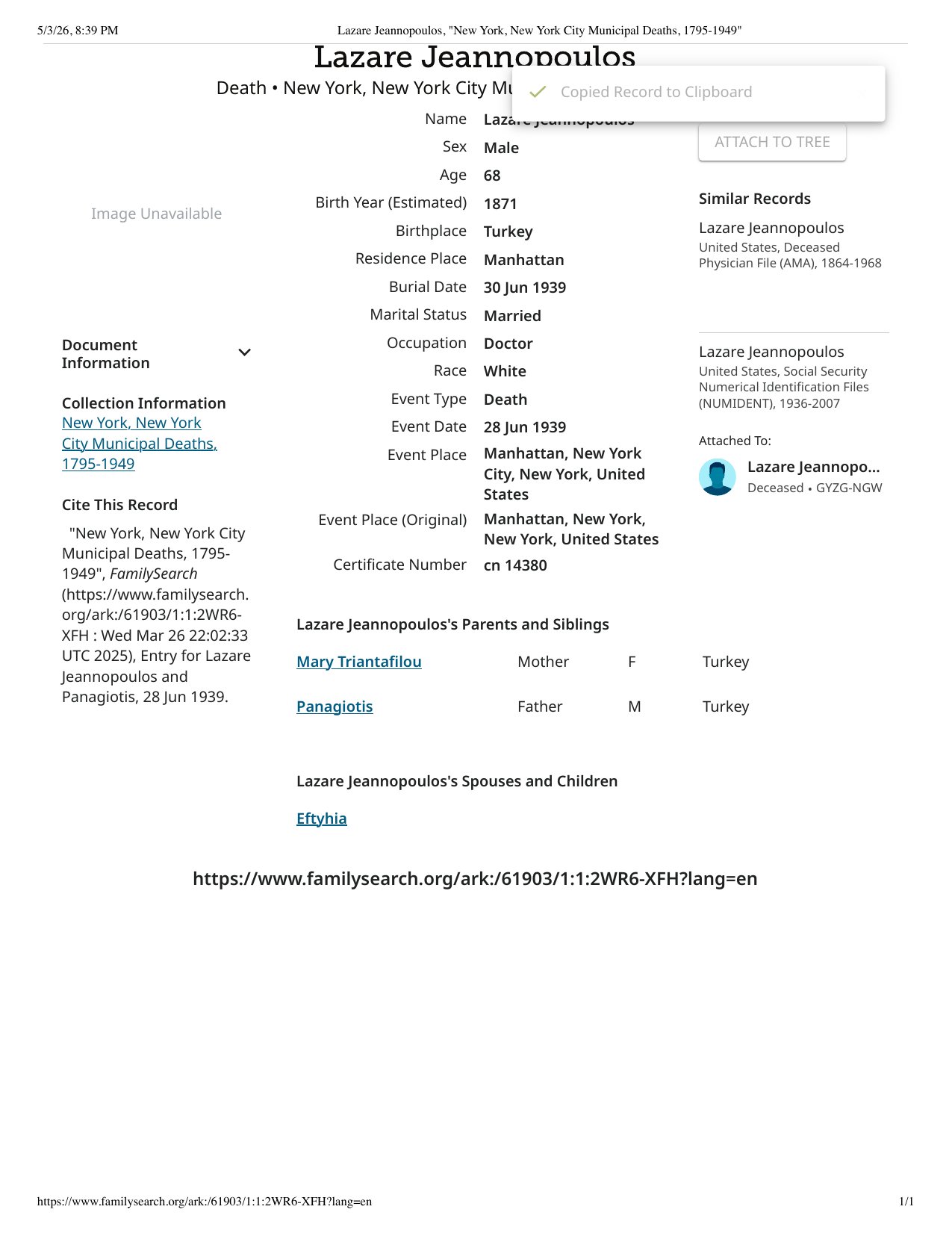
| c. 1871 | Born in Akhisar (Axar), western Asia Minor, to Panagiotis Jeannopoulos and Mary Triantafilou | 1924 CV (birthplace) · 1939 death certificate (parents, age) |
| 1888–1893 | Public (elementary) School of Axar | 1924 CV |
| 1893–1896 | Half-Gymnasium (Σχολαρχείον) of Axar | 1924 CV |
| 1896–1899 | Gymnasium of the Evangelical School of Smyrna | 1924 CV |
| 1899–1903 | MD, School of Medicine, National University of Athens | 1924 CV |
| ~1903–1906 | Three years of postgraduate hospital training in Paris — general medicine, obstetrics, urology, syphilology | 1924 CV, corroborated by the 1923 Université de Paris diploma-duplicate authorization |
| September 1910 | Elected representative of the province of Ephesus to the National Assembly convened by the Patriarchate (Ethnosyneleusi), Constantinople | 1926 book — publisher’s biography |
| February 24, 1914 | Named in the Ottoman newspaper Koiullou, which publicly demanded he leave Anatolia or be expelled by the government | quoted in his 1915 book |
| 1914 | Arrested by Ottoman authorities — his house raided for weapons, jailed about a month on the Soma–Izmir road, released for lack of evidence | his 1915 book (first-person) |
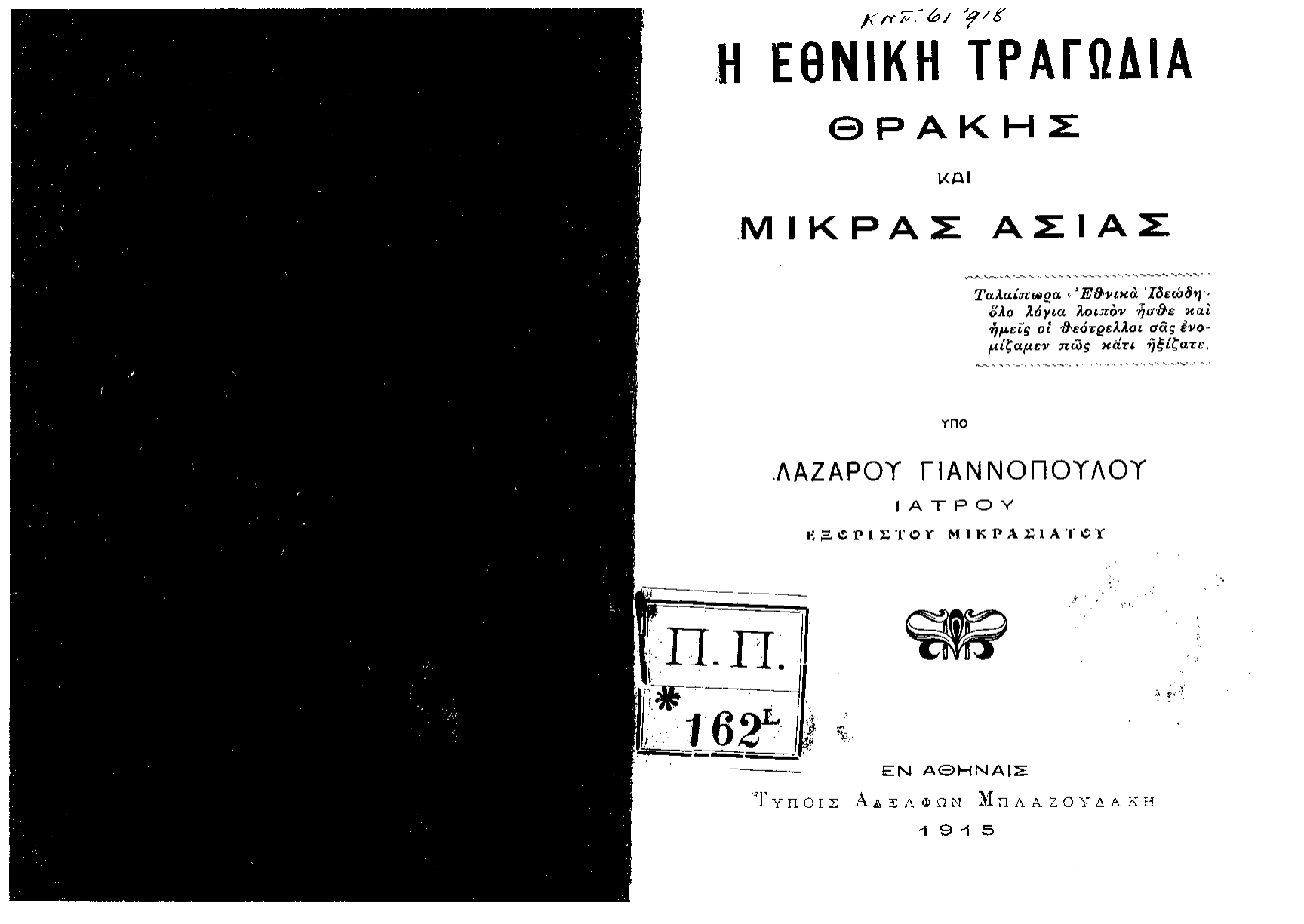
| 1915 | Publishes The National Tragedy of Thrace and Asia Minor in Athens, signing himself “Exiled Asia-Minor-Greek” | the 1915 book |
| 1915 | Elected representative of the Asia Minor Refugees to the Greek Government; co-founds the Pan-Asia Minor Union in Mytilene | 1926 book — publisher’s biography |
| c. 1915 | Serves roughly 10 months as an army doctor in Serbia | his 1915 book |
His three pre-medical diplomas do not survive: on the 1924 CV each is annotated “Has been burned” — destroyed in the 1922 catastrophe. Only the Athens medical degree could be reconstructed, from a University-held duplicate. The chronology then continues into the 1923–1924 credentials portfolio he assembled for emigration, detailed below.
The Pergamon warning — family memory, 2026-05-24
His granddaughter Aline, writing to Alex in May 2026 about the 1922 catastrophe and what it took from her grandmother Eftyhia’s Karamitrou family, added a sentence that reframes Lazaros’s prewar work:
“Lazar warned the people there [in Pergamon] including her family to leave and they did not. And a massacre followed. I always got the impression that her family members were among those lost.”
If Aline’s family memory is accurate, then Lazaros was not only publishing in Athens in 1915 as an exiled Asia-Minor-Greek writing about the national tragedy of Thrace and Asia Minor — he was, in 1922 itself, actively warning his wife’s hometown community to evacuate before the violence arrived. The Pergamenes did not listen. Most of Eftyhia’s family, including her mother, were killed. Their loss runs through every subsequent year of Eftyhia’s life on this site.
This recasts his 1915 polemic, his 1925 refugee compensation work for the Pergamon estate, his 1927 New York fundraising for the Soma diaspora, and his 1932-35 directorship of Aletheia as a continuous forty-year arc of one man trying to make a record — first prophetic, then memorial — of what was happening to the Anatolian Greeks.
The pasha’s wife (family tradition)
Family tradition — relayed in May 2026 by Aline Pepe (Lazaros’s granddaughter through his eldest son John Lazare) from what her father had told her — holds that Lazaros was once under an Ottoman death sentence.
“Lazare was supposed to be executed. According to my father a favorite wife of a pasha was having a very difficult long labor and as word spread that she was in grave condition it came to the attention of the pasha that Dr Jeannopoulos was in jail. He was given an offer. Deliver mother and child safely and his sentence would be changed to prison term — I’m pretty sure he said life. Deliver mother and a healthy son and he would be free and exiled. Not sure if that’s the story he writes about — he was jailed multiple times.” — Aline Pepe, 2026-05-22
If the story is true — and the chain is short enough (Lazaros → his son John Lazare → John’s daughter Aline → relayed here) to take it seriously — then the line on his 1915 National Tragedy title page is not a literary flourish. Ιατρού, Εξορίστου Μικρασιάτου — “Doctor, Exiled Asia-Minor-Greek” — names a literal judicial outcome. He was condemned, commuted, and exiled, the terms negotiated over a labor-room emergency that a Paris-trained obstetrician was uniquely positioned to resolve.
It also reframes his Paris postgraduate training in obstetrics (per his 1924 CV) as both a vocational choice and, in the end, a life-saving one — the specialty that put him in a pasha’s debt rather than at the end of an Ottoman rope.
Aline notes a wider pattern: “he was jailed multiple times.” Which of the jailings led to the exile, what the original charge was, which pasha and which Ottoman provincial seat — all open. The upper bound on the exile date is 1915 (the year Athens publishes him as an exile); the most plausible window is the post-Young-Turk-Revolution years, 1908–1914, when Greek Christians in Anatolia faced rising Ottoman pressure.
This is family tradition, not a primary-source record — but a primary-source record of the arrests does now exist. A full English translation of his 1915 National Tragedy reveals that Lazaros devotes several pages to his own imprisonment, in the first person. Turkish authorities surrounded his house with “over 20 gendarmes,” separated him from his family, and dug up his yard and cellar hunting for hidden weapons; finding nothing, they fabricated telegrams claiming they had found “10,000 weapons, 60,000 cartridges and a box of bombs” in his home. He was jailed about a month on the Soma–Izmir road and released for lack of evidence, “despite the fiery articles of the obscene newspaper ‘Koiullou’ asking for my hanging.” That paper had named him in print on February 24, 1914, demanding he leave Anatolia or be expelled by the government. A second time he was “violently separated from my heavily ill child, and sent under police surveillance.” The specific mechanism of the pasha’s-wife commutation is still Aline’s family tradition alone — but the surrounding fact, that Lazaros was repeatedly arrested and finally driven into exile by the Ottoman authorities, is now his own written testimony.
The earliest preserved photographs
Two newly-surfaced family photos from his pre-NY decades pre-date the 1923 Mytilene ID portrait by years.
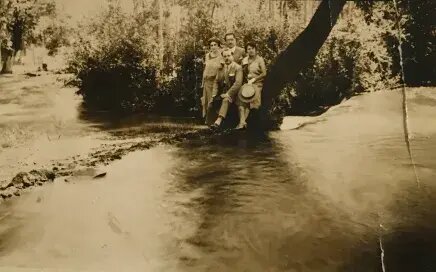 Lazaros at about thirty-nine, seated center on a tree branch over an Anatolian stream near Smyrna with three companions, c. 1910 — five years before the Athens publication of his National Tragedy book, twelve before the catastrophe. The earliest known photograph of him; the lost pastoral world he wrote in defense of.
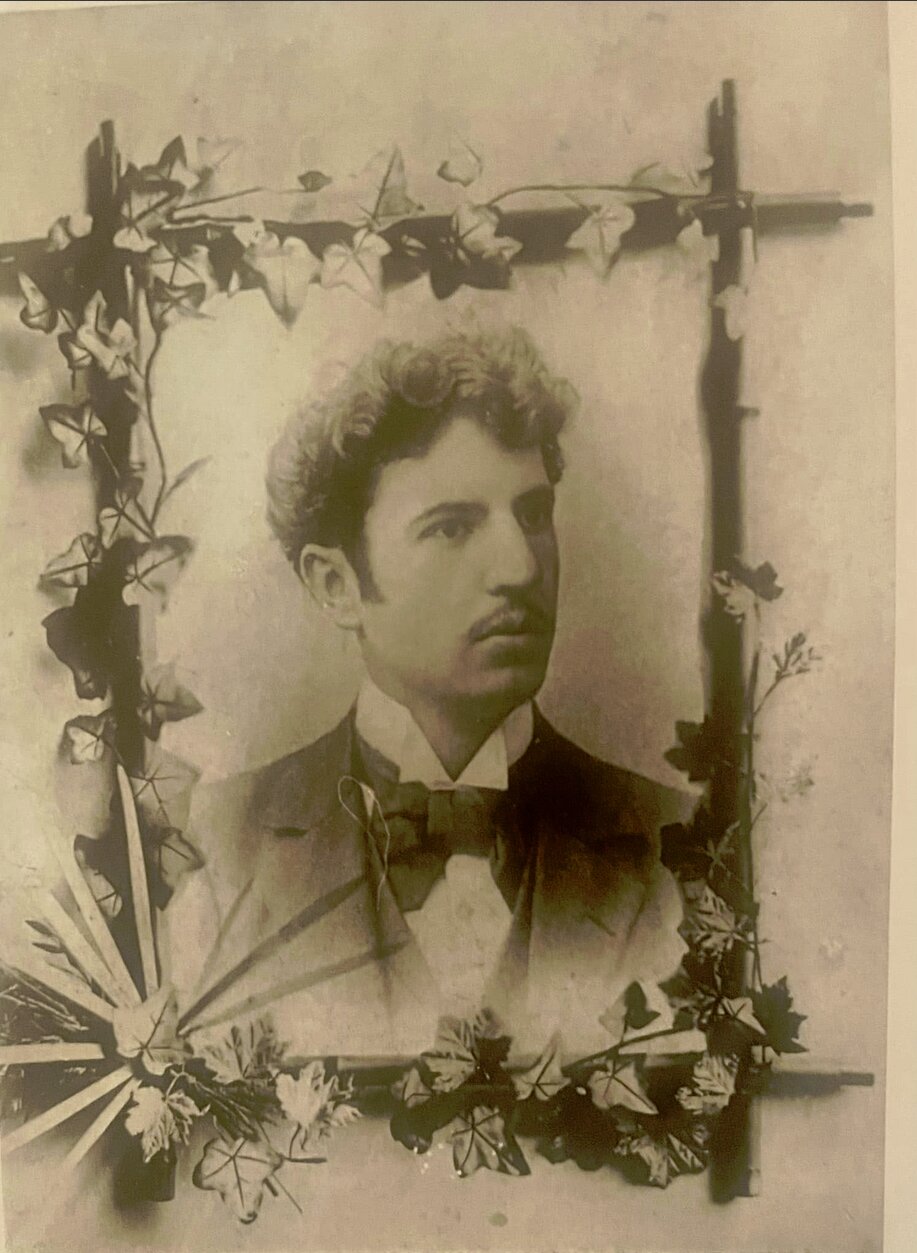 Studio portrait of a curly-haired young man in mustache and bow tie, in an oval frame with a hand-painted vine motif — Lazaros in his Athens medical-school years (1899–1903) or just after, age ~25–30. From the family album, exact date unrecorded.
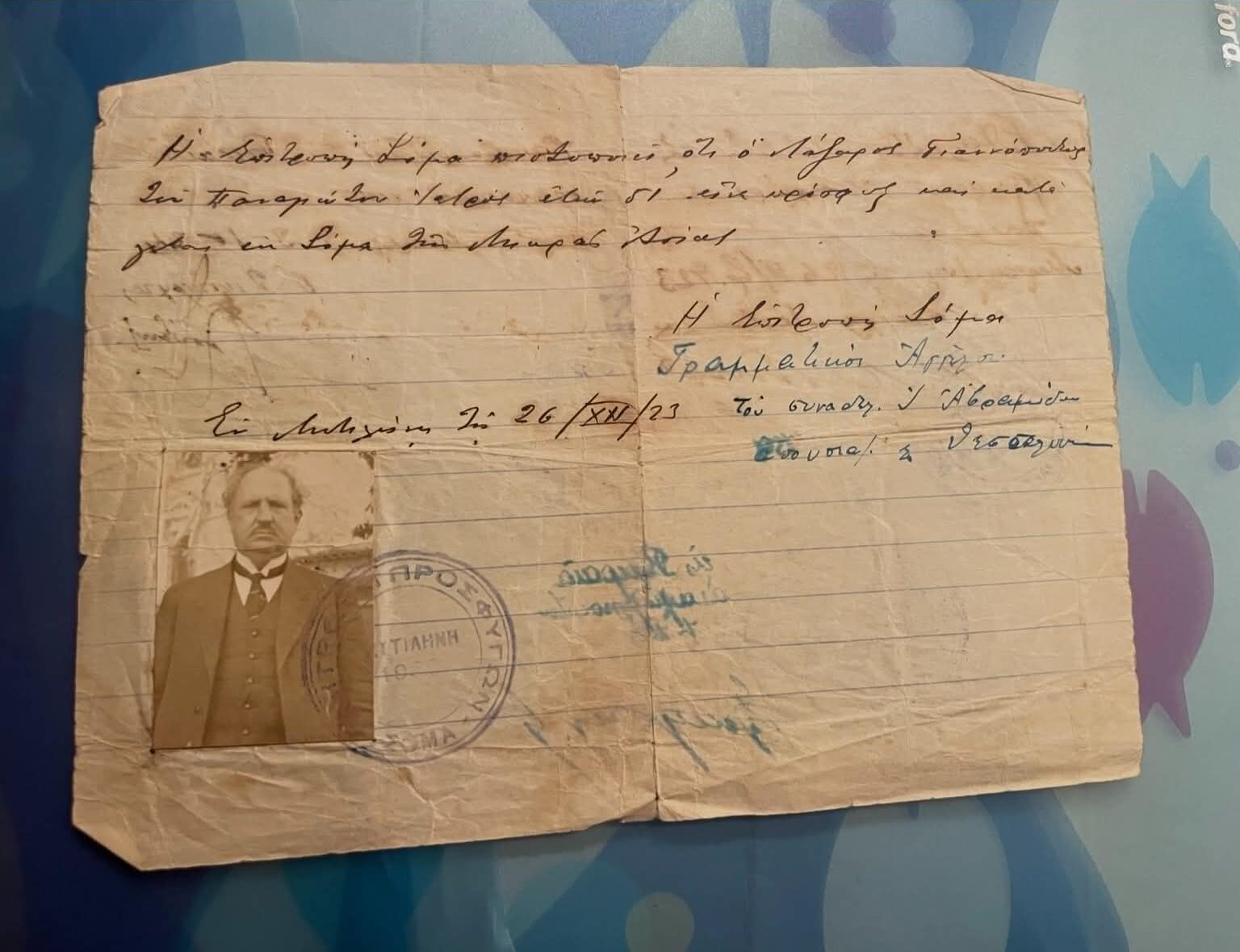
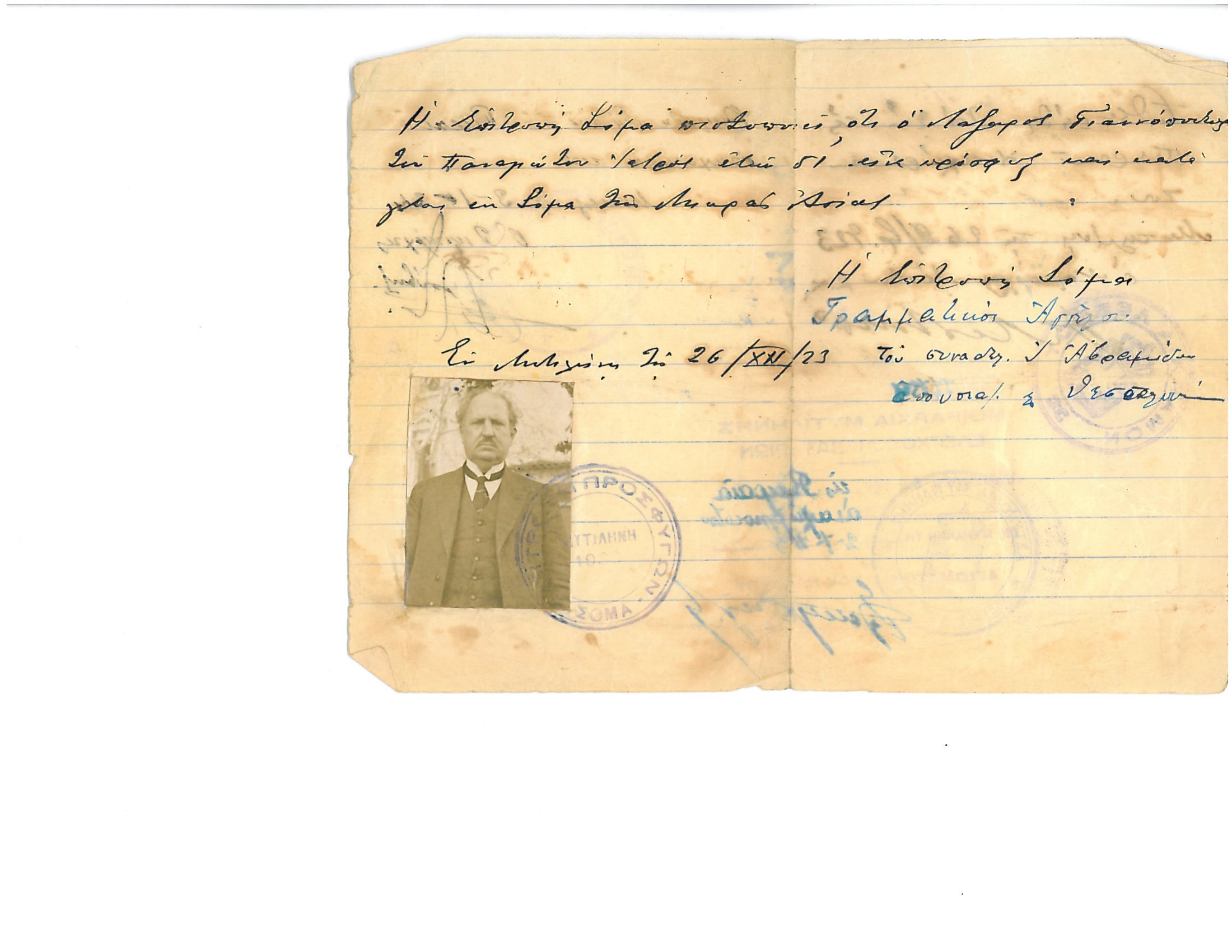
Then, formal three-piece suit, full grey-flecked beard, salt-and-pepper hair — Lazaros at fifty-two, in the Soma Refugees Association ID booklet issued in Mytilene on December 26, 1923, three months before the SS Themistocles would carry the household to New York.
He died in Manhattan at age 68 on June 28, 1939 at 214 Audubon Avenue, Washington Heights. His wife Eftyhia outlived him. Six children survived him (Takis, John Lazare, Mary, Constantine, Achilles, Rhea), and possibly an older John born 1899 whose link to this family is still uncertain.
The 1923-1924 credentials portfolio — two Mytilene→Athens trips
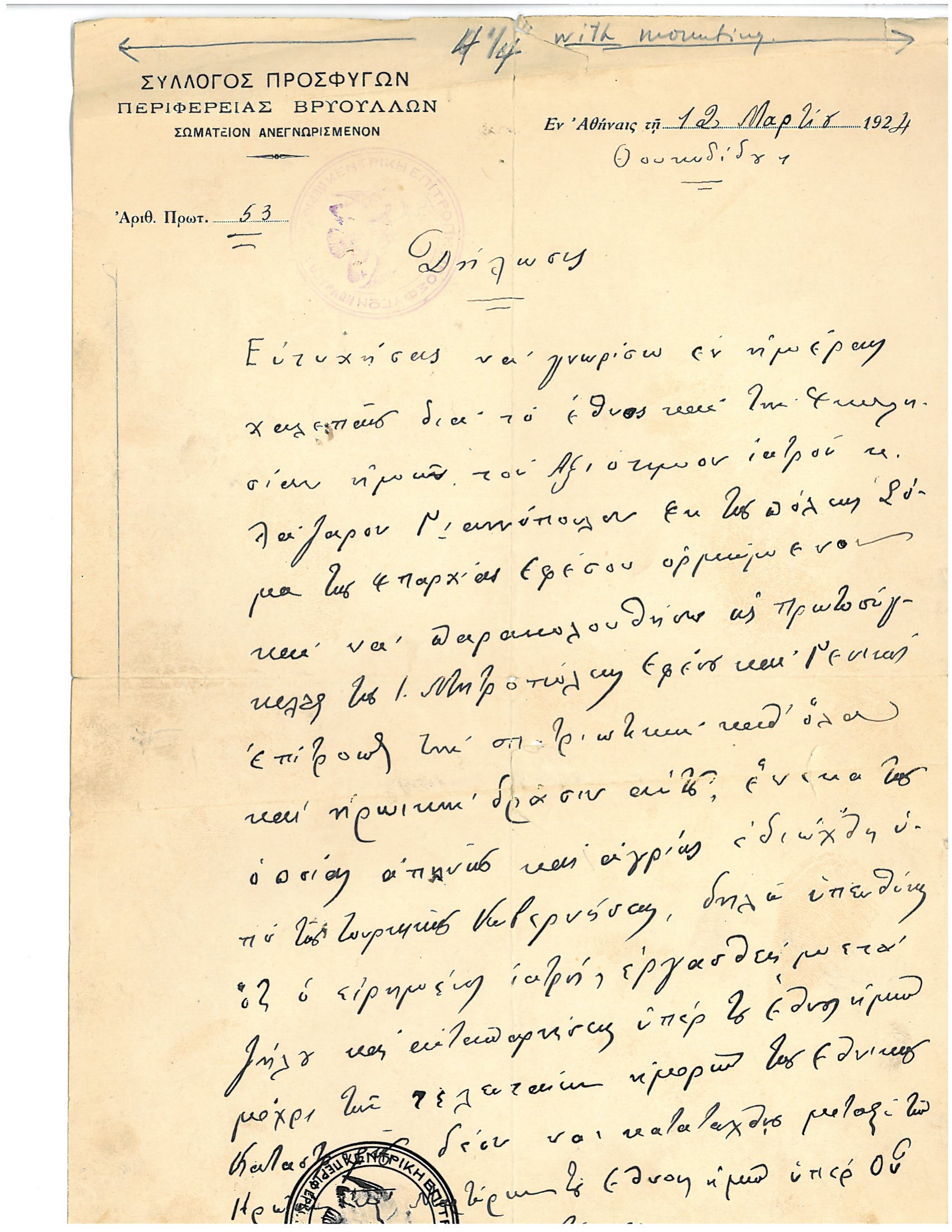
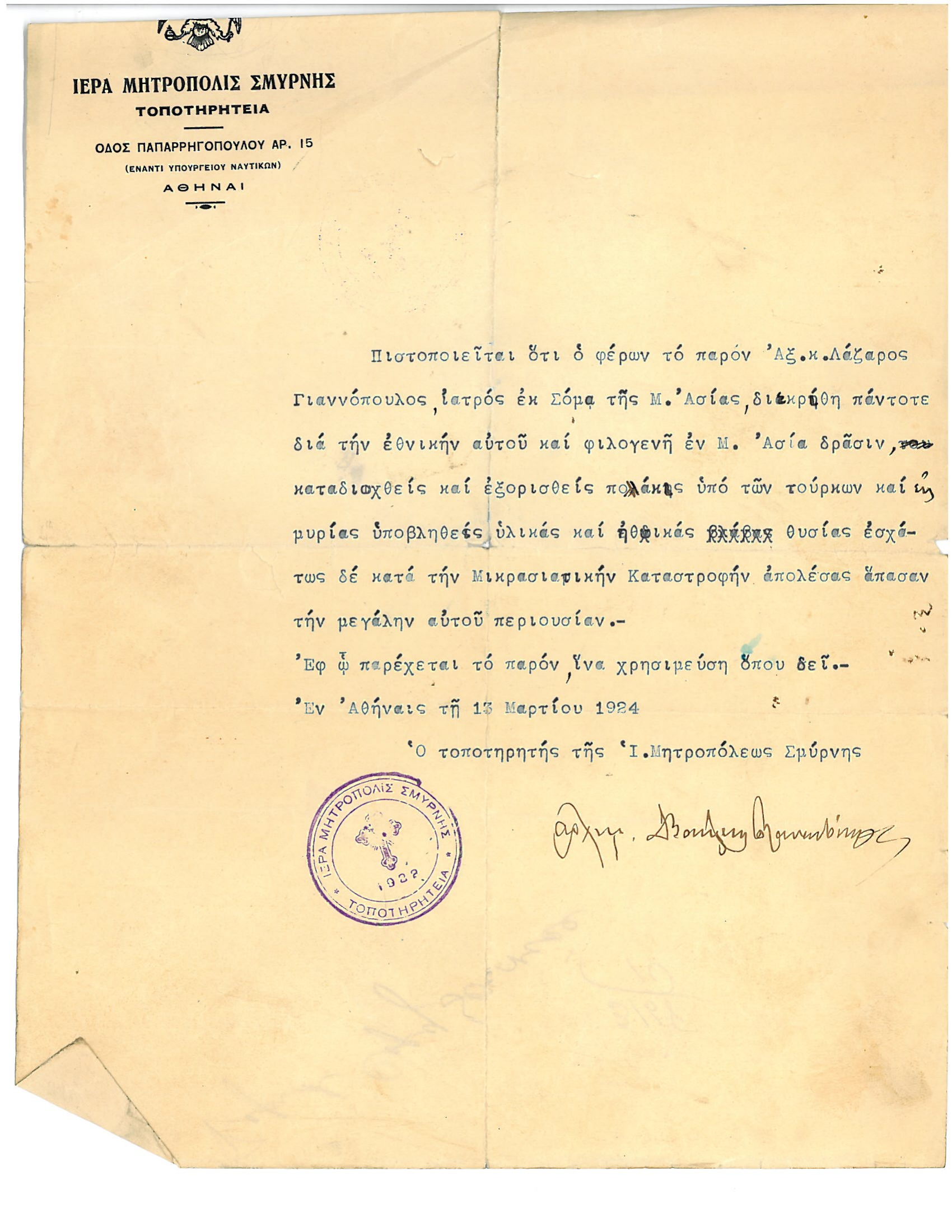
Between July 1923 and March 1924 Lazaros assembled a deliberate portfolio of credential and testimonial documents from every institutional axis available to him — academic, civic, professional, regional refugee, and senior ecclesiastical — for use on his US arrival. The portfolio spans nine months and required two separate trips between Mytilene and Athens. The seven surviving documents:
| Date | Document | Place |
|---|---|---|
| July 26, 1923 | Université de Paris Faculté de Médecine — MD diploma duplicate authorized (his original 1896 Paris MD lost in the 1922 catastrophe) | Paris |
| December 26, 1923 | Soma Refugees Association ID booklet with photograph | Mytilene |
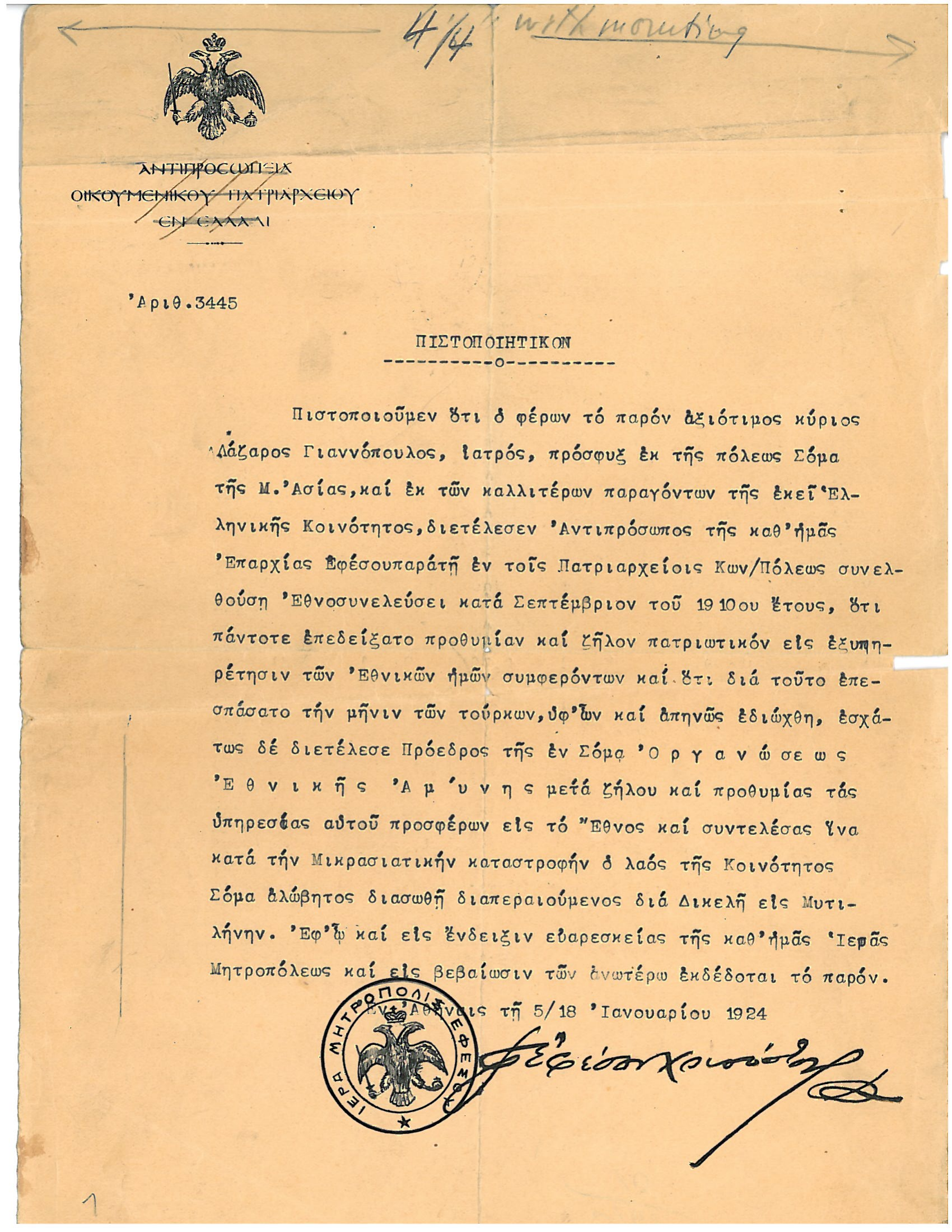
| January 18, 1924 | ★ Ecumenical Patriarchate testimonial — signed by Metropolitan Chrysostomos of Ephesus (highest-rank ecclesiastical vouching in the archive) | Athens |
| March 6, 1924 | Soma Community Elders + Refugee Committee farewell (civic) | Mytilene |
| March 6, 1924 | Medical Association of Lesbos farewell (professional) | Mytilene |
| March 12, 1924 | Association of Refugees of Vryoula declaration, signed by the Protosynkellos of Ephesus | Athens |
| March 13, 1924 | Smyrna Metropolitanate Locum Tenens testimonial | Athens |
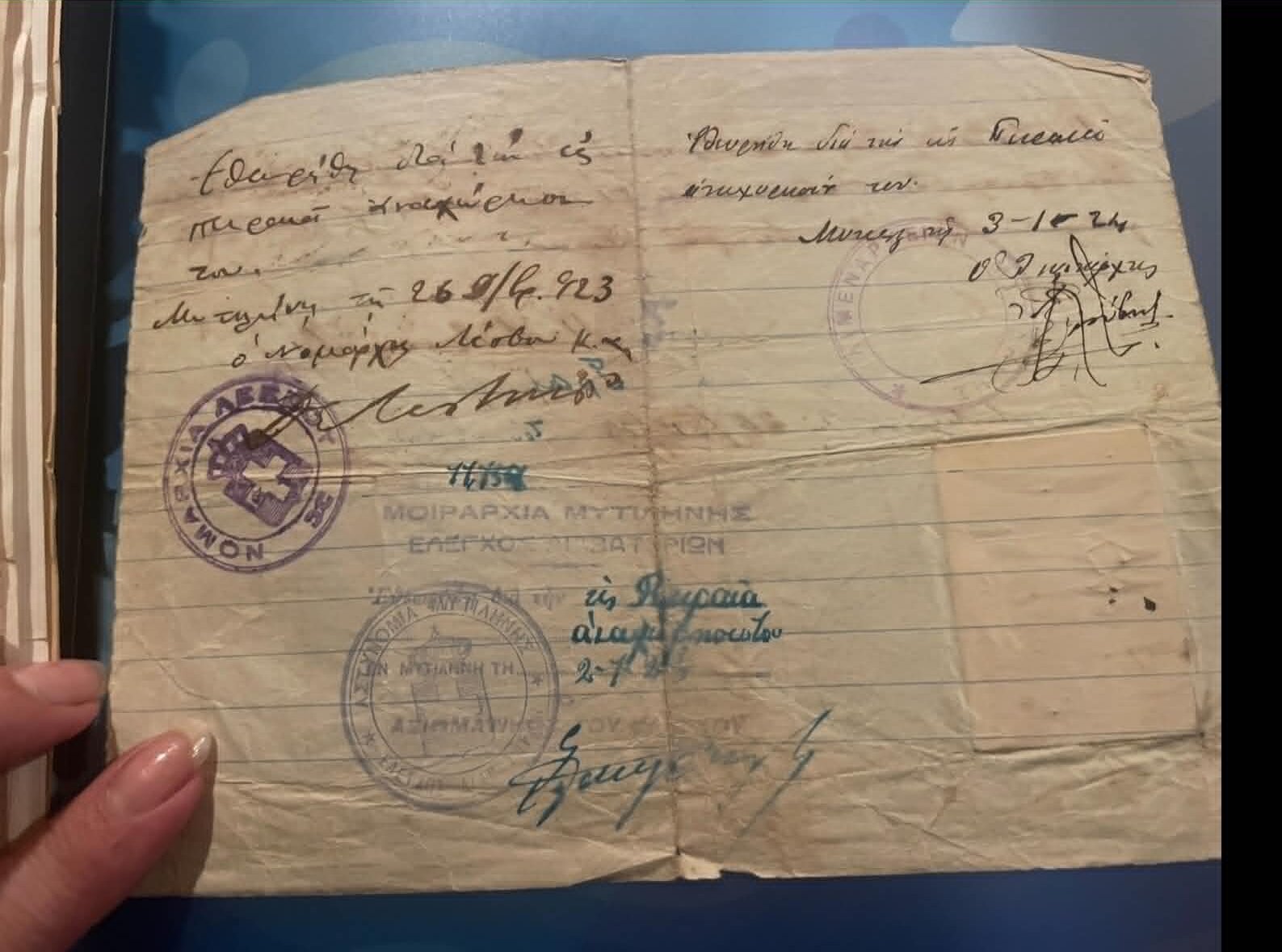
The January 1924 Athens trip — the one that produced the Ecumenical Patriarchate testimonial — is anchored by the Mytilene Gendarmerie passport-control endorsement on Lazaros’s Soma refugee ID booklet (page 2), dated January 3, 1924, “αναχωρών εις Πειραιά” (departing for Piraeus). The March 1924 trip was the final pre-emigration assembly run.
The Diocese of Ephesus (which had jurisdiction over Soma, Pergamos, Vryoula, Kinik, Akhisar, and the broader western Anatolian Greek world) and the Metropolis of Smyrna had each lost their physical sees in the 1922 expulsion. Their joint vouching for Lazaros — first the Ecumenical Patriarchate’s own Greek-side office signed personally by Metropolitan Chrysostomos of Ephesus in January 1924, then the Protosynkellos of Ephesus and Smyrna Locum Tenens in March 1924, on consecutive days at Athens — represents about as senior a Greek Orthodox attestation as a 1924 Anatolian refugee could obtain. The testimonial sequence spans every level of the Greek Orthodox hierarchy from local parish → diocesan vicar → metropolitan caretaker → Patriarchate’s exile office.
Two books, eleven years apart — Athens 1915, New York 1926
Lazaros is a twice-published political author. The two books bracket the Asia Minor catastrophe — the 1915 Athens National Tragedy as the prelude, written while the Anatolian Greek world was still standing but cracking, and the 1926 New York Hidden Truth as the postmortem, written from US exile after the catastrophe was complete.
The 1926 book — Η Κρυμμένη Αλήθεια ή Τα Παρασκήνια του Μεγάλου Μικρασιατικού Δράματος (The Hidden Truth, or The Backstage of the Great Asia-Minor Drama) — was published in New York 1926 by American-Greek Publishing Co., printed at the Divry establishments. The title page identifies him formally as “Λάζαρος Π. Γιαννόπουλος, Ιατρός, εκ Σόμα της Μικράς Ασίας” — Lazaros P. Giannopoulos, Physician, from Soma of Asia Minor — and page two carries the earliest published portrait of him in any preserved source: a studio photograph in a three-piece suit, captioned with a polemical curse against any who would offer leniency to “the workers-of-ruin and traitors of Asia Minor.” The book has been reissued in a 2025 modern Greek edition by Ελληνική Πρωτοπορία (Hellenic Vanguard), ISBN 978-618-5383-63-3 — purchasable today.
The 2025 publisher’s catalog reproduces a consolidated biographical paragraph that is itself a major source for his political CV, anchoring dates and offices that were previously only partially documented:
Lazaros Yiannopoulos was a physician from Soma, in Asia Minor. He was elected representative of the province of Ephesus to the National Assembly convened by the Patriarchates in September 1910. In 1915 he was elected representative of the Asia Minor Refugees to the Greek Government for the Asia Minor Struggle. He was co-founder of the Pan-Asia Minor Union in Mytilene (1915), which aimed to support the demands of Asia Minor refugees and the formation of a voluntary military corps for participation in the war with the side of the Entente. He resigned and withdrew with many of their unanimous representatives from the Pan-Asia Minor Union, protesting for “the savagely obligatory recruitment of Refugees” from Eleftherios Venizelos and the use of these Greek volunteers, who formed the core of the so-called National Defense Movement of Thessaloniki, to conduct a guerrilla against the “State of Athens”. Later, he assisted the establishment of Asia Minor Defense as President of the organization in his region. With the prevalence of the Plastiras-Gonatas-Pangalos dictatorship in 1922 and the re-occupation of the principle by Eleftherios Venizelos, Lazaros Giannopoulos fled to the United States of America, where he published the book in hand.
That paragraph reframes the family’s 1924 US migration. The previous account treated the SS Themistocles voyage as a consequence of the 1922 Asia Minor catastrophe alone — Turkey expelled the Greek Anatolian population, the family lost Soma, the Mytilene refugee year followed, and from there the only door open was New York. The 1926 publisher’s bio adds a second proximate cause: the 1922 revolution in Greece itself. The Plastiras-Gonatas-Pangalos coup of September 1922 sentenced six royalist ministers to death by firing squad and brought Eleftherios Venizelos back to power within months. For an anti-Venizelist with a 1915 published critique of Venizelist policy and a documented Pan-Asia-Minor Union resignation over Venizelos’s coerced refugee conscription, mainland Greece in late 1922 was politically dangerous. The United States was the only refuge available from both the Turkish catastrophe and the Greek state. It also explains why Lazaros never returned — even after Eftyhia’s Karamitrou Pergamon compensation was paid through Sofianos in 1928, even after the dictatorship ended, there was no Greek republican government he was willing to live under.
The 1926 book’s preface stakes the position he held for the next decade: a bipartite refusal of the National Schism. No praise for Venizelos as “Father of the Nation” / “Savior of the Homeland,” and no anathema for King Constantine as “the traitor King.” Both factions of the Εθνικός Διχασμός (National Schism) are wrong. The catastrophe was caused by partisanship itself — and the refugees themselves had fed it to their own ruin. Only by treating partisanship as the enemy could the refugees be saved and the state compelled to honor its treaty obligations toward them. It is exactly the framework that would later explain his 1933 Aletheia position against Archbishop Athenagoras: Athenagoras was Venizelos’s pick for Archbishop of America, and Aletheia opposed the appointing power and the appointee simultaneously, on the same anti-partisan grounds Lazaros had laid out in 1926.
The two books, the 1932-1935+ Aletheia directorship, and the Ethnikos Keryx 1925-05-07 profile’s reference to his “wise and original treatises — purely medical, medico-philosophical, medico-sociological” together describe a man who wrote across four publishing platforms over three decades — pre-catastrophe Athens, US-exile New York books, US-exile New York newspapers, and Greek-medical journals. The 1915 and 1926 books are the most complete surviving pieces.
Asia Minor refugee compensation, two-front
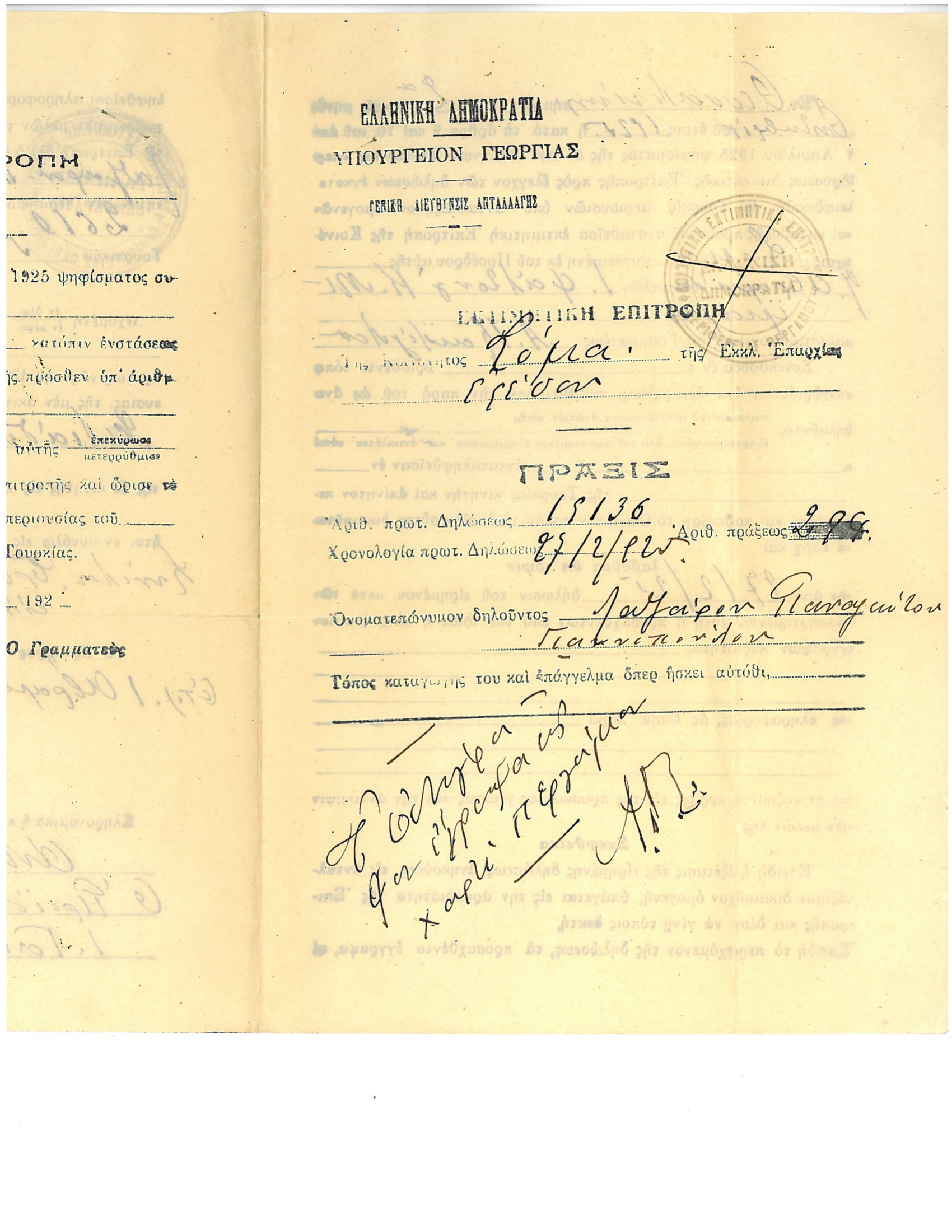
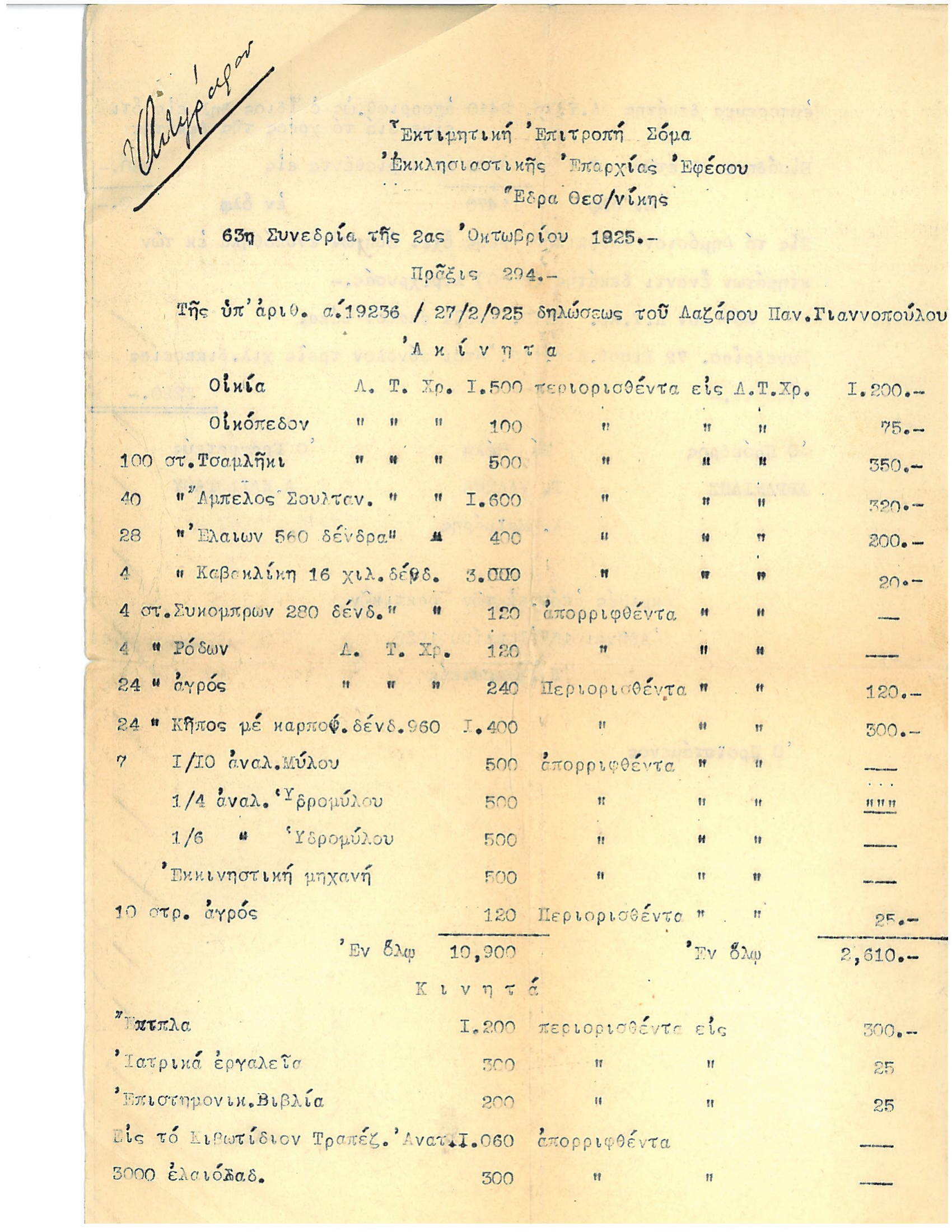
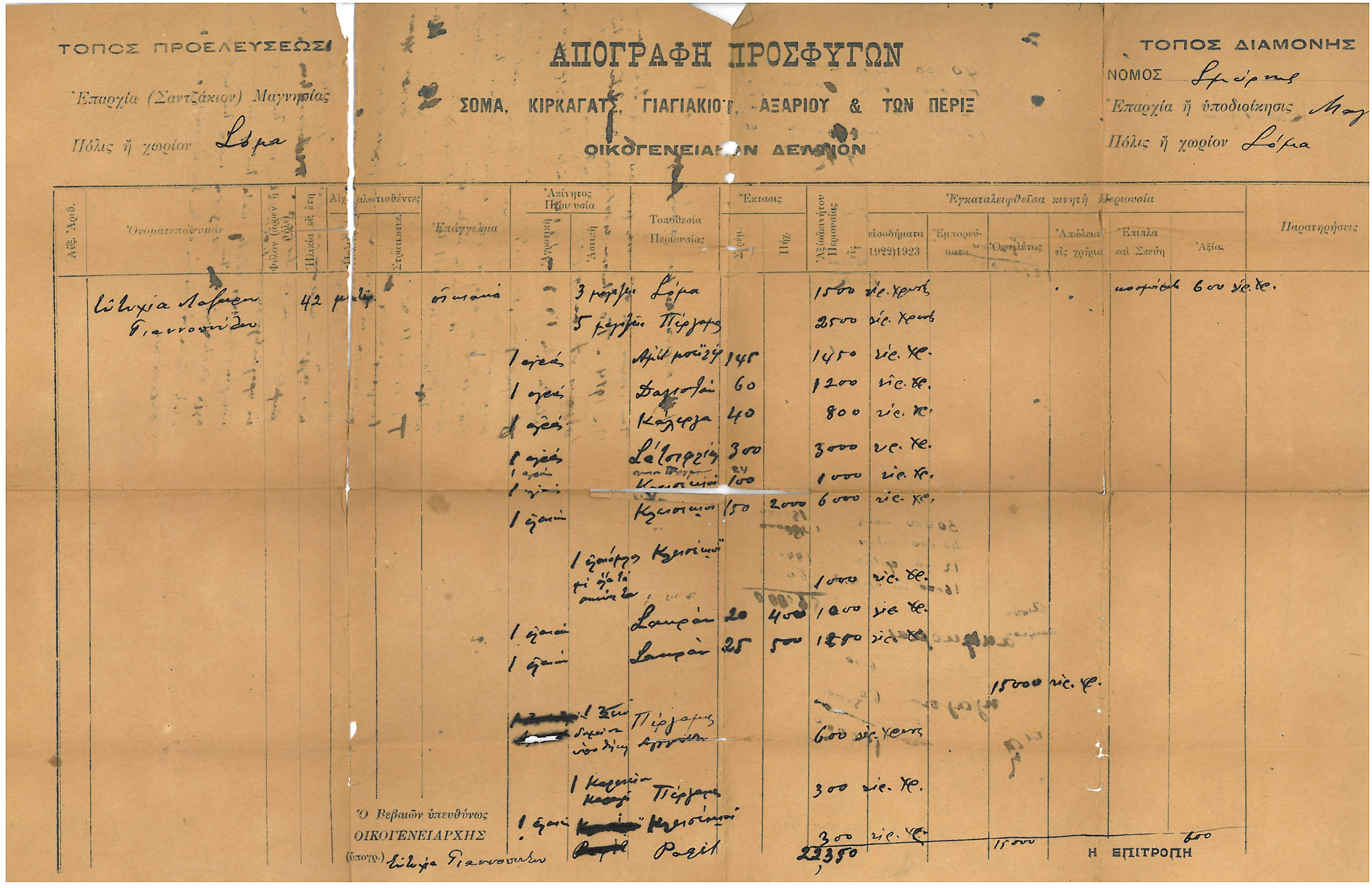
The Greek state set up multiple post-Lausanne committees to assess the property losses of expelled Asia Minor Greeks. The Jeannopoulos household pursued claims on both sides of the family simultaneously. The general Greek Refugee Compensation Committee assessed Lazaros’s Soma estate at 3,330 Turkish gold pounds on February 27, 1925 — about 22 kg of raw gold, or roughly $2.5 million today in gold-equivalent wealth. A more granular review by the Assessment Committee of Soma (Diocese of Ephesus, headquartered in Thessaloniki) on October 2, 1925 itemized the underlying estate: a house and lot in Soma town; about 200 stremmata of farms (Sultan grape vineyards, olive groves, fruit orchards, fig and mulberry, rose fields, poplar coppice); partial ownership of three different community water mills; a motorized engine; medical practice equipment and a scientific library; 3,000 units of olive oil; bank-vault contents. The picture is of a prosperous regional physician’s estate. Lazaros had originally declared a loss of about 14,000 Turkish gold pounds — call it $10 million today — and the Committee approved roughly 23% of it. A typical Greek-state outcome with the post-Lausanne system.
Separately, the Pergamon Assessment Committee, based in Mytilene, was pursued for Eftyhia’s Karamitrou-side property — her father Sofianos Karamitrou’s lost Bergama estate.
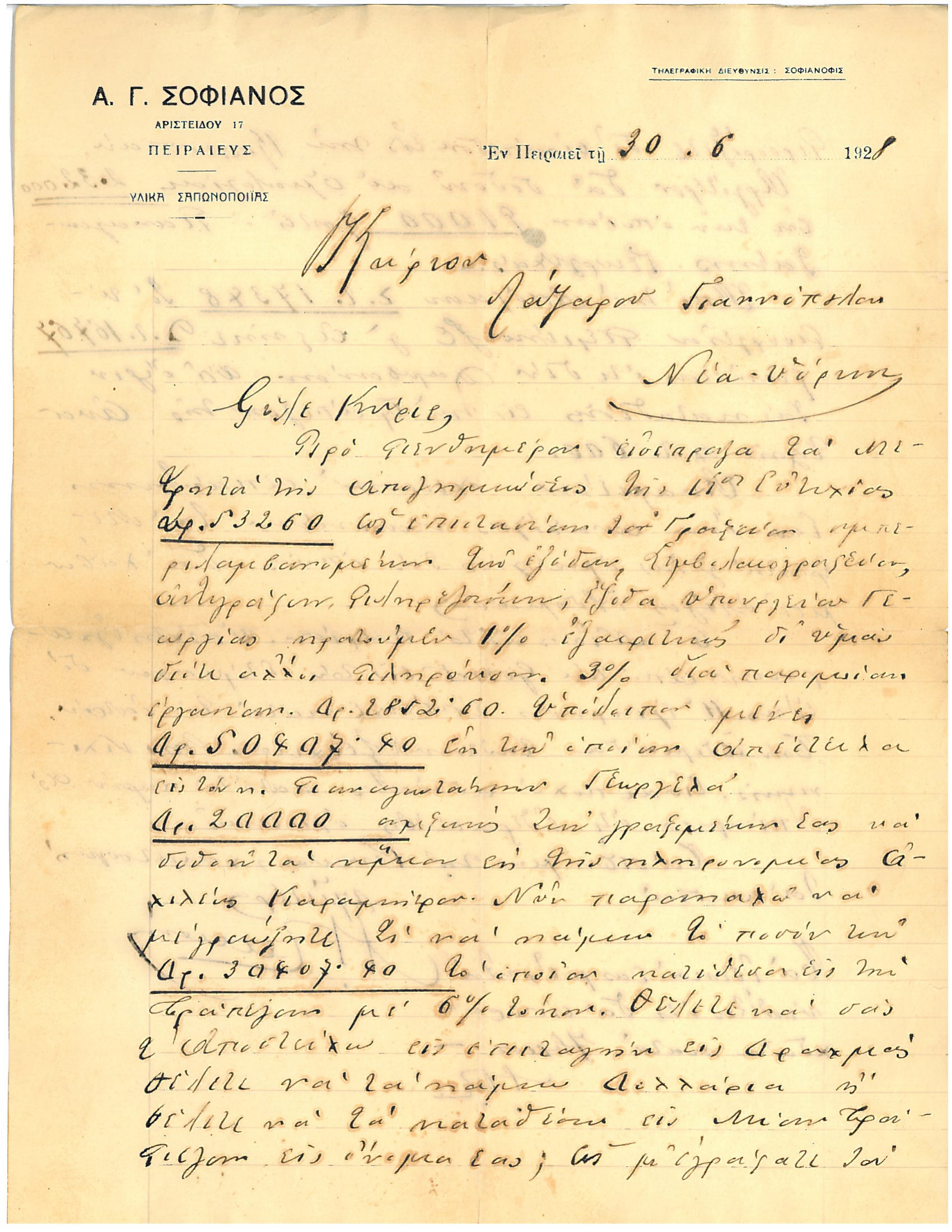
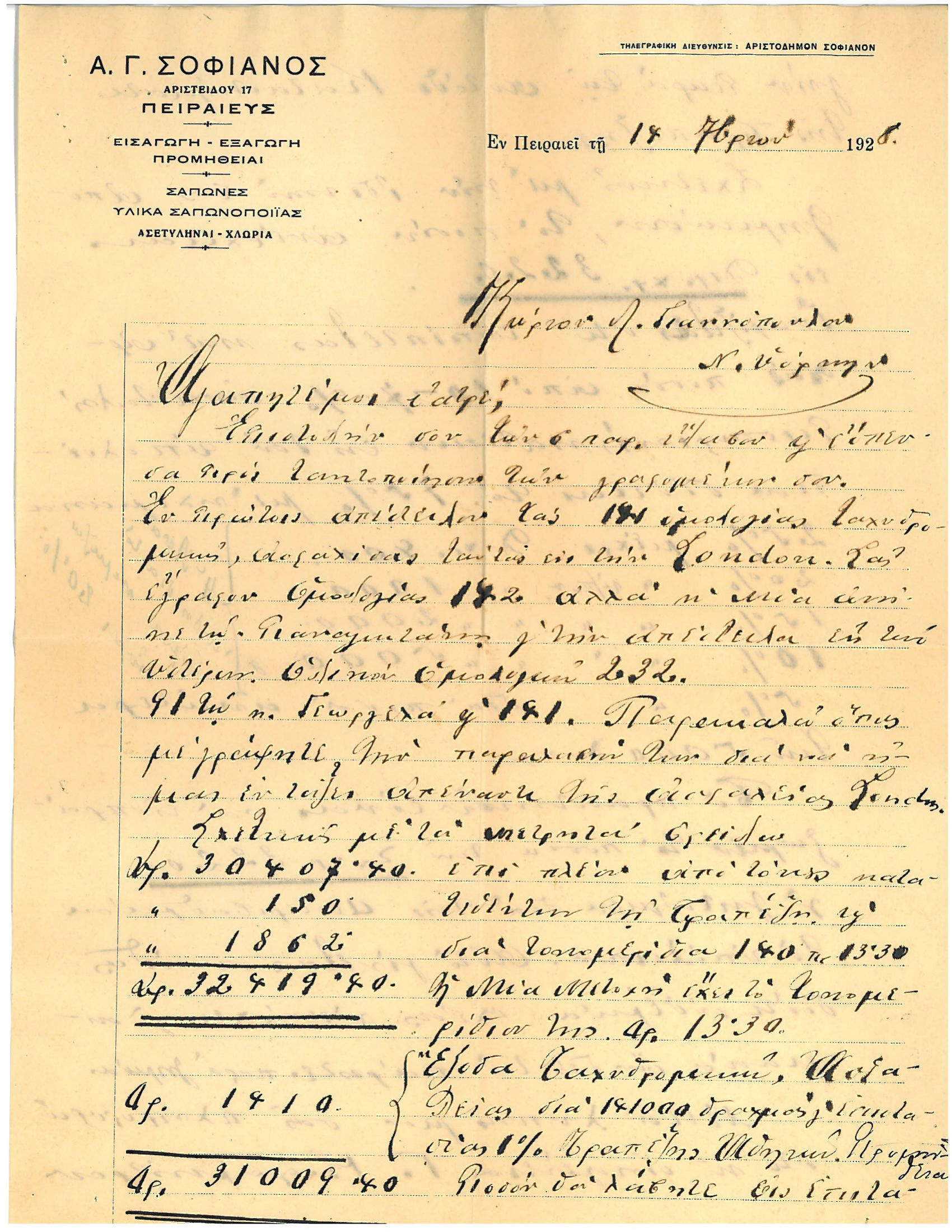
The 1928 Sofianos letters from Piraeus document the operational machinery in painstaking detail. The earliest, June 30, 1928, reports a 53,260-drachma compensation payout to Eftyhia — about $110,000 in today’s money, gold-equivalent — netting roughly 50,400 drachmas ($105,000) after fees. Of that, 20,000 drachmas ($42,000) was disbursed initially to one Panagiotakis Georgelas per Lazaros’s instructions, and the balance allocated to “the inheritors of Achilles Karamitrou” — likely Eftyhia’s deceased brother on the Karamitrou side, whose own heirs were sharing in the family compensation track. Subsequent letters (July and September 1928) cover 232 postal bonds insured to London (about half a million dollars in face value at today’s gold), a 3,220-drachma payout (~$6,700) from the Pergamon Assessment Committee, a sliding-scale retention system (75% / 25% on small claims up to 95% / 5% on large), and Alexandria, Egypt as an alternate disbursement channel. The financial operation was distributed across New York, Piraeus, Mytilene, London, and Alexandria, sustained over years.
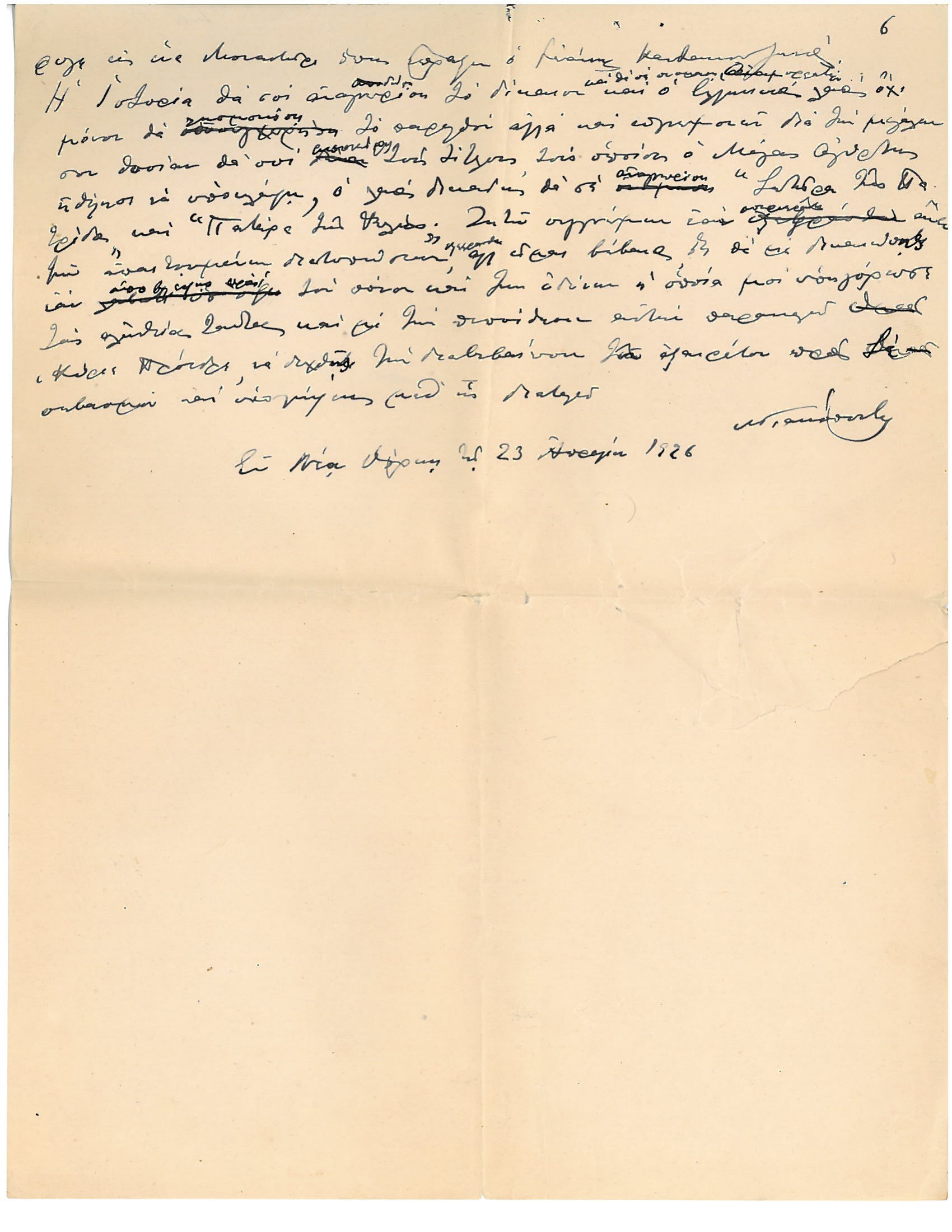
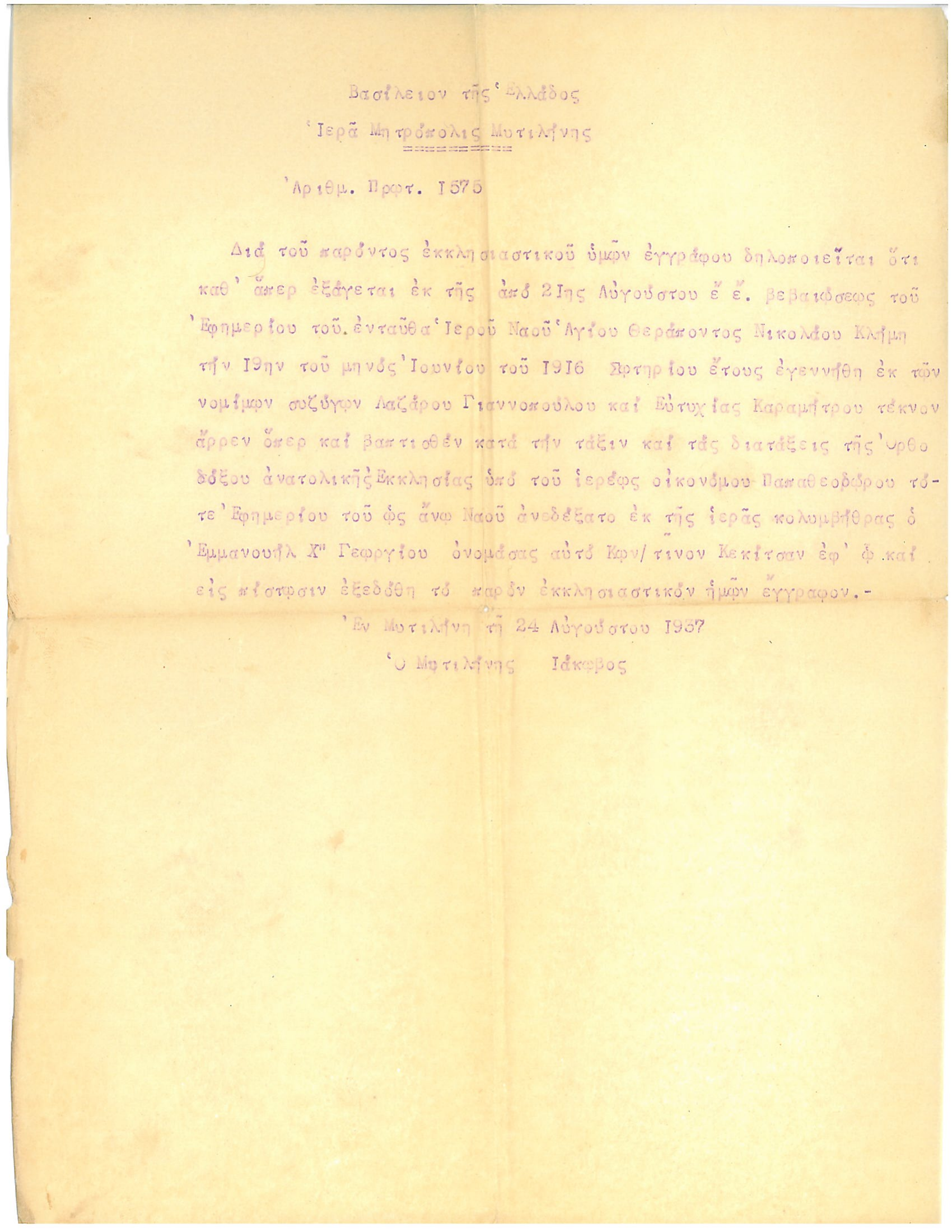
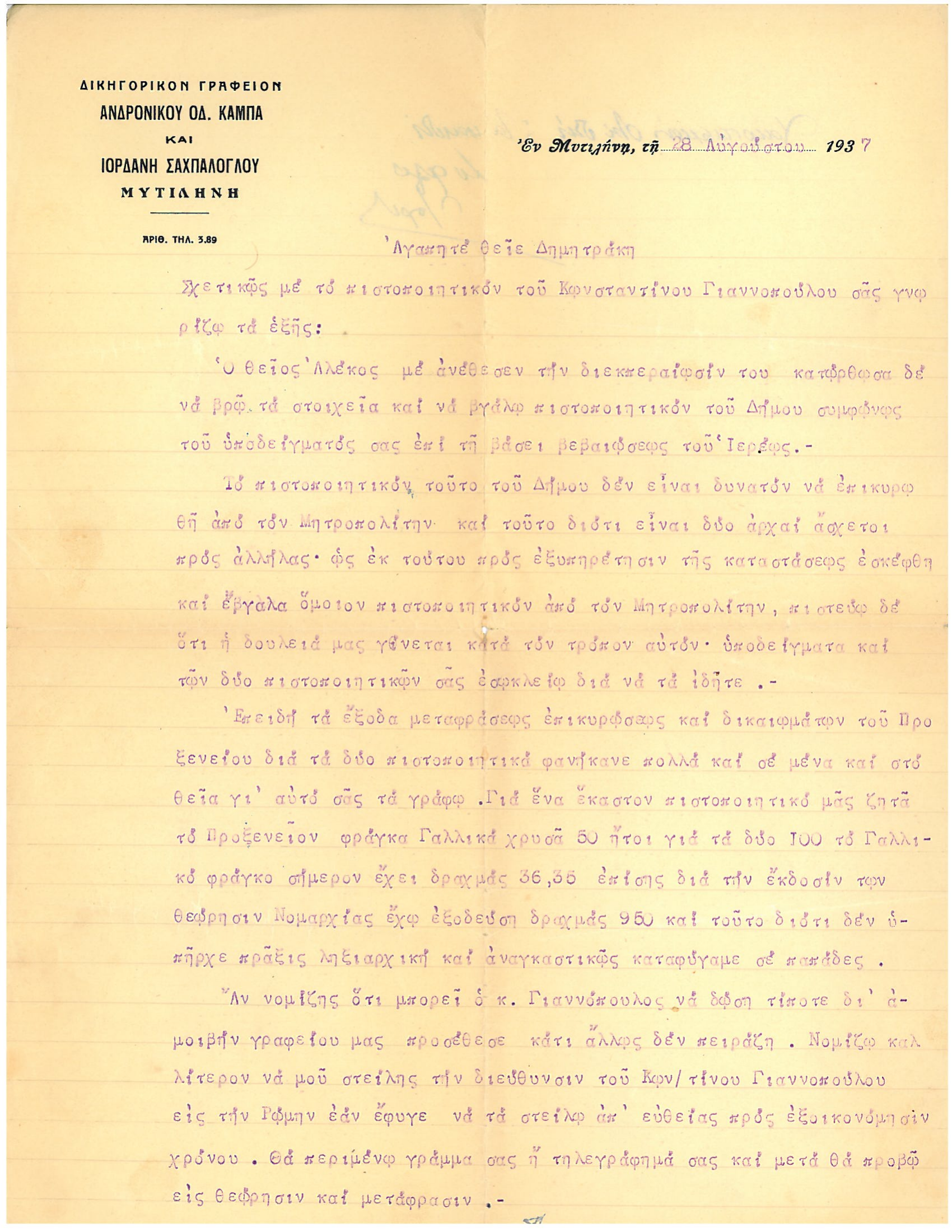
A handwritten letter draft in Lazaros’s own hand, dated October 23, 1926, New York, is the earliest preserved sample of his writing in the family archive. It references Karamitrou matters and a figure called “Great Alexander” (Μέγας Αλέξας) — almost certainly the same Uncle Alekos who reappears a decade later in the 1937 Mytilene law-office correspondence.
The Bronx parish — Saints Constantine and Helen, 1931–33
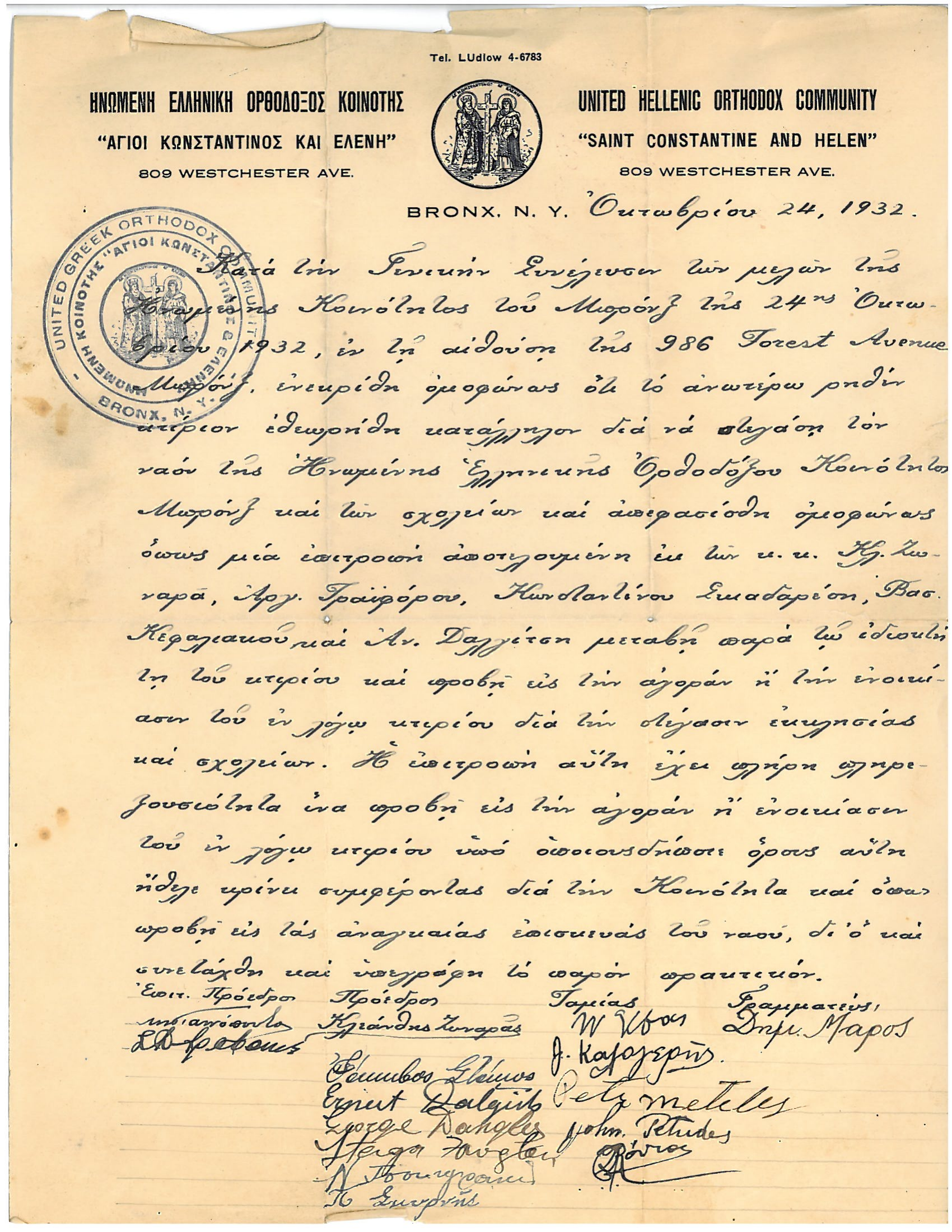
Lazaros’s Bronx Greek Orthodox parish was the Church of Saints Constantine and Helen (Άγιοι Κωνσταντίνος και Ελένη) — jointly dedicated to Constantine the Great and his mother Saint Helen. The full canonical name is documented on the parish’s own letterhead from October 1932; less formal references use the shorter “Saint Constantine” form. The parish address: 809 Westchester Avenue, Bronx, NY.
The parish papers in Lazaros’s archive trace a three-year institutional consolidation drama:
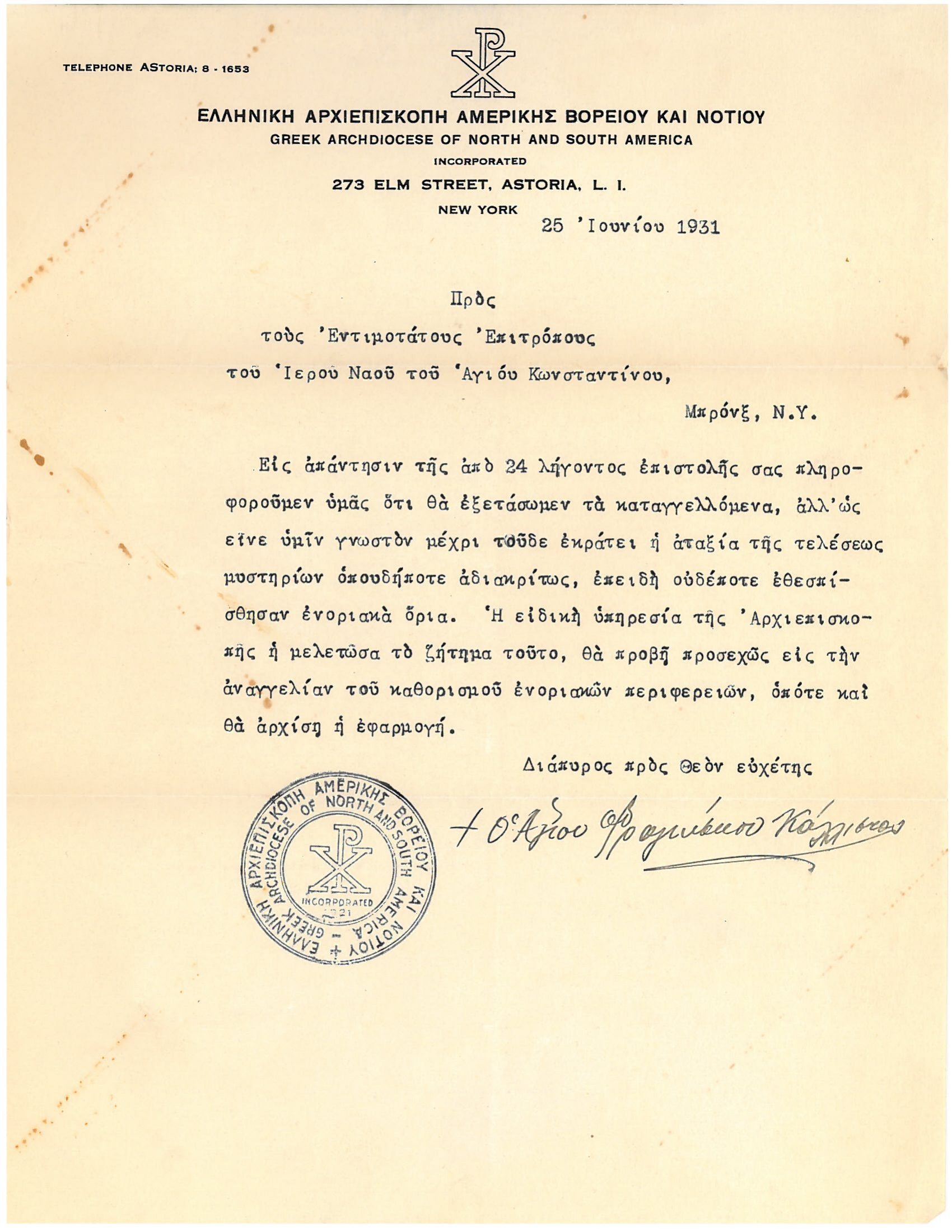
- June 1931 — Bronx parish trustees complain to the Archdiocese about rival parishes performing sacraments without territorial boundaries; Archdiocese responds that “parish boundaries were never established” and promises to define districts.
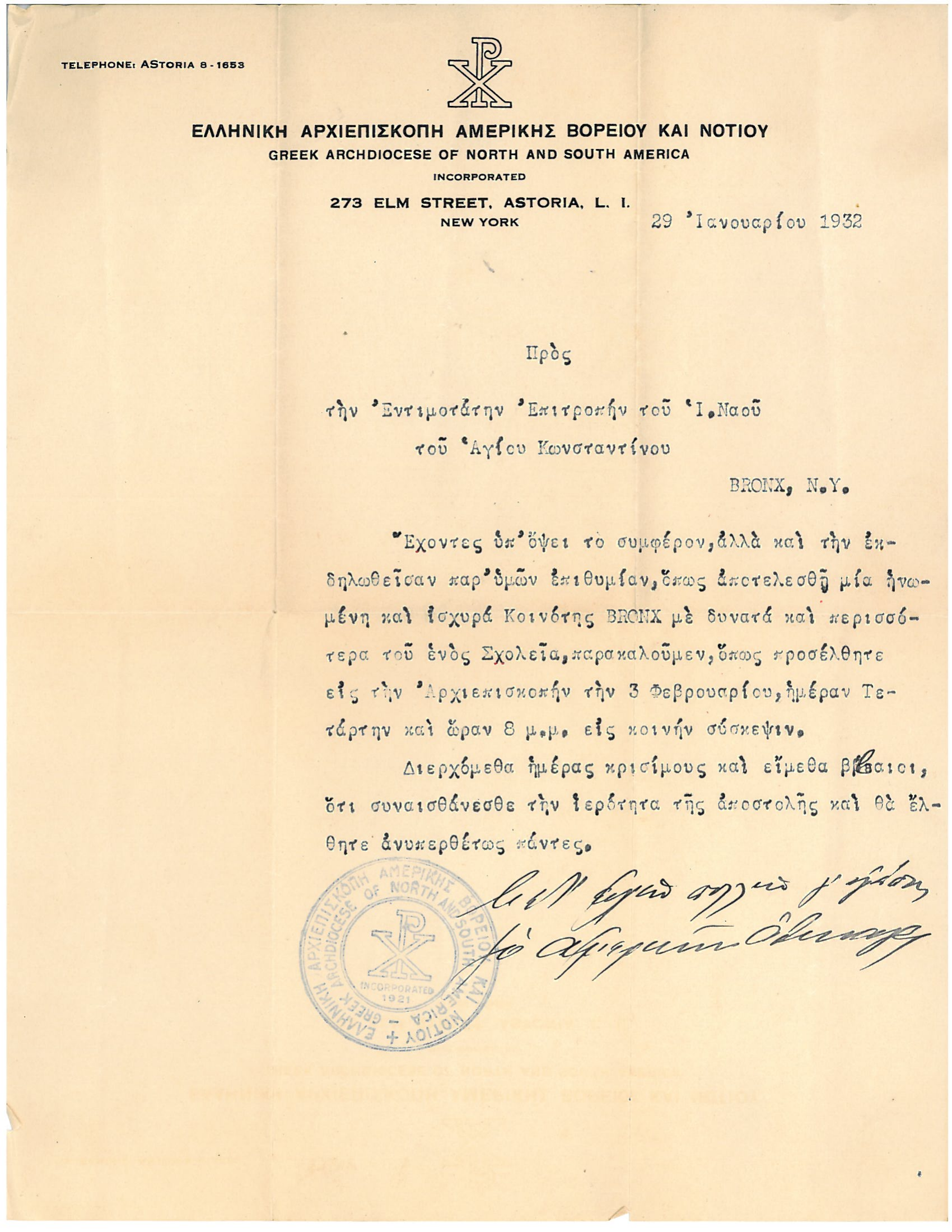
- January 1932 — Archdiocese pushes for a merger of fragmented Bronx parishes into “one united and strong Bronx Community with multiple Schools.”
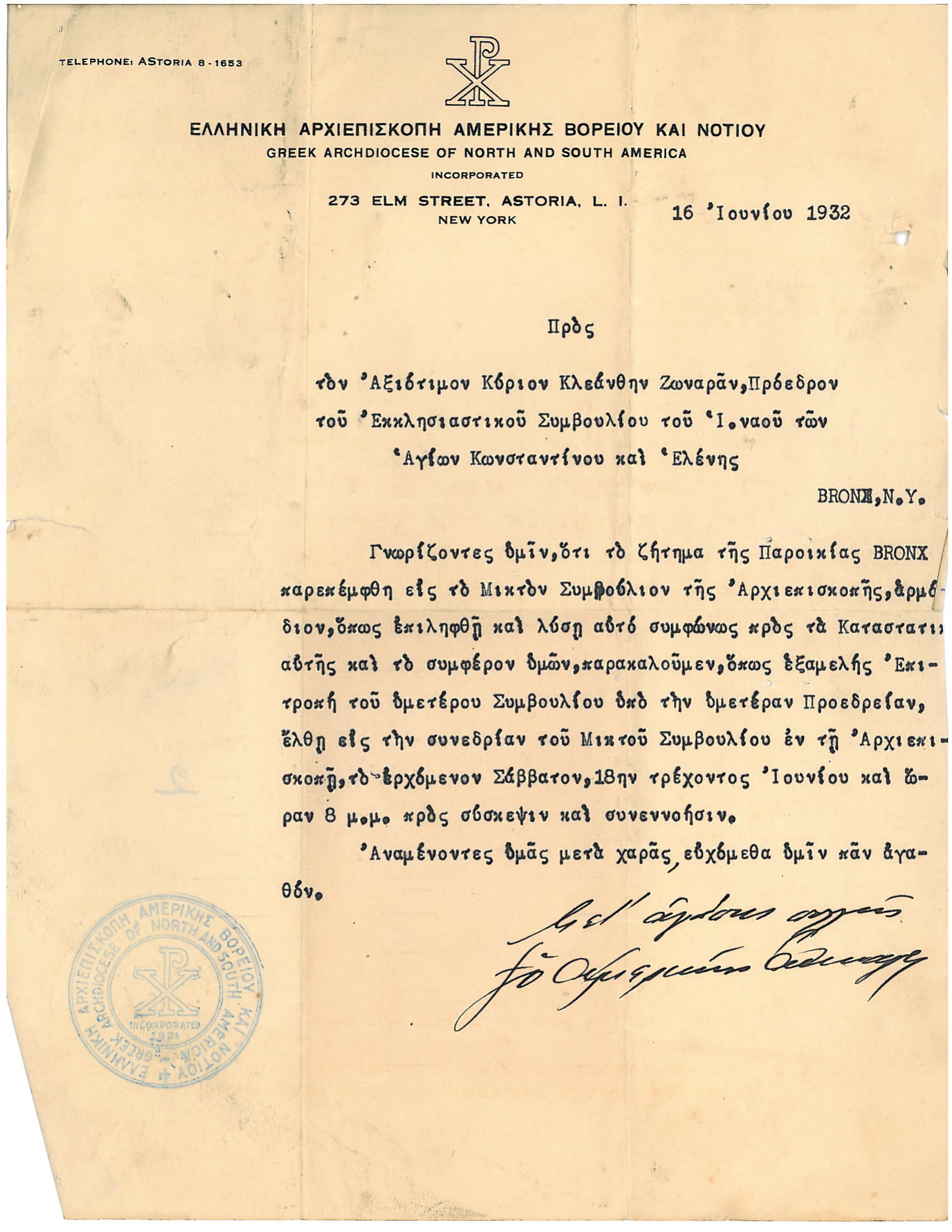
- June 1932 — Bronx matter referred to the Archdiocese Mixed Council; Kleanthis Zonaras is parish President.
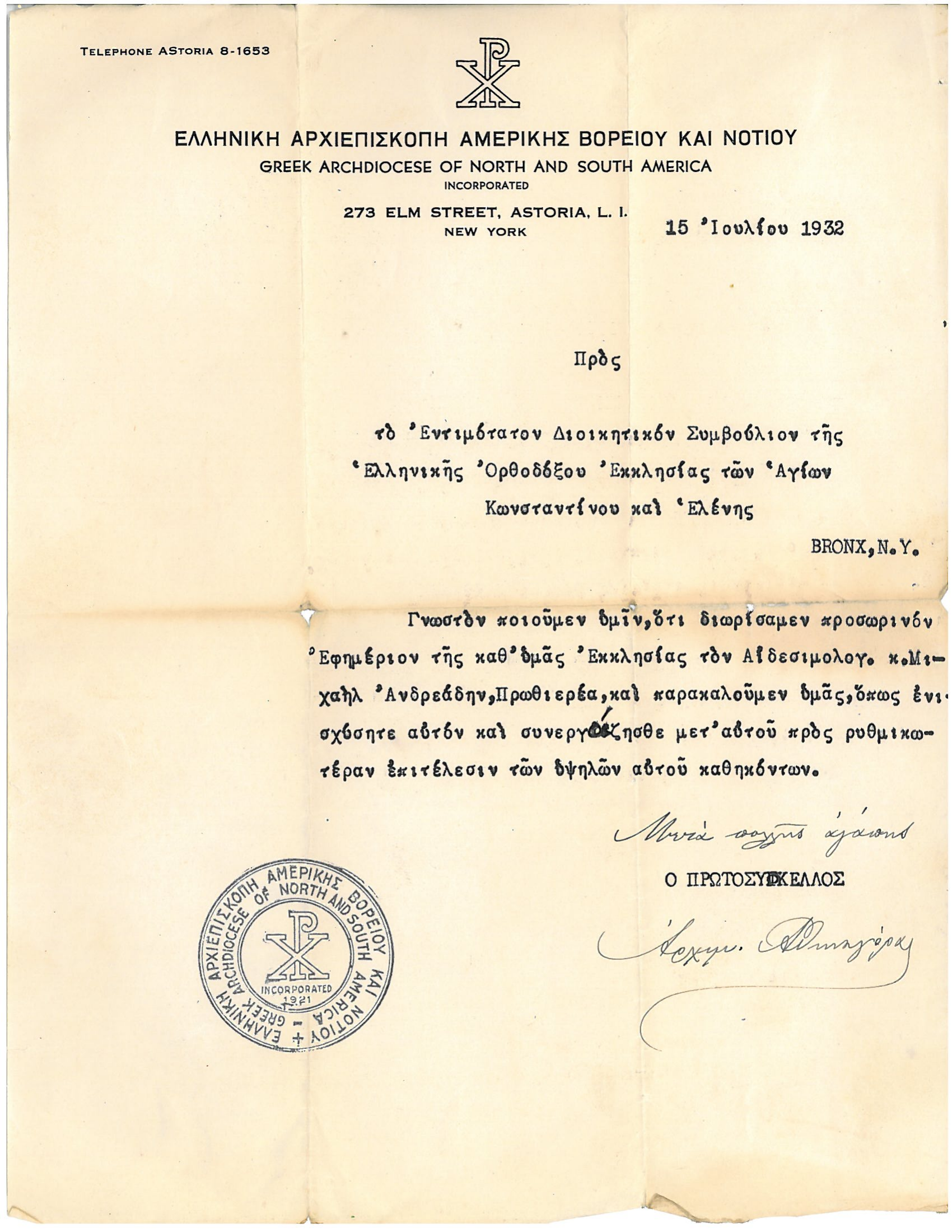
- July 1932 — Archdiocese appoints Father Michael Andreadis (Archpriest) as provisional parish priest.
- October 24, 1932 — General Assembly of the now-formally-named “United Hellenic Orthodox Community Saints Constantine and Helen” convenes at 986 Forest Avenue. A five-member Building Acquisition Committee is empowered to negotiate the church property at 809 Westchester Avenue. The merger has succeeded.
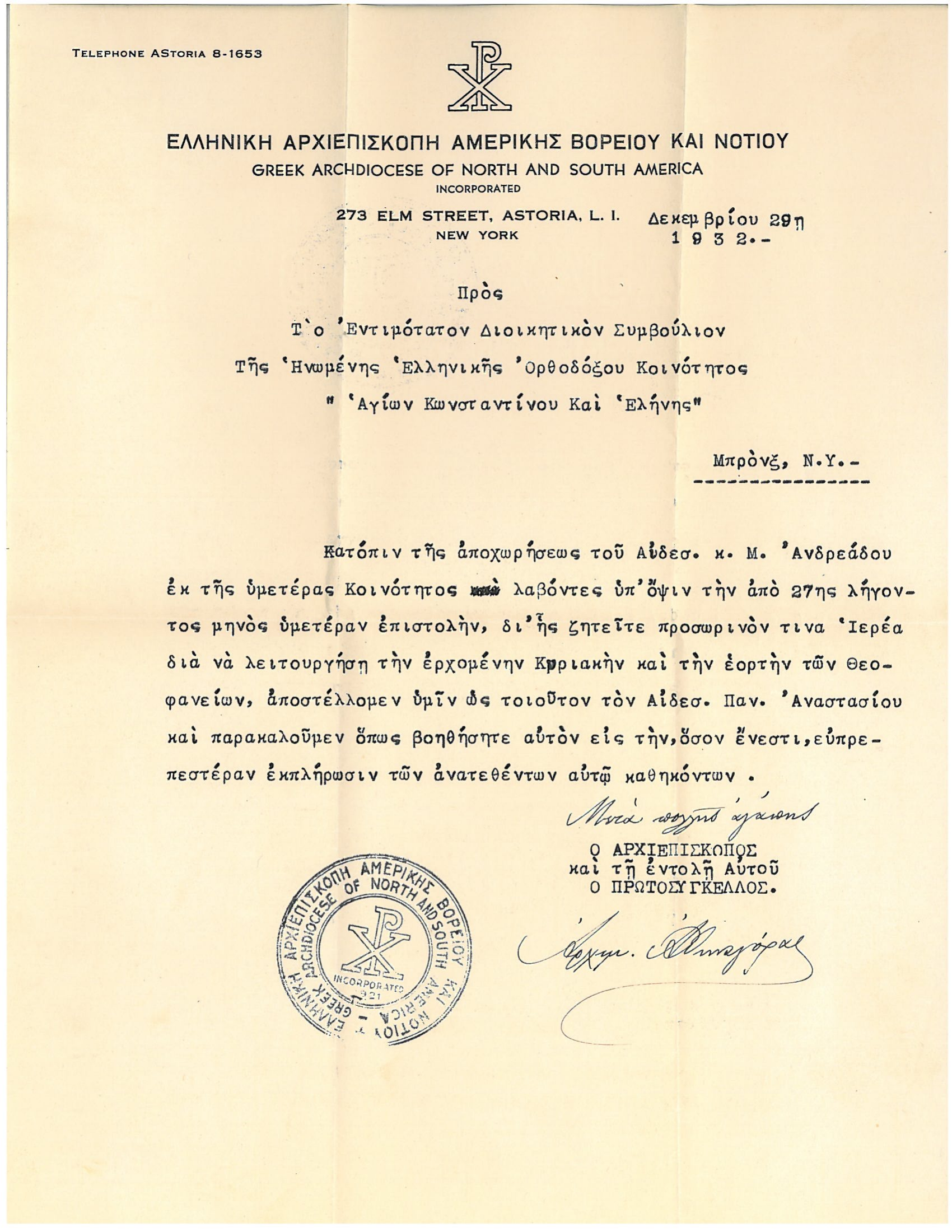
- December 1932 — Father Andreadis departs the parish after only five months. The Archdiocese appoints Father Pan. Anastasios as a temporary fill-in for the Theophany (Epiphany) services on January 6, 1933.
- June 1, 1933 — Archdiocese refers the Sidirokanellis matter to the US Justice Department and Postal Service — a substantial legal escalation against the dissident faction.
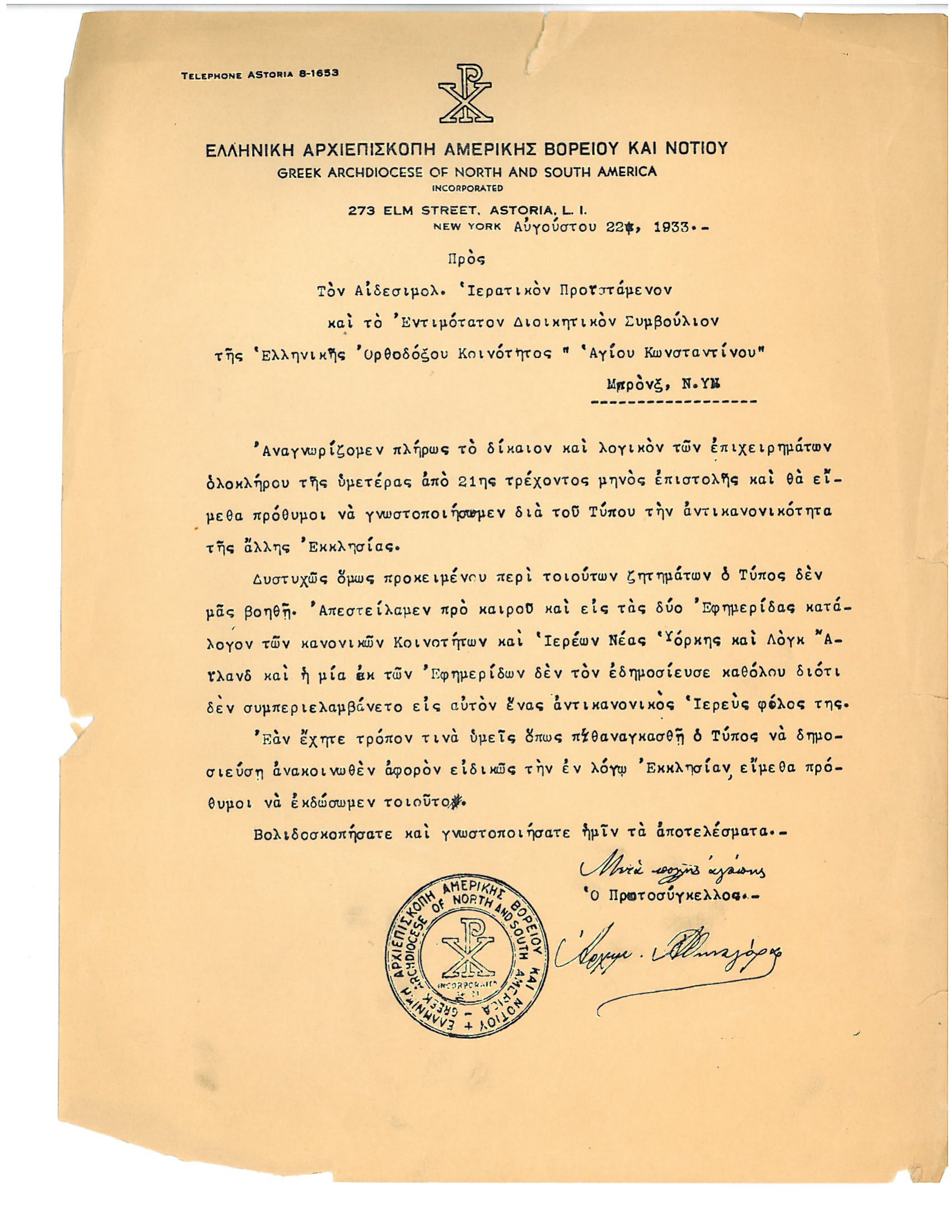
- August 22, 1933 — Archdiocese coordinates a press strategy with the Bronx parish administrative council to delegitimize “the other Church” through the Greek-American newspapers.
- September 1, 1933 — Archdiocese formally recognizes Saints Constantine and Helen as canonical, opposing the rival Zoodochos Pege parish.
- November 1, 1933 — Archbishop Athenagoras Spyrou allegedly assaults Archimandrite Christopher Kontogeorgos in Chicago.
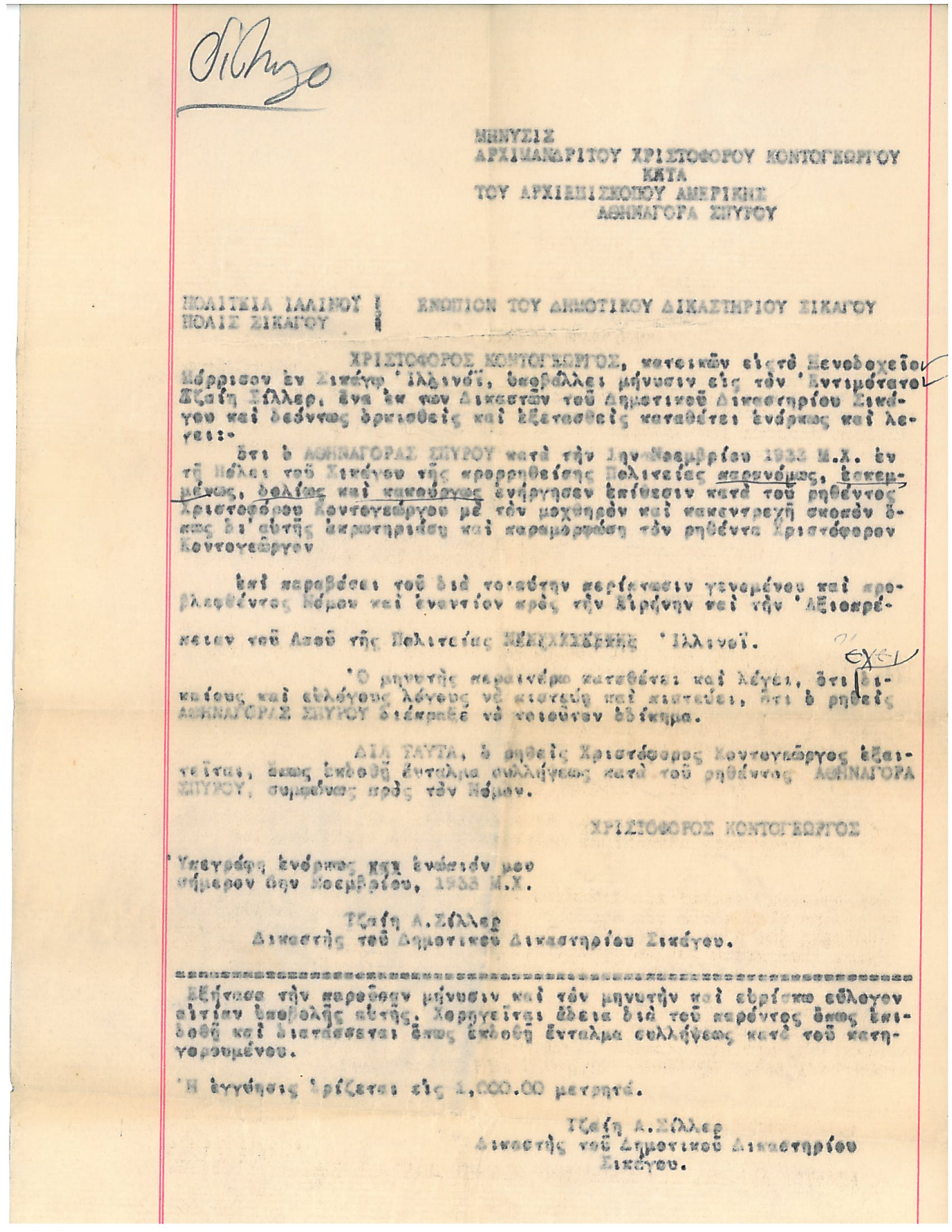
- November 8, 1933 — Kontogeorgos files a criminal complaint in the Chicago Municipal Court; Judge Tzaph A. Siller finds sufficient cause and issues a warrant of arrest against Archbishop Athenagoras Spyrou with bond set at $1,000 cash — equivalent to roughly $24,000 in 2026 dollars. The case appears not to have proceeded to trial, but the underlying conflict directly catalyzed the next step.
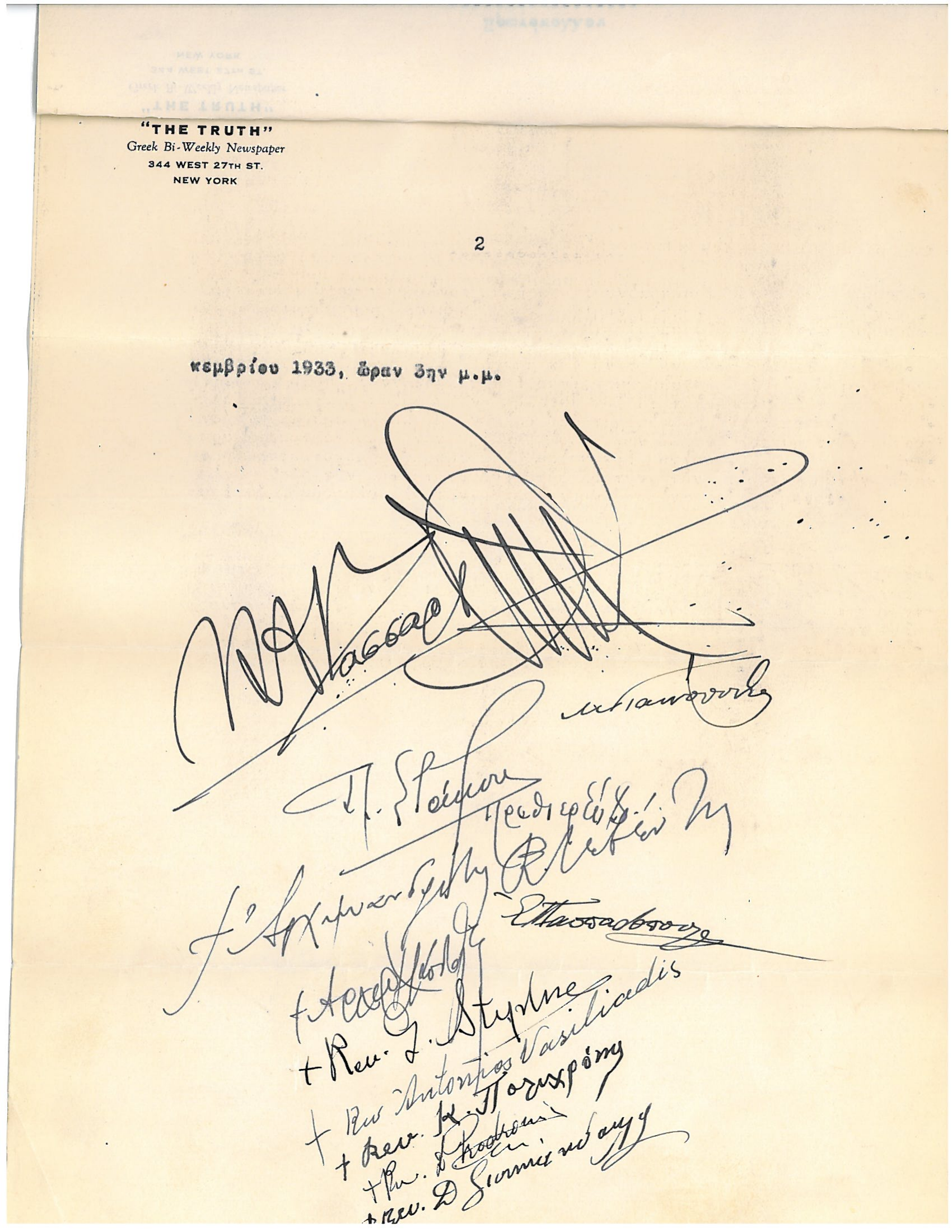
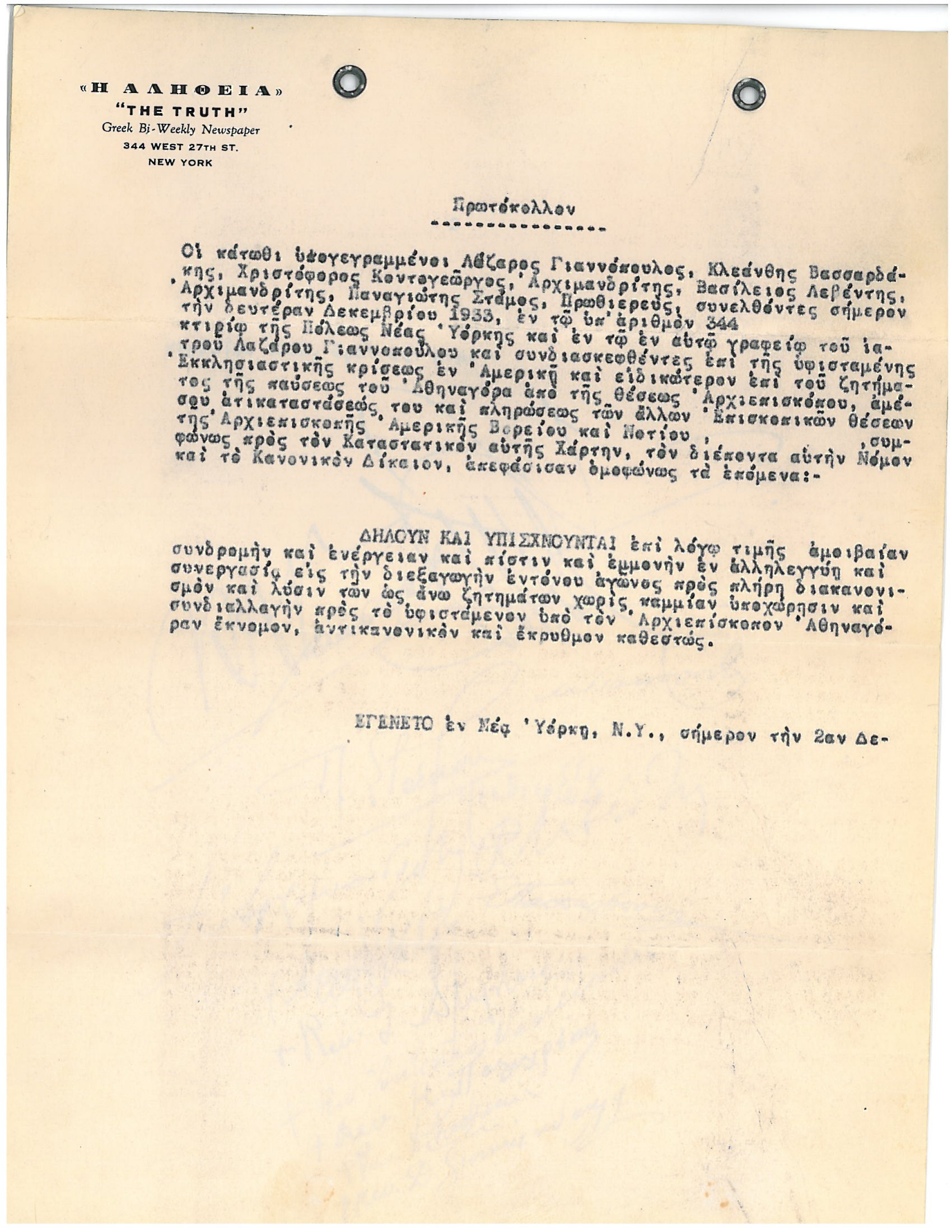
- December 2, 1933 — The Aletheia Protocol — founding charter of the dissident-faction movement — is signed at Lazaros’s office at 344 West 27th Street, NYC. Five founding members: Lazaros (first signatory + office host), Kleanthis Vassardakis (lay), Archimandrite Kontogeorgos, Archpriest Panayiotis Stamos, and Archimandrite Vassileios Leventis. Twenty-four days after the Chicago arrest warrant; nine days before the Palm Garden rally.
- December 11, 1933 — Palm Garden NYC anti-Athenagoras rally. Lazaros sat on the New York organizing committee.
The faction Lazaros backed lost in the long run — Athenagoras went on to become Ecumenical Patriarch in 1948 — but the church-politics activism left a substantial paper trail in the household archive, and the underlying institution at 809 Westchester Avenue would in different form be the home of the Greek Orthodox Bronx community for decades to follow.
Director of Aletheia newspaper
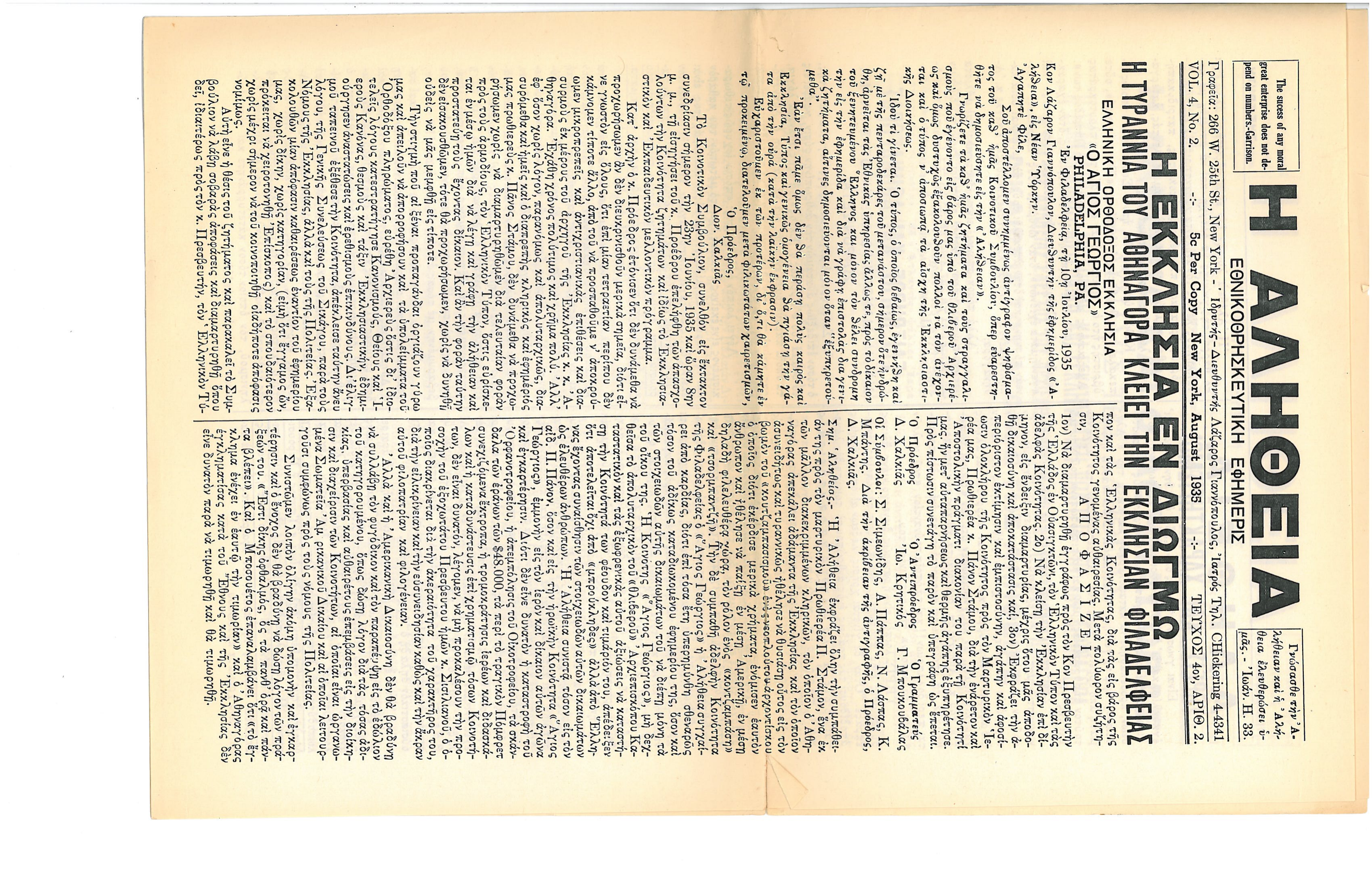
A long-standing hint in the family record was finally settled in 2026 by a single salutation in the August 1935 front page of Aletheia — “Mr. Lazaros Yannopoulos, Director of the newspaper ‘H ALETHEIA’, New York”. Lazaros was the Editor-in-Chief of Aletheia (“The Truth”), running it from editorial offices that moved from 344 West 27th Street to 266 West 25th Street by 1935 — both within the Chelsea / Hell’s Kitchen corridor of Manhattan where much of the Greek-American press of the era clustered.
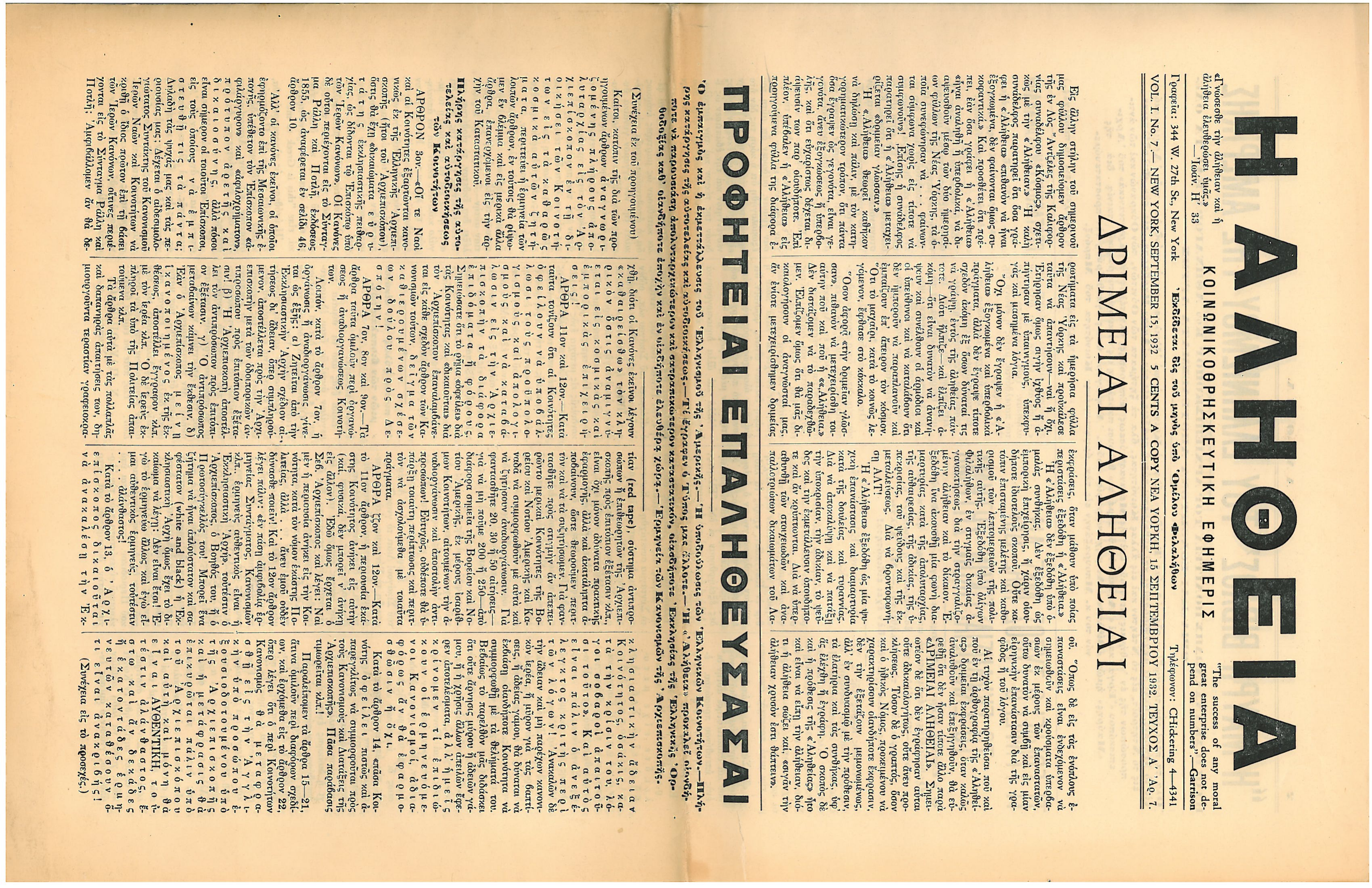
The earliest preserved issue is Vol I No 7, September 15, 1932 — placing the newspaper’s first issue at approximately mid-June 1932 at biweekly cadence. The 1932 masthead carried the subtitle “Social-Religious Newspaper” (ΚΟΙΝΩΝΙΚΟΘΡΗΣΚΕΥΤΙΚΗ), framing it as a reform organ within the Greek Orthodox Archdiocese of America rather than a dissident-faction publication. That register would change in late 1933.
The pivot moment was the Aletheia Protocol of December 2, 1933 — signed at his 344 W 27th St office by him plus four clergy: Archimandrite Christopher Kontogeorgos (the same priest who issued John Lazare’s 1931 birth certificate and who had just obtained a Chicago arrest warrant against Archbishop Athenagoras), Kleanthis Vassardakis, Archpriest Panayiotis Stamos, and Archimandrite Vassileios Leventis. The Protocol was a re-founding of the already-running 1932 newspaper — Aletheia’s organizational pivot from reform organ to dissident-faction organ in direct response to the November 1, 1933 Chicago assault and the resulting arrest warrant against the Archbishop. By August 1935 the masthead subtitle had changed to “National-Religious Newspaper” (ΕΘΝΙΚΟΘΡΗΣΚΕΥΤΙΚΗ) — the full dissident-faction posture.
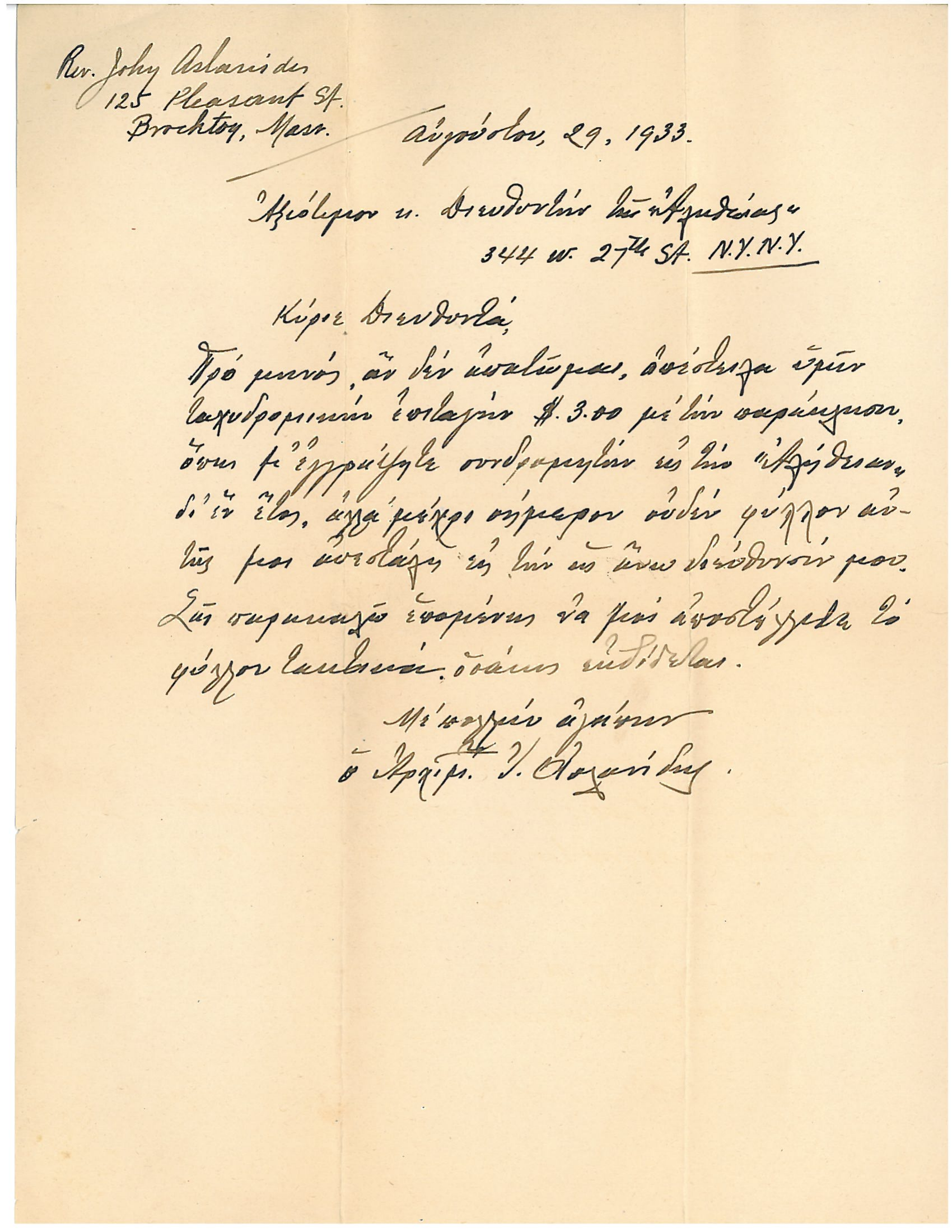
In the August 1935 issue, Aletheia’s lead story under his direction was the closure of the Saint George Greek Orthodox Church of Philadelphia by Archbishop Athenagoras — the same dissident-faction struggle that had broken out in the Bronx in 1933, now spread to Philadelphia two years later. Aletheia’s national subscription network reached as far as Greek Orthodox clergy in Brockton, Massachusetts, by 1933.
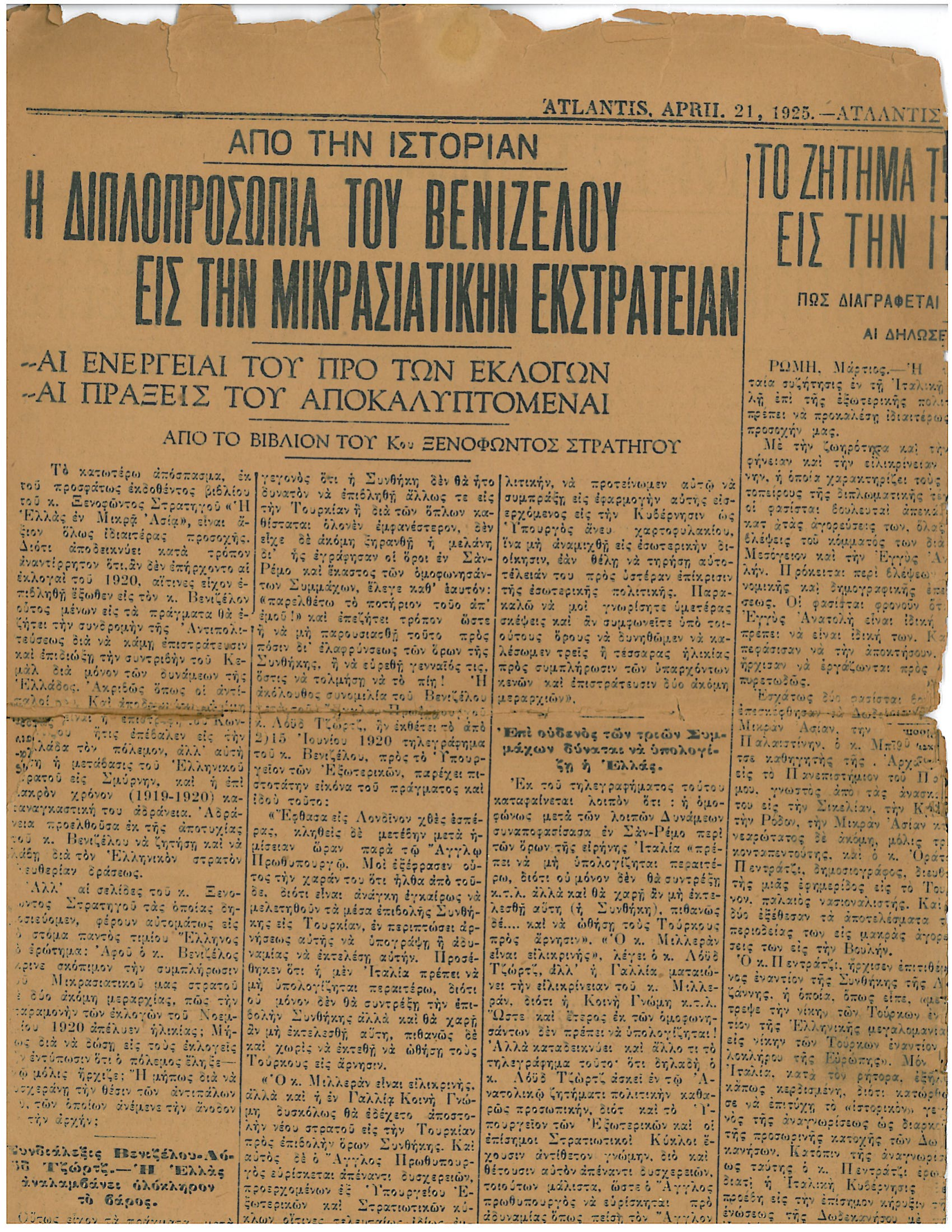
Lazaros’s role as Director re-classifies a substantial portion of his archive: the church-politics letters that flowed through his papers in 1932–1933 (Bronx parish correspondence, Sidirokanellis Justice Department referral, Archdiocese-press strategy notes) were not only the records of a parish member, they were the editorial intake of the newspaper’s editor. He was the nationwide voice of the conservative Greek-American resistance to the Athenagoras Archdiocese — a role that, combined with his anti-Venizelist politics (he kept the April 1925 Atlantis serialization of Stratigos’s anti-Venizelos book in his files) and his pro-Pangalos politics (the 1925–26 handwritten open letter to General Theodoros Pangalos in his papers), placed him squarely on the royalist / conservative axis of Greek-American political life for the full decade of his active years.
Diaspora refugee organizing
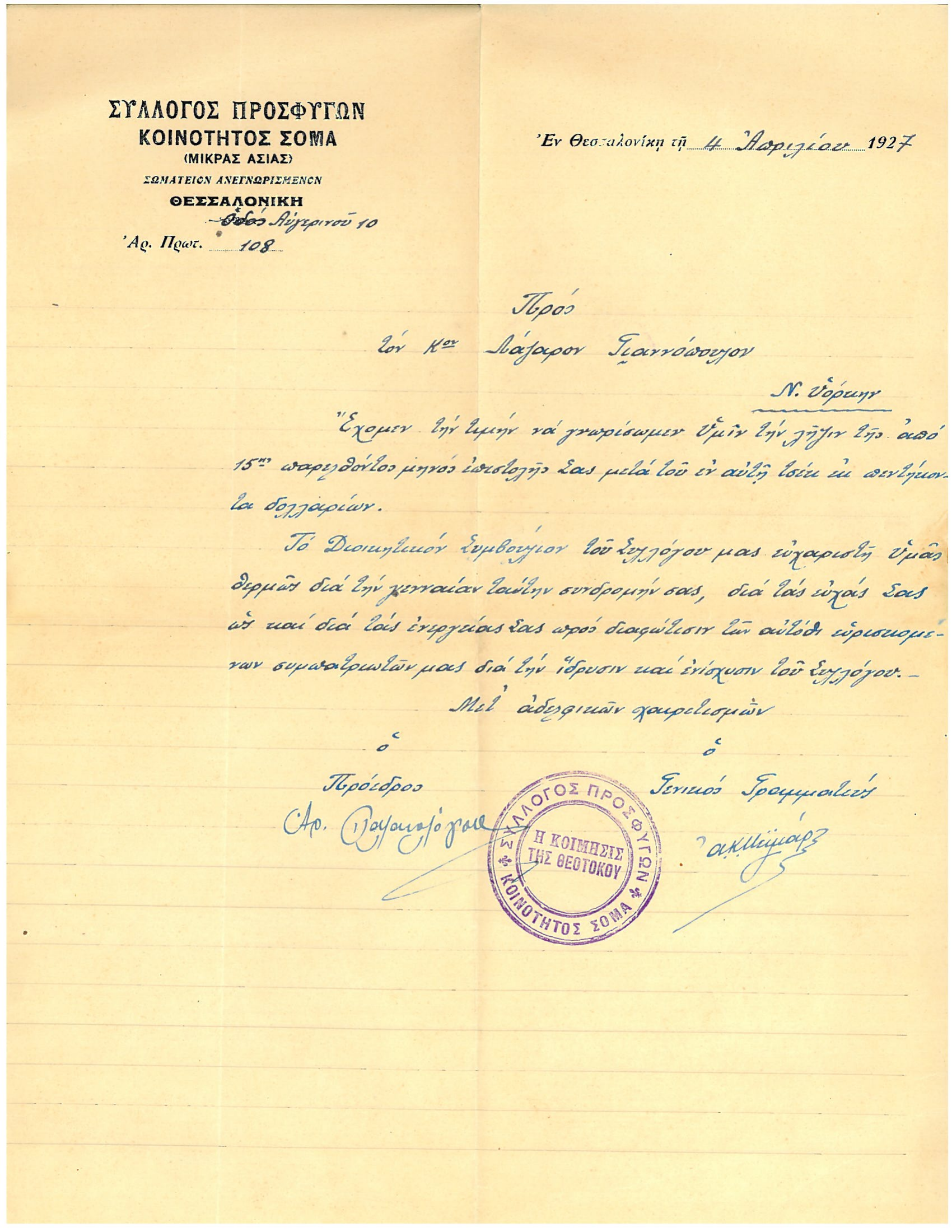
Beyond his individual property-compensation work and his Bronx parish church politics, Lazaros took on an institutional role coordinating the Soma refugee diaspora from New York. A July 1927 letter from the Soma Refugees Association of Thessaloniki thanked him for “your generous contribution and for your efforts to enlighten our compatriots there [in New York] for the establishment and reinforcement of the Association” — identifying him as the principal US-side fundraiser and organizer for Soma diaspora compatriots. Combined with his correspondence to the Eleni N. Zanni Orphanage in Piraeus (1926), the Vryoula Refugees Association in Athens (1924), and the Pergamene Association in Athens (mid-1920s onward), Lazaros’s diaspora reach covered all the major Greek-mainland refugee centers from his Manhattan medical practice.
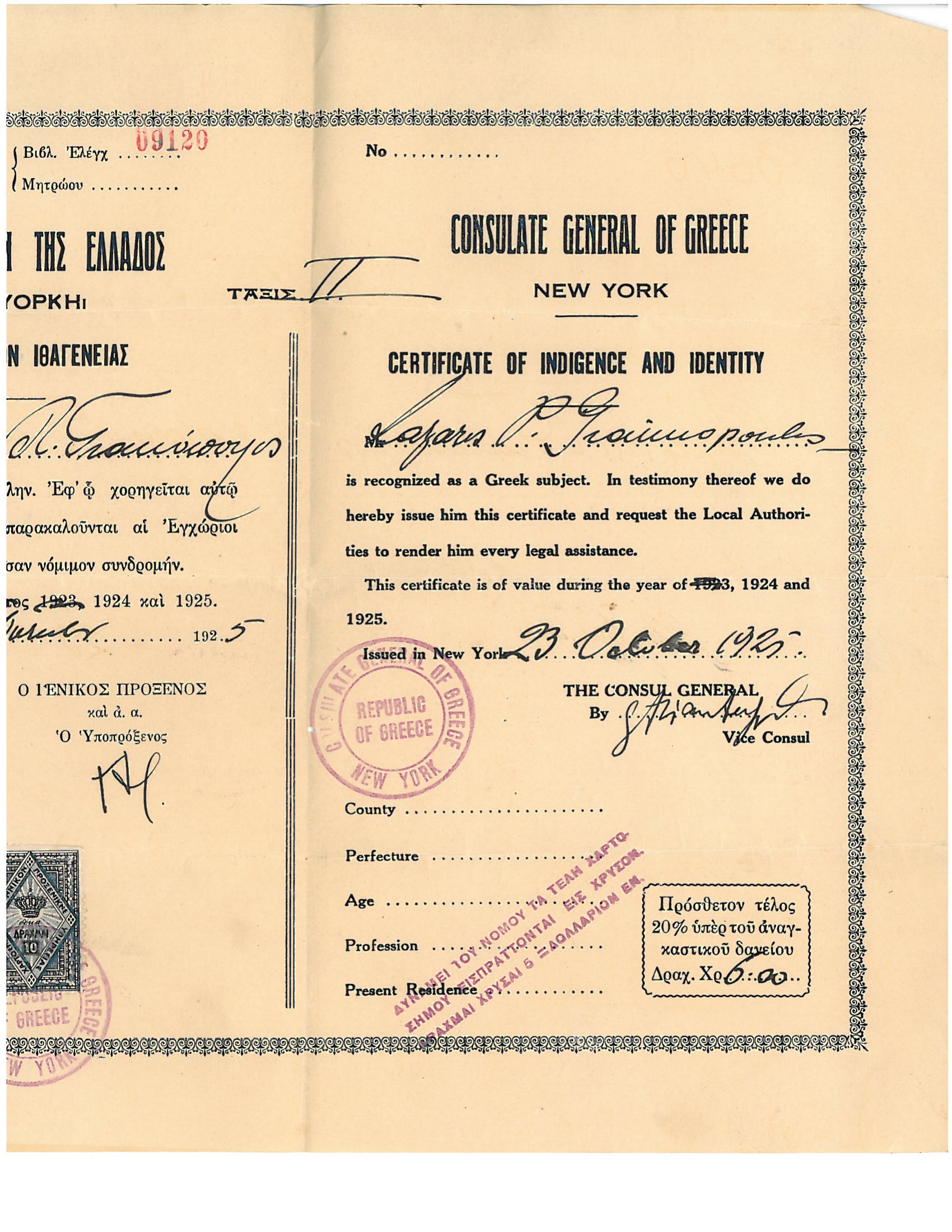
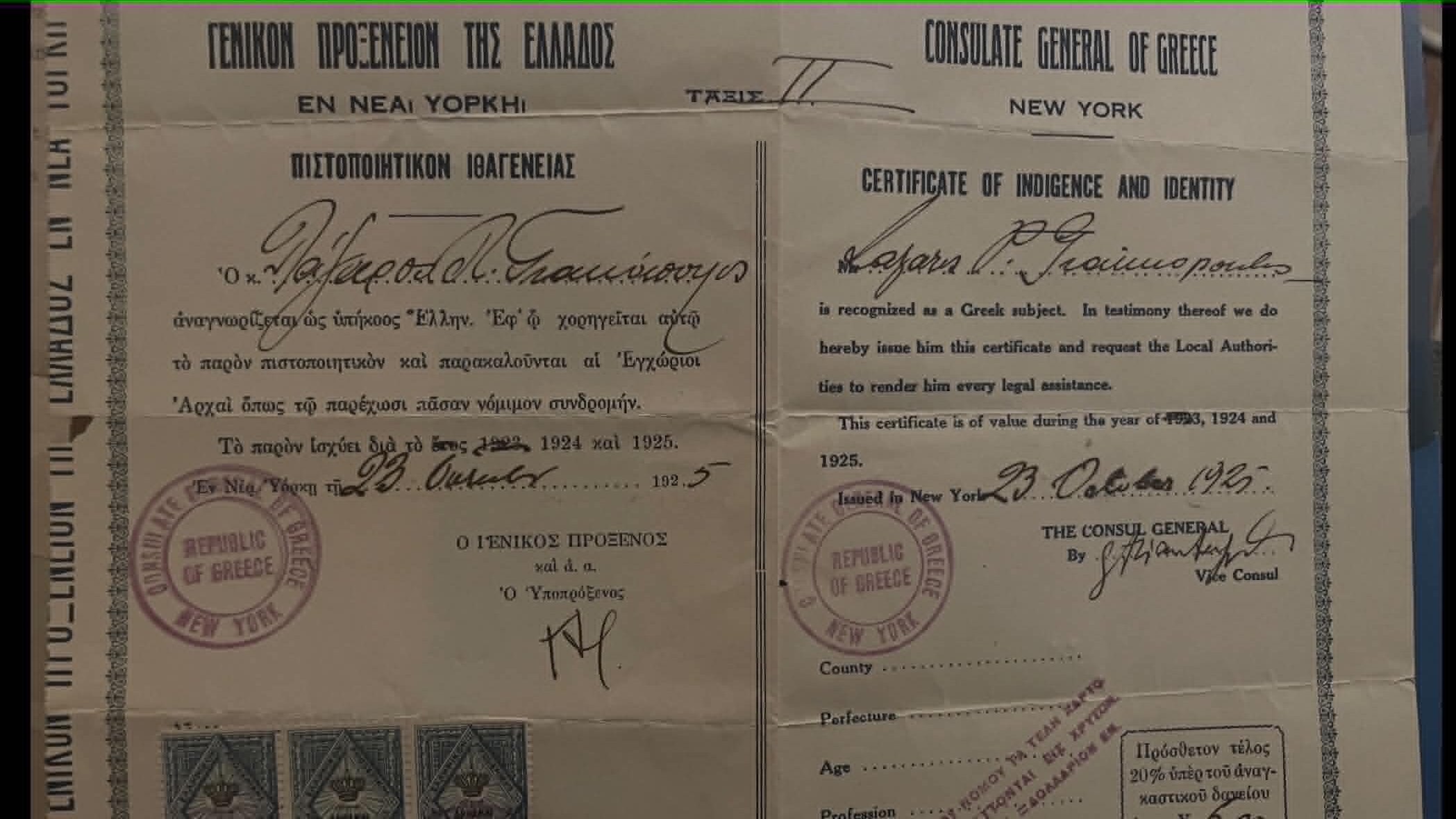
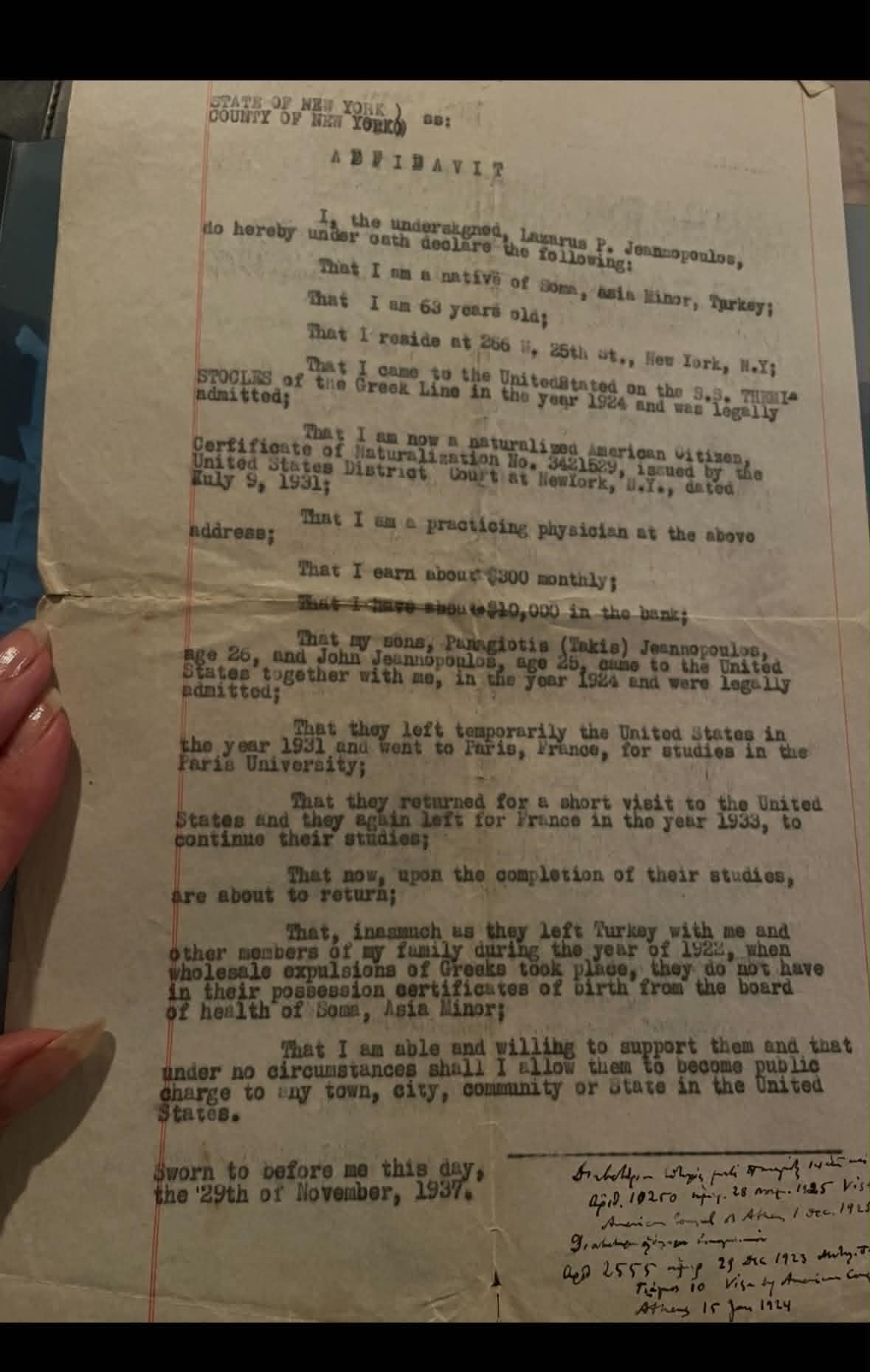
His official Greek-state status was maintained continuously. The Greek Consulate General of New York issued him a “Certificate of Indigence and Identity” on October 23, 1925 — registration No. 09120 in the Consulate’s books — recognizing him as a Greek subject in dispossessed-refugee status. This is the earliest Greek Consulate document for him in the family archive, twelve years before his sworn 1937 naturalization affidavit.
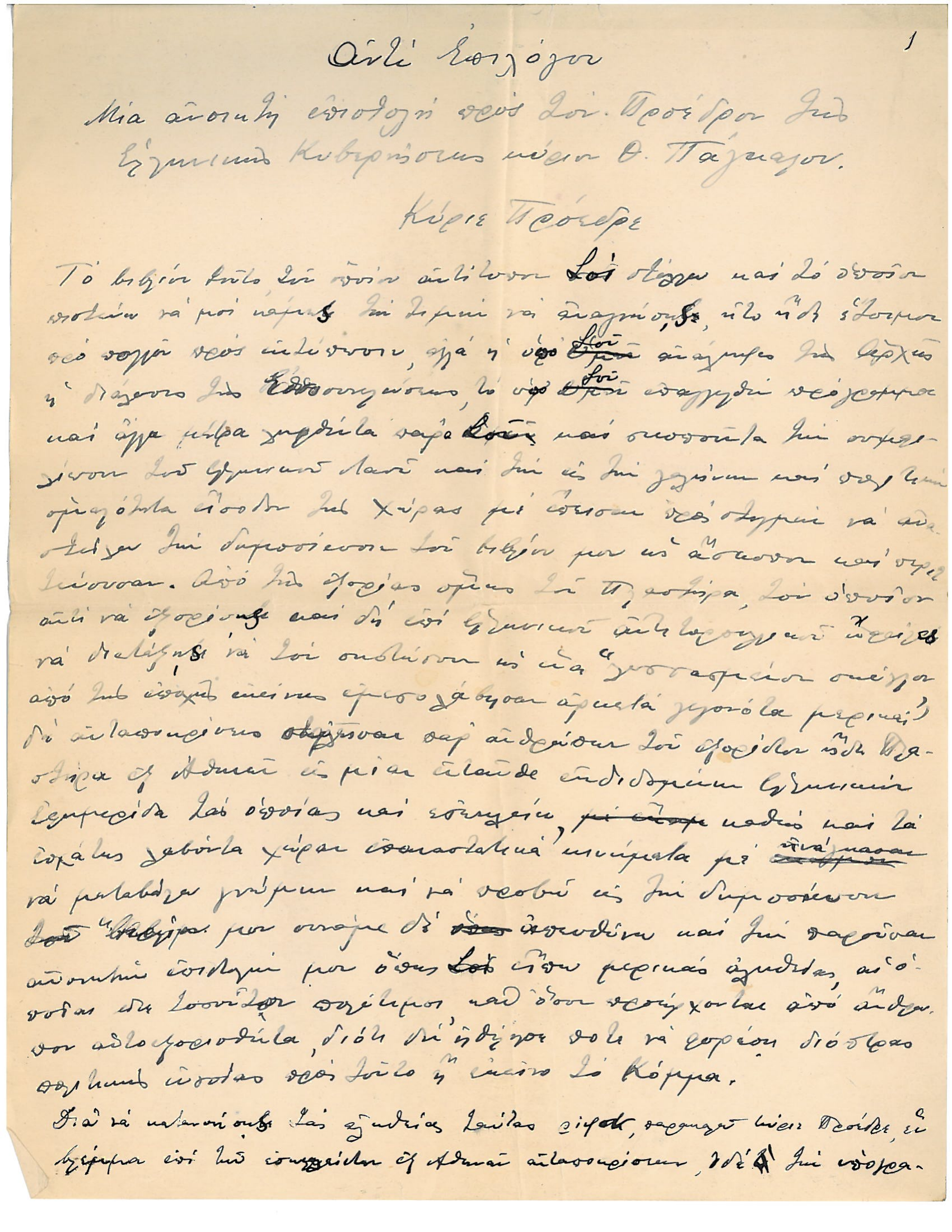
A three-page handwritten Greek open letter dated to the General Theodoros Pangalos dictatorship (June 1925 – August 1926), titled “An open appeal to the President of the Greek Government, Mr. Th. Pangalos,” also sits in his papers. Whether Lazaros himself wrote it as a political polemic in the tradition of his 1915 National Tragedy of Thrace and Asia Minor, or preserved a copy of someone else’s open letter, has not yet been determined from the handwriting alone.