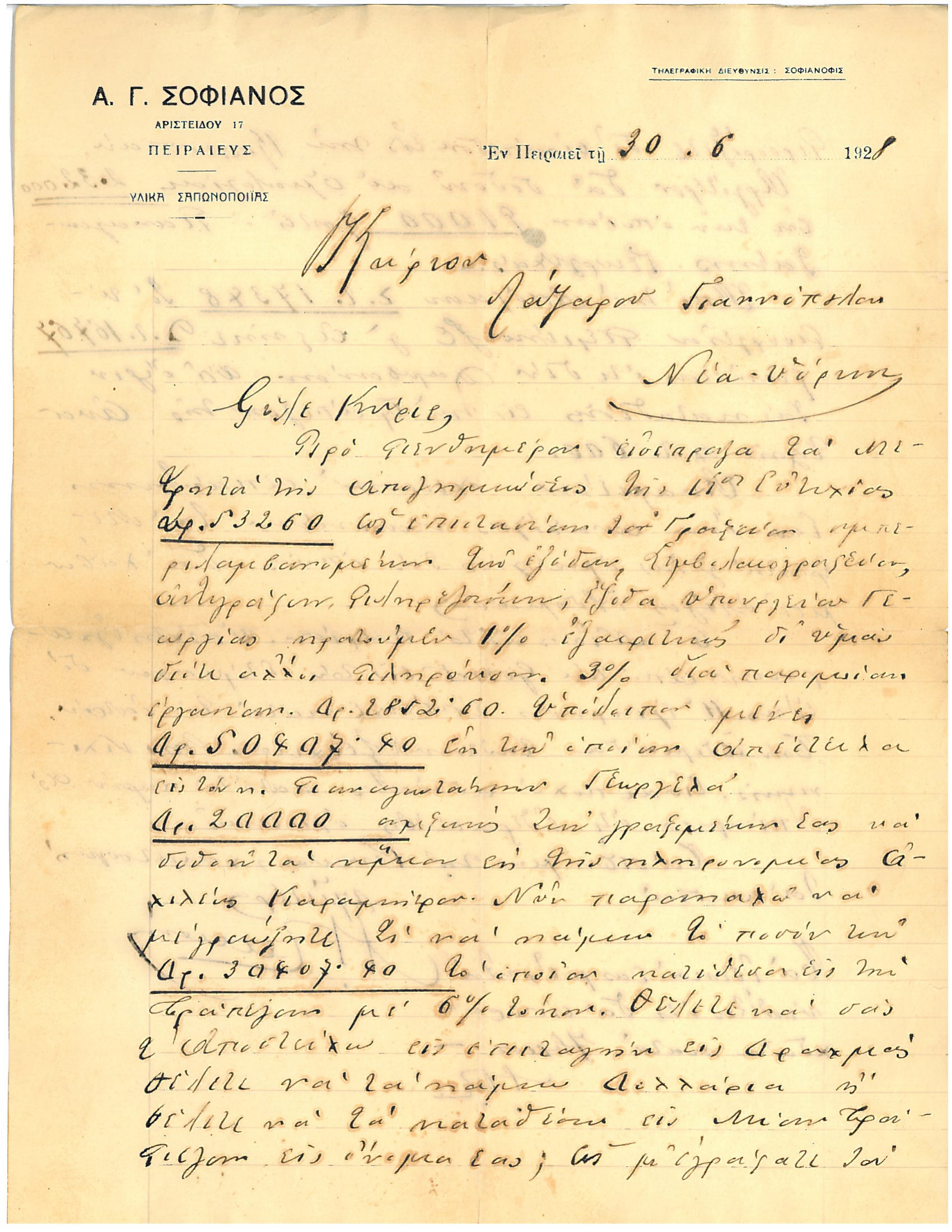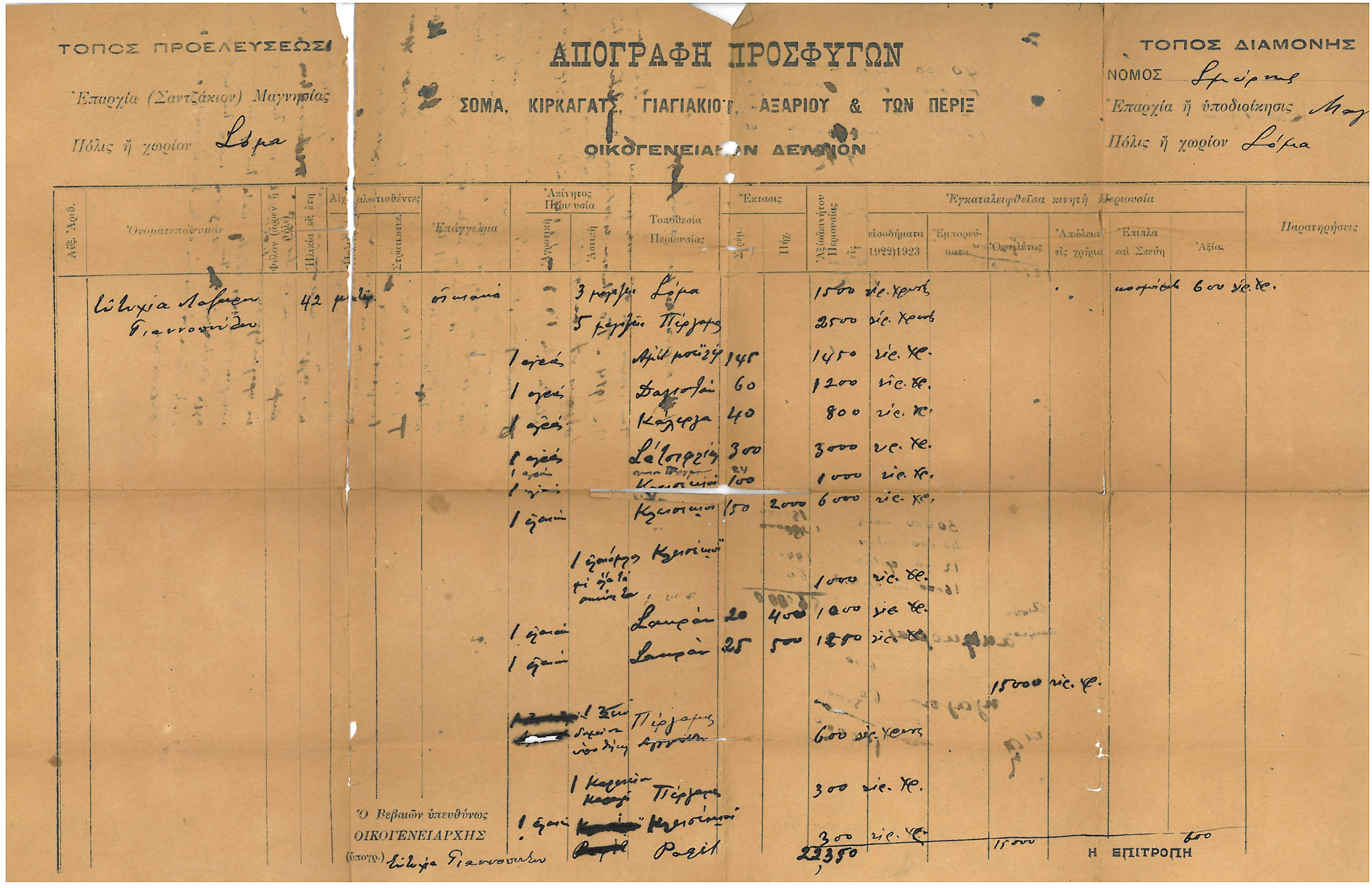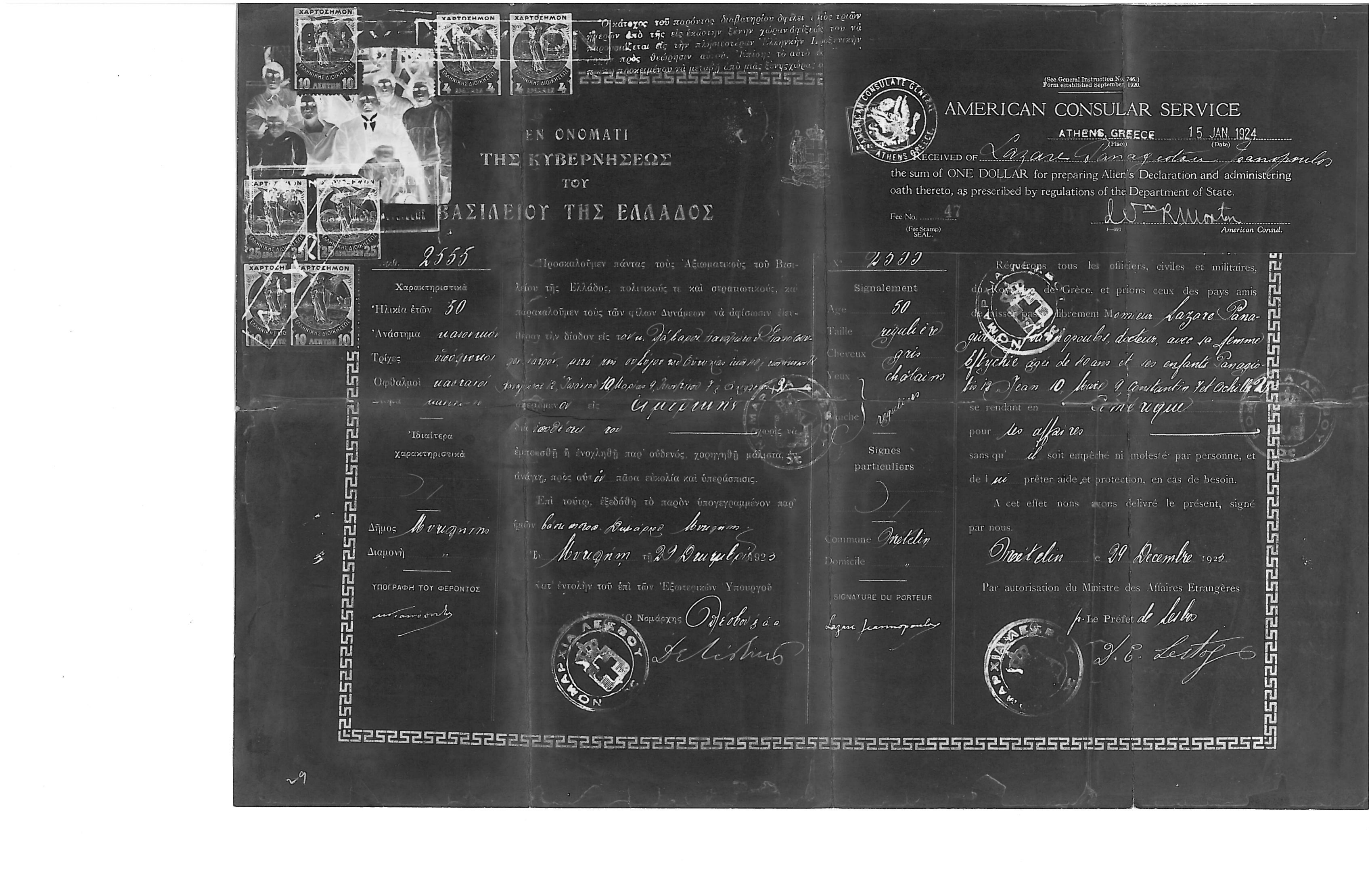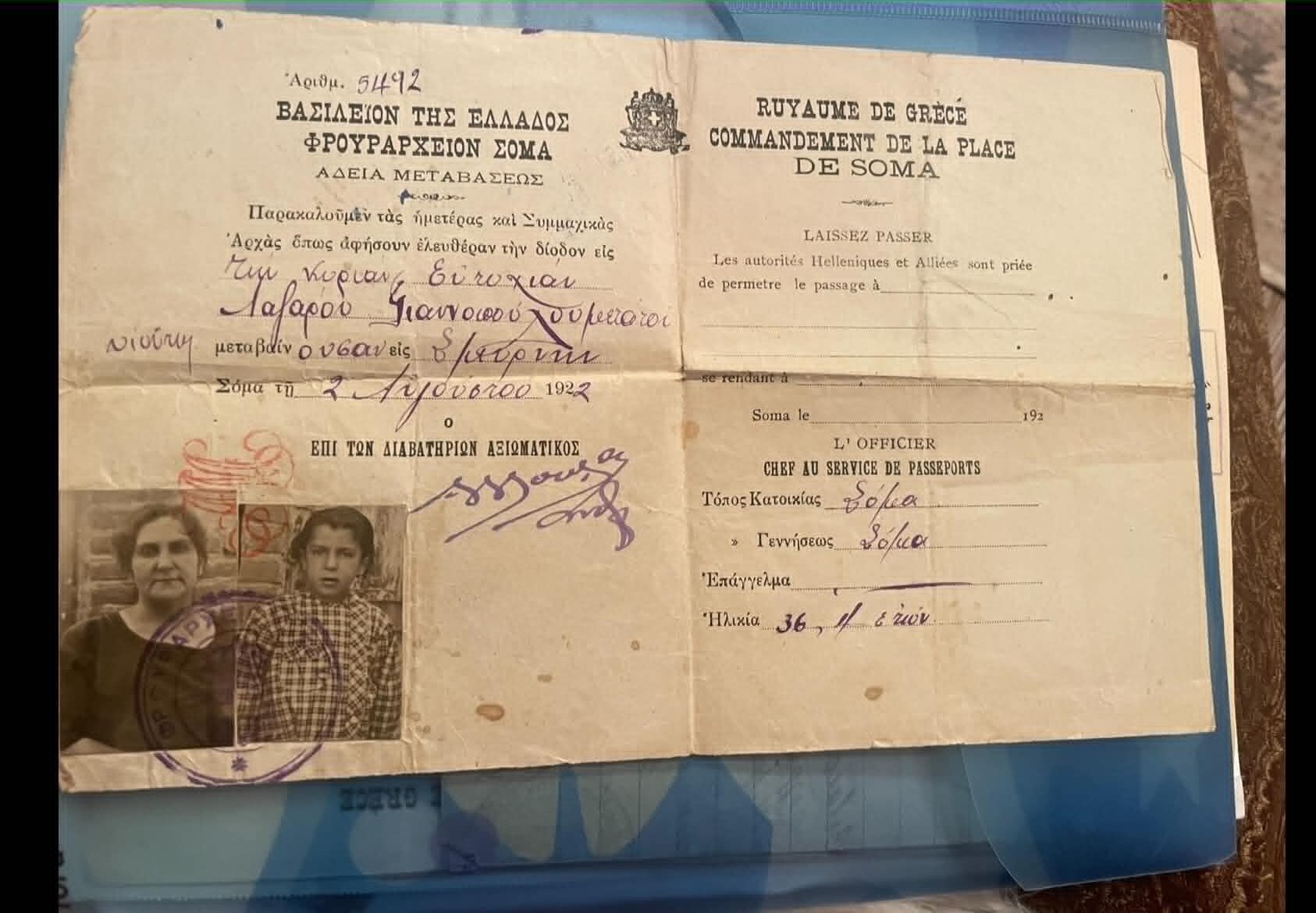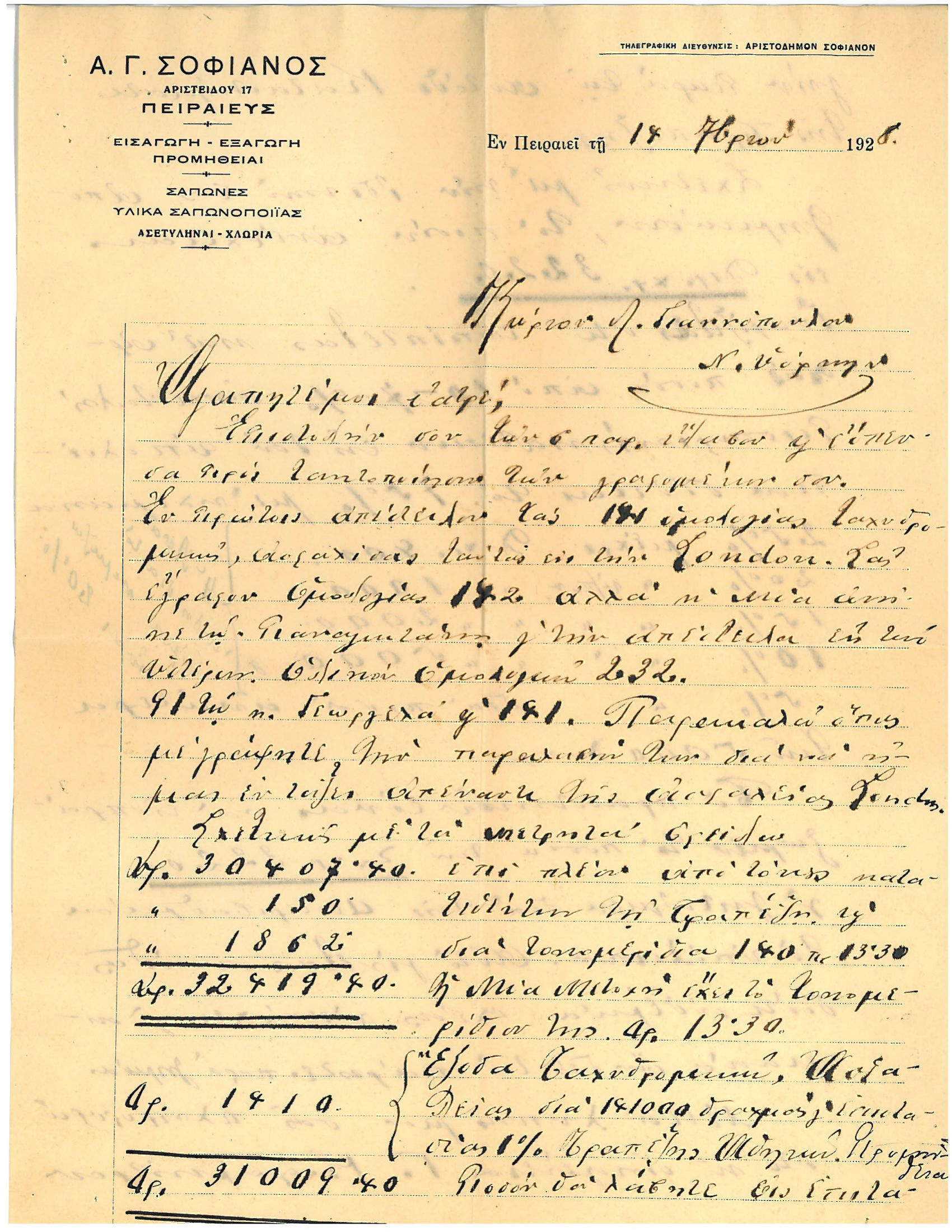
By September 1928 they were no longer “Dear Sir” to each other. The salutation on this two-page letter from Aristidou 17, Piraeus — “My dear Lazaros” (Αγαπητέ μοι Λάζαρε) — confirms what the three months of monthly accounting between them had become: a working friendship, with money. A.G. Sofianos ran an import/export trade in soap-making materials, acetylenes, and chlorines under the telegraph address ARISTODIMON SOFIANON. He was also Lazaros’s Greek-side financial agent for everything to do with Eftyhia’s Karamitrou-side refugee compensation. The letter is dated September 18, 1928, two months after Sofianos’s July 1928 letter on the same topics.
The first page is detailed financial accounting:
- 232 postal bonds insured to London (181 already processed, plus 51 new) — Greek refugee compensation bonds, securely couriered into the City of London for safekeeping
- 32,419.80 drachmas (~$67,000 in today’s gold-equivalent money) in total receipts processed through the bank
- 1,410 drachmas (~$2,900 today) in postal expenses and 1% bank commission
- 31,009.40 drachmas (~$64,500) net to be credited to the account
- 3,220 drachmas (~$6,700 today) received as a Pergamon Assessment Committee compensation payment for the Karamitrou family claim — the Pergamene-side compensation track for Eftyhia’s father Sofianos Karamitrou’s lost Bergama property
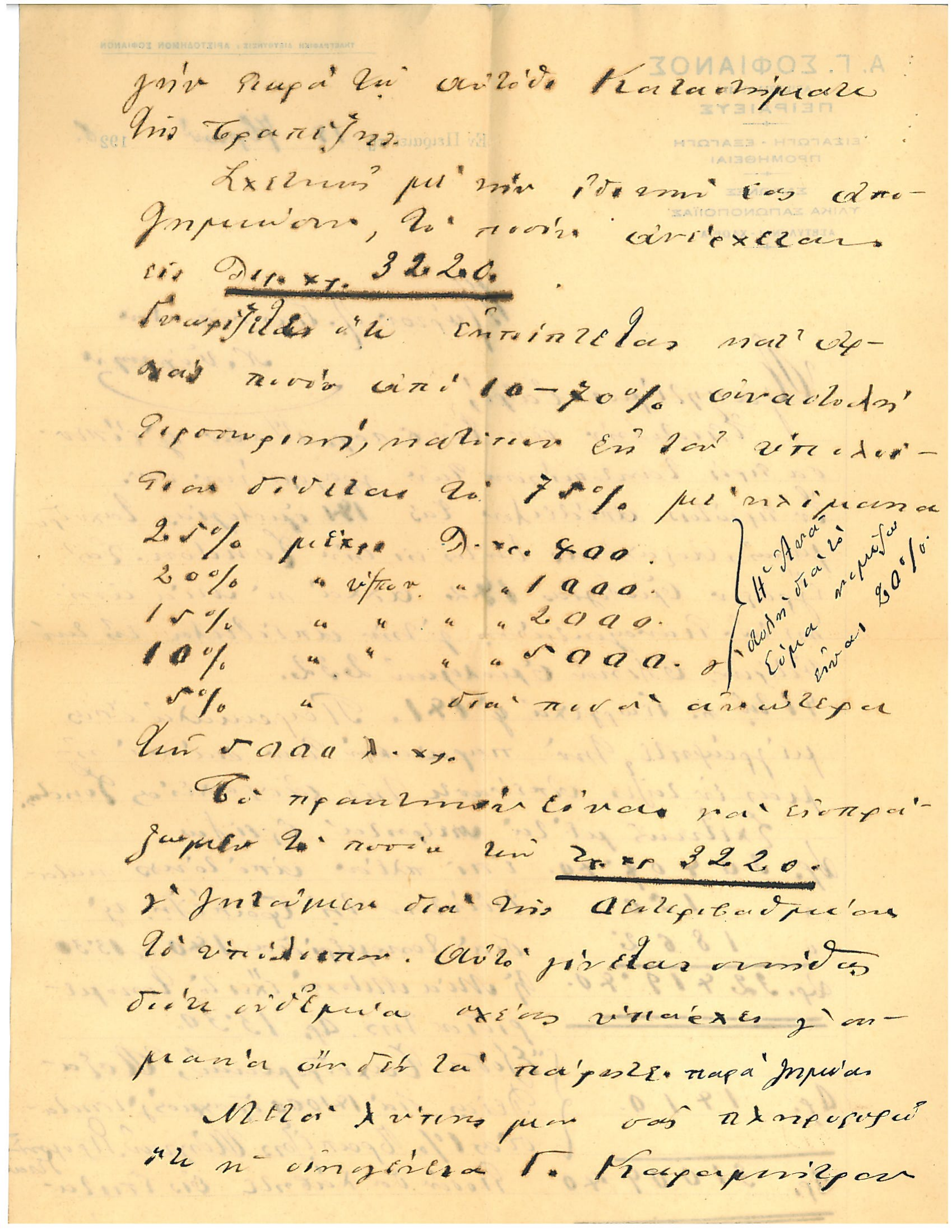
The letter explains the payout-with-retention scale the Greek state was applying to refugee compensation claims through the Pergamon Assessment Committee:
| Claim size (drachmas) | Paid | Retained |
|---|---|---|
| Up to 800 | 75% | 25% |
| Up to 1,000 | 80% | 20% |
| Up to 2,000 | 85% | 15% |
| Up to 5,000 | 90% | 10% |
| Above 5,000 | 95% | 5% |
The retention scale was sliding — larger claims received proportionally more cash up front, with smaller percentages held back for later disbursement against future budgetary capacity. The Karamitrou family claim of 3,220 drachmas placed it in the 90% / 10% tier. Sofianos suggests pursuing the remaining 10% balance through Alexandria, Egypt — confirming that the post-1922 Greek diaspora financial network operated through Alexandria as a secondary channel for refugee transactions.
The second page opens with a sentence that breaks the financial register sharply:
“With sorrow I inform you that the sister G. Karamitr[ou]…”
The continuation is on a page not preserved in this scan. The opening phrase reads as a death or serious-illness notification about a Karamitrou sister — most plausibly a sister of Eftyhia herself. The “G.” is the only identifying letter — a Greek first name beginning with Γ (perhaps Γεωργία, Γαρυφαλλιά, Γιαννούλα, Γιαννία, or another). The full identification awaits the continuation page.
What the letter establishes definitively is the distributed financial network by which the Jeannopoulos household managed its Asia Minor refugee compensation from New York: Sofianos in Piraeus handling Greek-state interactions; bonds insured to London for security; alternative channels through Alexandria; quarterly remittances documented in painstaking drachma accounting. This was not occasional correspondence — it was a sustained, institutional, multi-jurisdictional financial operation conducted at distance over years.