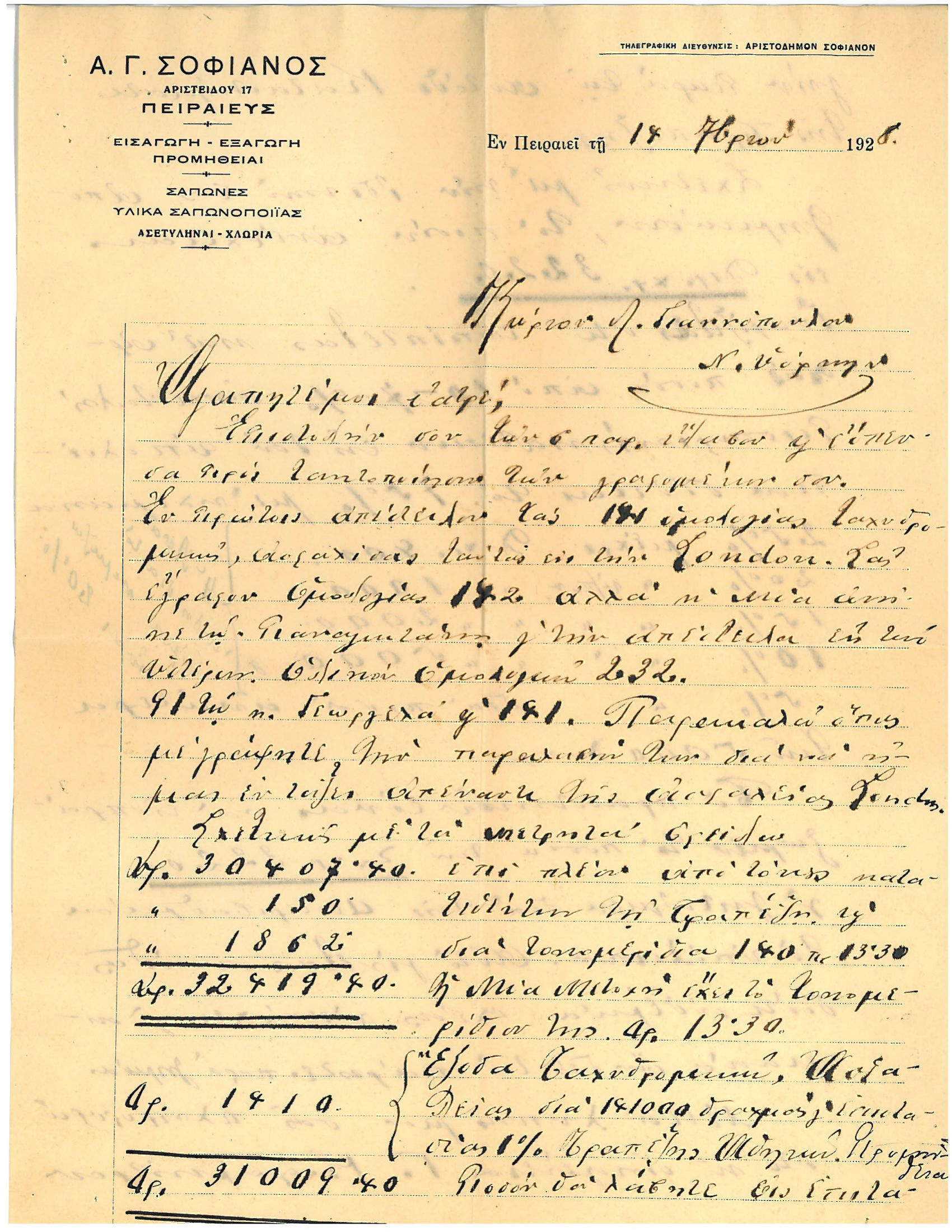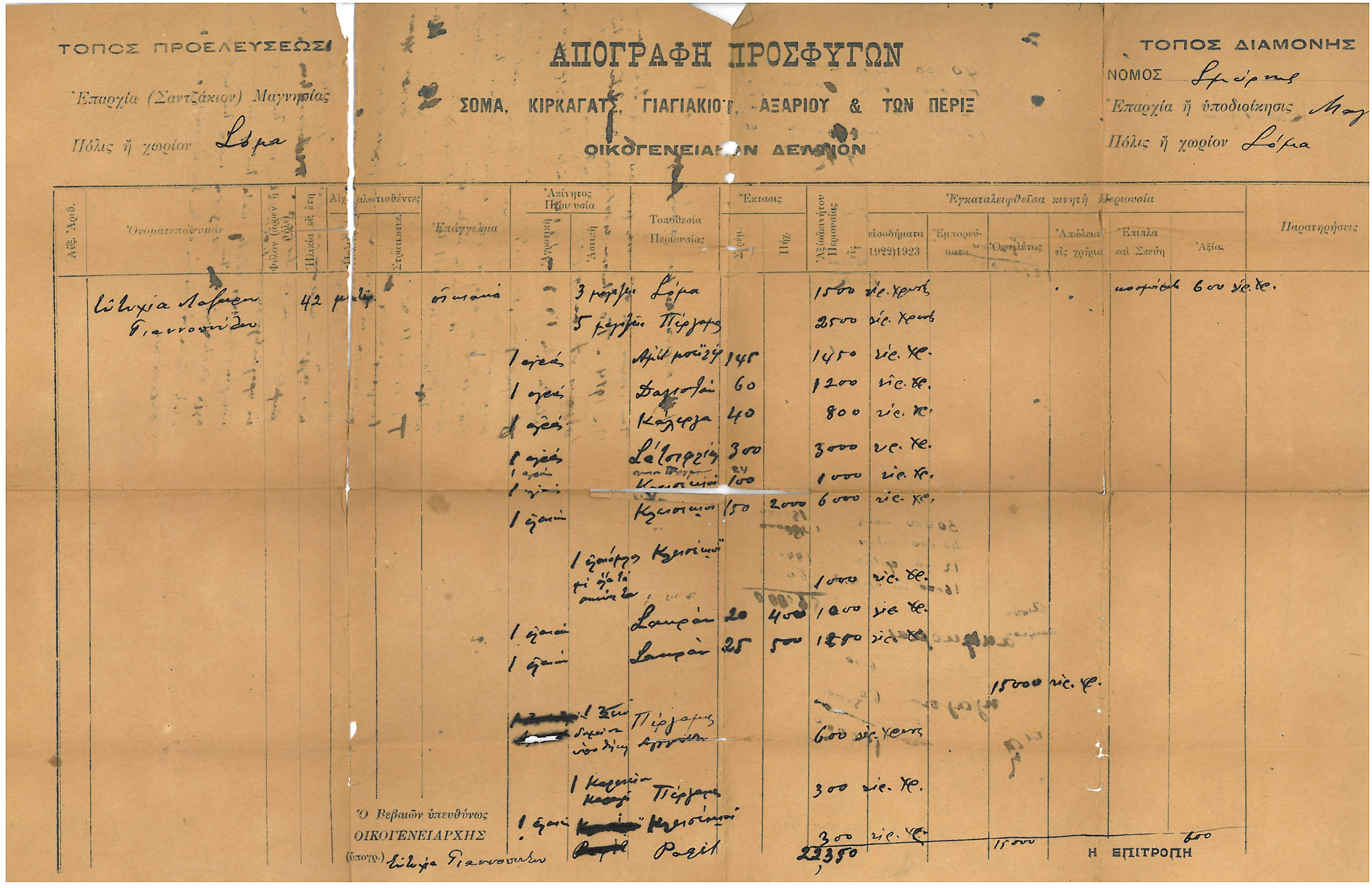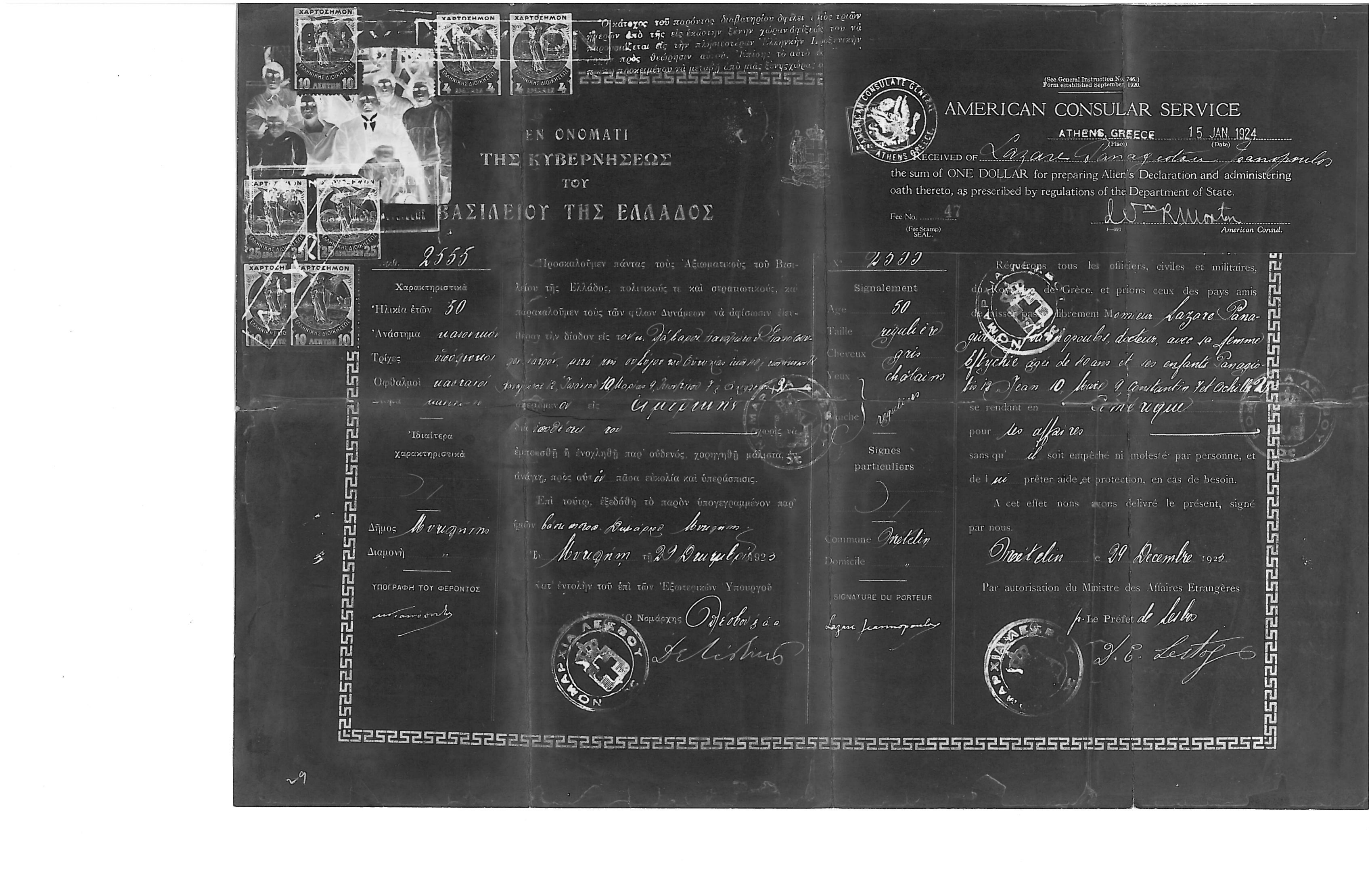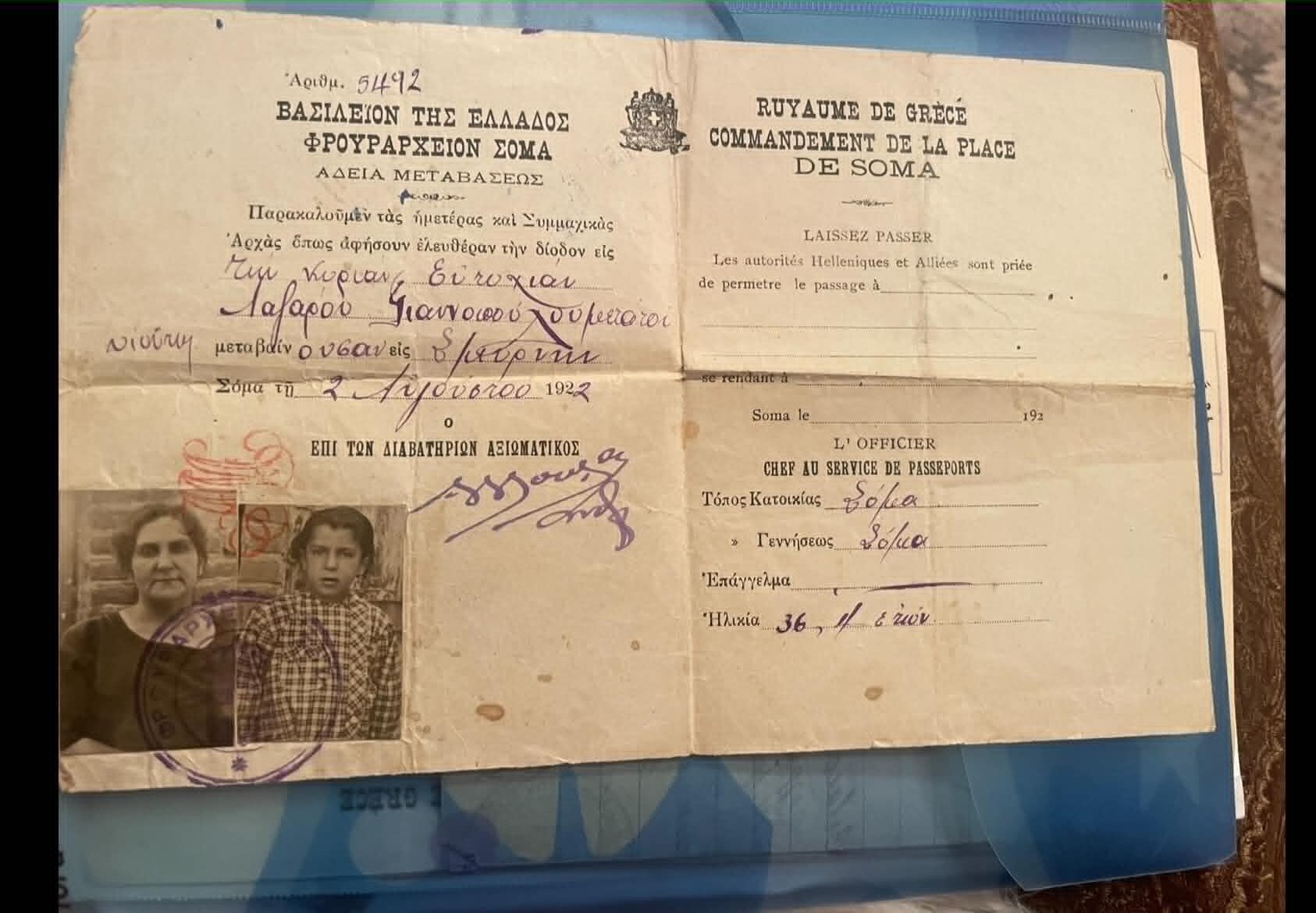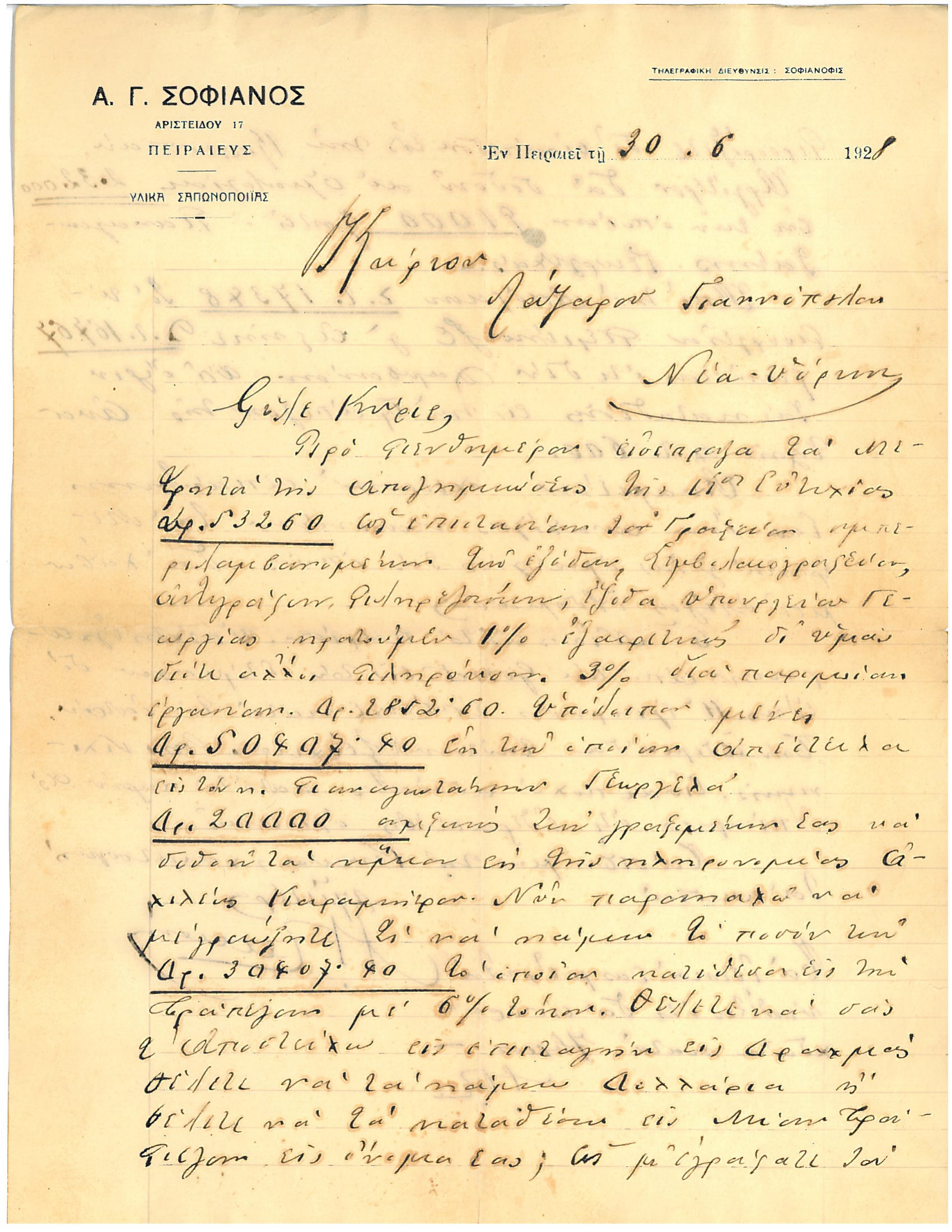
The earliest Sofianos letter in the family archive — two pages of handwritten Greek, dated June 30, 1928, Piraeus, from a small Greek merchant to a refugee doctor in Manhattan, six years after the catastrophe. A.G. Sofianos dealt in soap-making materials, acetylenes, and chlorines under the telegraph address ARISTODIMON SOFIANON. His salutation here — “Dear Sir” (Φίλε Κύριε) — is more reserved than the “My dear Lazaros” of the July and September letters, which dates this letter as early in their relationship, before the business agency turned personal.
The substance is detailed financial reporting on Eftyhia’s compensation payout from the Pergamon-side refugee claim — money the Greek state was finally repaying her, six years after her father’s Bergama property had been abandoned in the catastrophe:
- Eftyhia received 53,260 drachmas from the Bank — roughly $110,000 in today’s money, gold-equivalent.
- After withholding stamp duties, copies, postage, 1% Ministry of Agriculture external fee, and 3% office fees: net 50,407.80 drachmas (~$105,000 today).
- 20,000 drachmas (~$42,000 today) were disbursed to Mr. Panagiotakis Georgelas “initially per your [Lazaros’s] instructions” — a Piraeus intermediary on the Karamitrou-side family network.
- The remainder was allocated to “the inheritors of Achilles Karamitrou” — the first identified Karamitrou-side relative of Eftyhia beyond her father Sofianos. Most likely Eftyhia’s brother, deceased by mid-1928, with his own children inheriting his share.
- 30,407.80 drachmas (~$63,000 today) were deposited at 6% interest pending Lazaros’s instructions, with three options offered: keep in drachmas, convert to dollars, or wire to a NYC bank in Lazaros’s name.
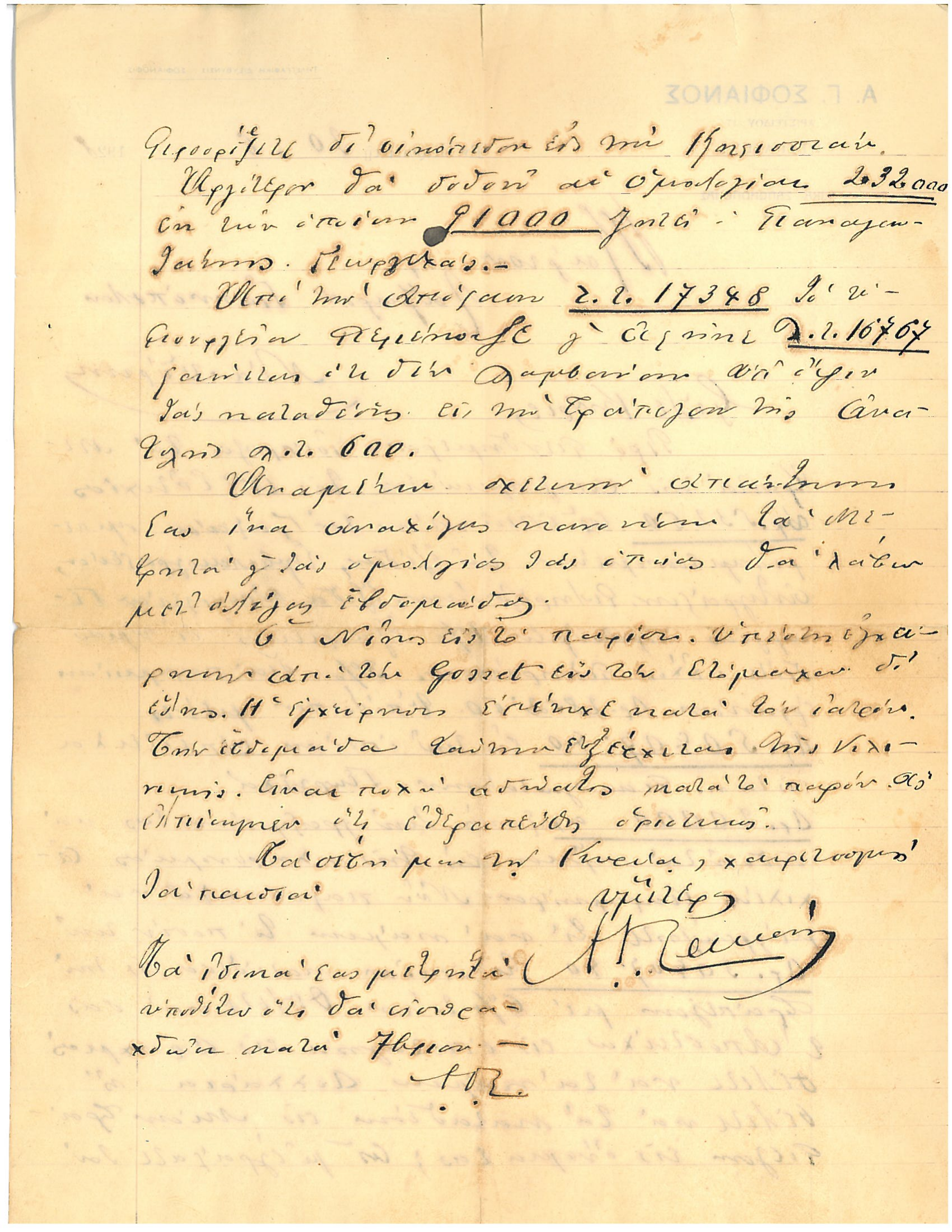
Page 2 lists 232,000 drachmas in Greek refugee compensation bonds outstanding — about half a million dollars in today’s wealth-equivalent, sitting as a long-tail receivable that the family would be collecting on for years. 21,000 of those are reserved for Georgelas; the rest is spread across “new Compensations 17,388…Georgelas Petropolis…16,767…brother-in-law from Darvaron.” A 600-drachma installment goes to the bank.
The letter also passes on family news from Paris:
“Ninos is in Paris. He had surgery from John Gosset at the [clinique] this week. The operation succeeded well. The same week he exits the Clinic. He is very weak at present, [recovering in good treatment].”
Ninos’s surgery is referenced in two subsequent Sofianos letters (July and September 1928) — a months-long medical recovery managed in Paris while Lazaros, in New York, was being kept informed by Sofianos as the Piraeus-based family agent.
The letter is the start of a sustained ~monthly correspondence between Sofianos and Lazaros through 1928, documenting the financial-administrative machinery by which the Jeannopoulos household managed its Asia Minor refugee compensation claims and Greek-side family finances at distance.