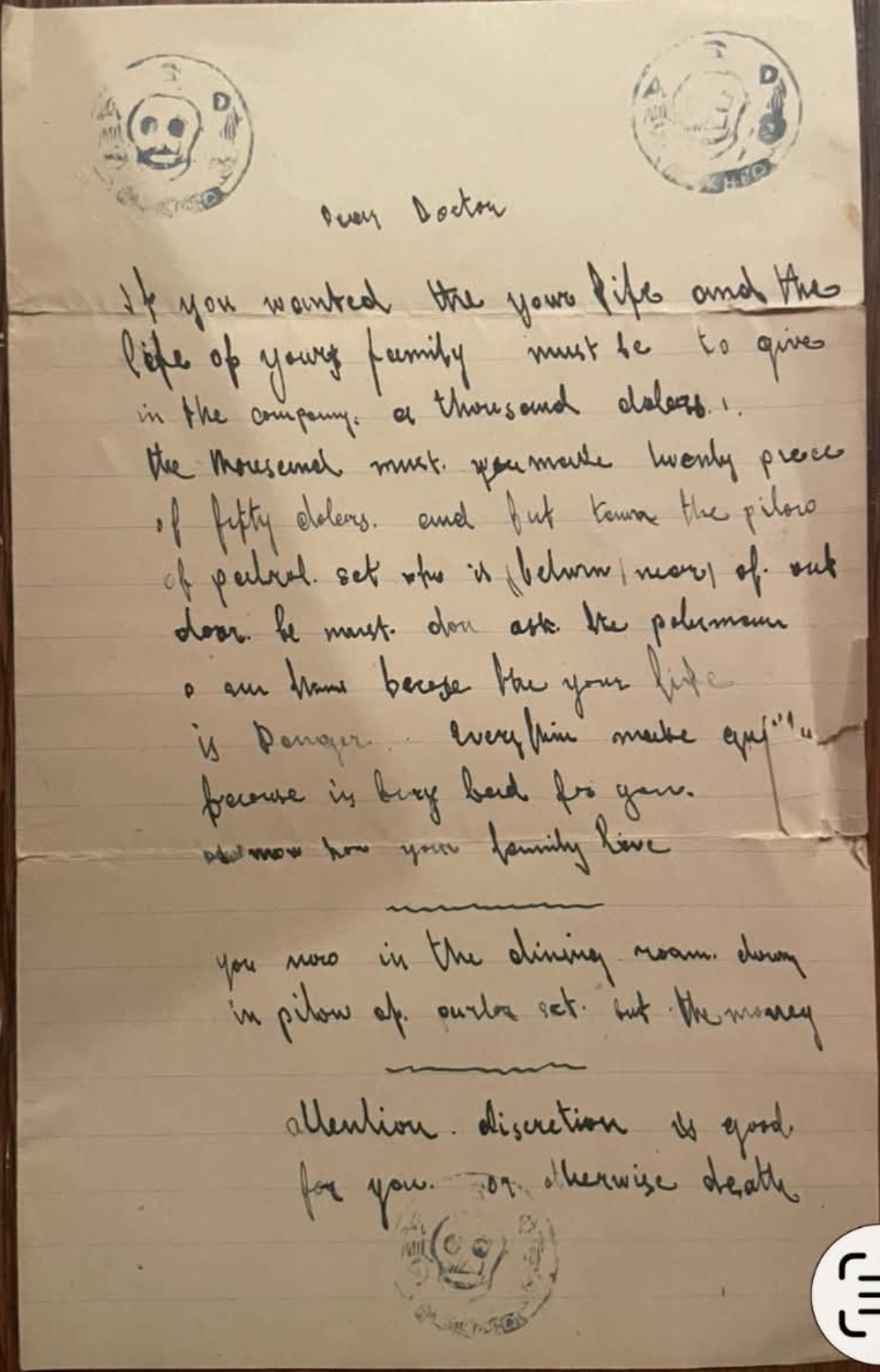
Someone tried to extort the family during one of the worst weeks of their decade. While the brothers Takis and John Lazare were actually safe in Greece — having forged passports of their own making and lied to the Greek consulate in NYC about being orphans — an opportunist in New York sent Lazaros and Eftyhia a ransom note demanding payment for the boys’ return. There were no boys to ransom; the brothers had already arrived in Greece by then. The note is a piece of the same week’s chaos: NYC newspaper notices, Greek-consulate correspondence, posters, and the thousand DeWitt Clinton High School students sweeping the city for boys who were no longer in it.
This piece of family documentary detail exists in the public record precisely because Aline retold the story to Alex in May 2026, and held on to a copy of the note in her own papers for the family.
Verbatim transcription
A single sheet of lined paper, handwritten in broken English. Two circular stamps or seals at the top corners (possibly skull motifs — see analysis below) and a third stamp at the bottom. Handwriting is faded; brackets indicate uncertain readings.
Dear Doctor
If you want[ed] the[?] your life and the life of your family must be to give in the company a thousand dolar[s].
The thousand must you make twenty pieces of fifty dolars and put down the pillow of parlor set who is [below?] mens of out door. Be must don[‘t] ask the policeman or [several illegible words] for your life is [in] Danger. Everything make easy [or “make easy in”] because [we’ll?] bring [him?] back for you. [Now / Don’t show?] [for?] your family love.
You must in the dining room down in pillow of [our?] set out the money.
Attention. Discretion is good for you, for otherwise death.
What the note tells us
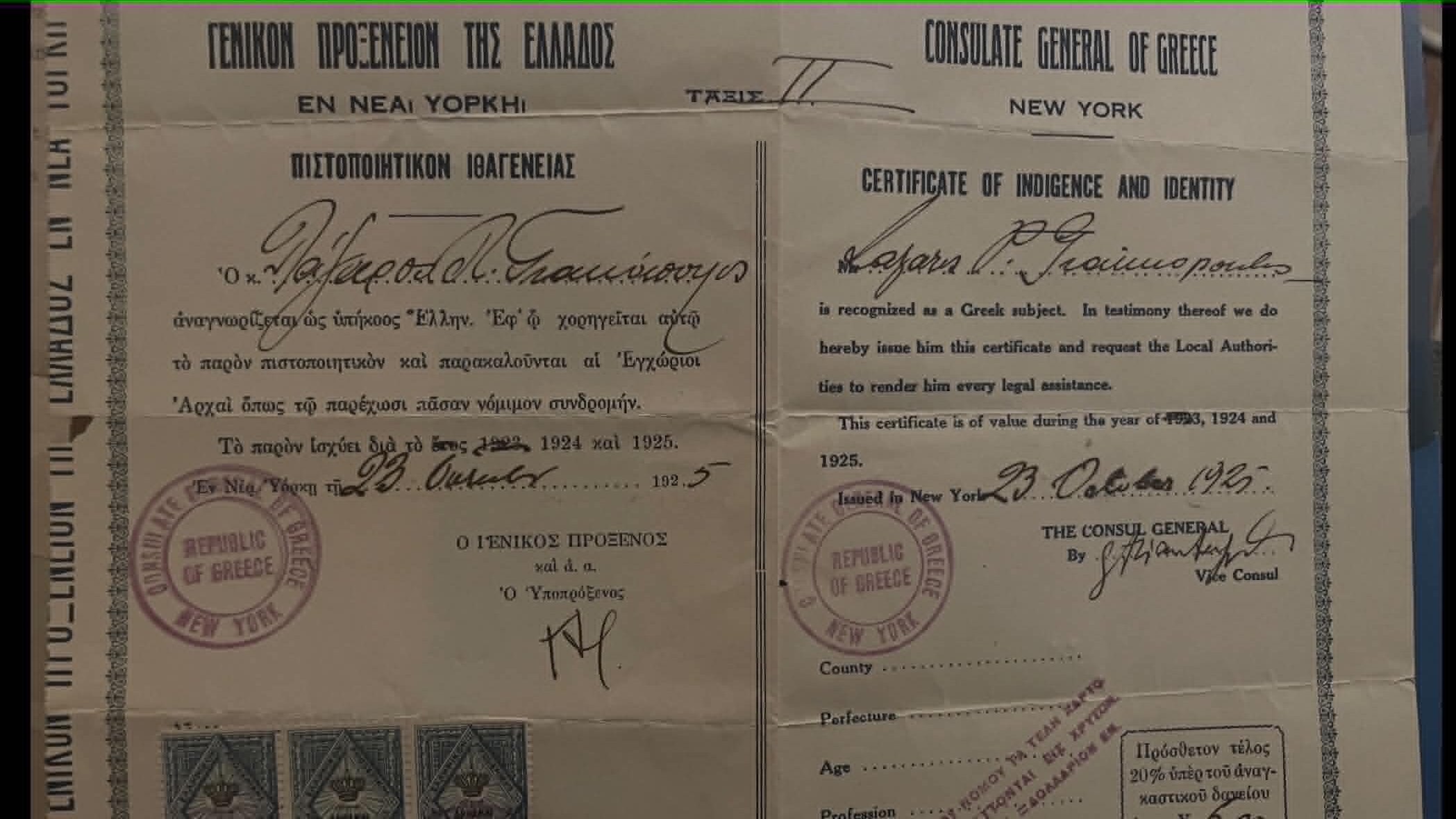
- Addressed “Dear Doctor” — the extortionist knew Lazaros’s profession. He was a practicing NYC physician (NY State medical license #574, issued 1925); his name and profession would have appeared on the October 11, 1925 missing-children appeal the family placed in the Daily News.
- Demand: $1,000 — paid as twenty bills of fifty dollars. In ~1925 dollars, $1,000 is roughly $17,000–$19,000 in 2026 purchasing power — a meaningful sum for a 1920s immigrant household, but within reach of a NYC-physician family. The “twenty pieces of fifty” specificity suggests the extortionist wanted bills small enough to be untraceable but large enough that the bundle would be compact and concealable.
- Drop location: inside the Jeannopoulos home — under “the pillow of parlor set” in the dining room. The extortionist asked the family to plant the money inside their own house, where it could be retrieved later — possibly by a domestic helper, a tradesman, or a planned break-in. This is the most striking clue in the note: the extortionist either knew the family’s home layout or expected to gain access to it. It is at least suggestive that the extortionist was someone in or near the household’s social circle.
- “Don’t ask the policeman” — explicit warning against involving NYPD. The family ignored it; Lazaros and Eftyhia called police and placed newspaper notices.
- Pretends to hold the boys — “because [we’ll] bring [him] back for you” — uses the missing-children news to extort. The extortionist almost certainly did not have the boys; Takis and John were already on a ship back to Greece by the time the note was written.
- Threat closure: “Attention. Discretion is good for you, for otherwise death” — explicit death threat.
- Broken English by a non-native speaker. Word order, dropped articles, “dolars” misspelling — consistent with an immigrant author. Could be Italian, Greek, or another early-20th-century NYC immigrant background.
The Black Hand parallel
The note’s whole format — broken English, death threats, specific cash demand, drop instructions, threatening seals stamped at top and bottom — closely matches the “Black Hand” (La Mano Nera) extortion racket that operated through immigrant New York from roughly 1900 to the mid-1920s. Black Hand letters were notorious for threatening symbols drawn or stamped on the paper — skulls, daggers, crossbones, hands — to communicate menace independent of literacy. The circular marks at the top and bottom of this note may well be skull stamps or similar Black Hand iconography.
A few things to understand about the Black Hand era:
- It targeted prosperous immigrants. Italian-Americans were the most common victims, but Greek, Polish, and other recent-immigrant professional and merchant families were extorted too. A practicing NYC physician with a public name and address — a “Dear Doctor” appearing in newspapers — was an archetypal mark.
- It was rarely a single organization. “Black Hand” was a style, not a syndicate. Established criminal groups used the letters, but so did amateur opportunists who copied the format. The 1925 missing-children press would have been a perfect trigger for an opportunist to send a follow-up extortion letter regardless of whether they knew anything about the case.
- It peaked around 1908–1915 and faded through the 1920s. Federal immigration restrictions, better NYPD investigative practice (the Italian Squad under Joe Petrosino, then later units), and the rise of organized bootlegging during Prohibition all drew criminal labor away from the small-time extortion business. By 1925 the Black Hand was in real decline — but copycat amateurs persisted, particularly in moments of public family crisis.
- It exploited the press. Black Hand operators read newspapers as carefully as anyone else. Family-tragedy notices — missing children, fires, deaths — would frequently be followed within days by an extortion letter playing on the public information. This Jeannopoulos note fits that pattern exactly: published appeal on October 11, opportunist letter to follow.
Whether this letter came from a real Black Hand operator or a copycat amateur, Lazaros’s response is telling: he didn’t pay; he called the police and placed newspaper notices anyway. A Greek immigrant physician working in NYC for one year by late 1925 would have known about the Black Hand racket through the immigrant-community grapevine. He recognized the letter for what it was. The extortion attempt failed.
Why the family kept the note
A century-plus survival of a single extortion letter in personal papers is unusual. Most threatened families either turned the note over to police or destroyed it. The Jeannopoulos household preserved this one — it crossed from Lazaros’s papers to Eftyhia’s, then through John Lazare’s archive to Aline, and now into the public record.
The most likely reason: the note belonged to a story the family wanted to keep. Lazaros’s calm refusal to be intimidated, set against the noisy disorder of his missing teenage sons and the chaos of immigrant NYC in 1925, is the kind of episode a family chooses to remember. The note is the physical artifact of a small triumph — a moment when the father stood his ground and the family held together.
Open questions
- Are the circular marks at top and bottom skull stamps (Black Hand–style) or some other symbol? A higher-resolution photo or in-person look would resolve this.
- Did NYPD investigate? A 1925 case file might survive in the New York City Municipal Archives.
- Was the extortionist ever caught? If the case was prosecuted, court records would name them.
- How was the note delivered — mailed to the home, slipped under the door, hand-delivered? The delivery mechanism would tell us something about how close to the household the extortionist was.
- Did Lazaros and Eftyhia ever learn who sent it? The fact that they kept the note for the rest of their lives — and that it passed down through three generations — suggests the story may have had an ending we don’t yet know.