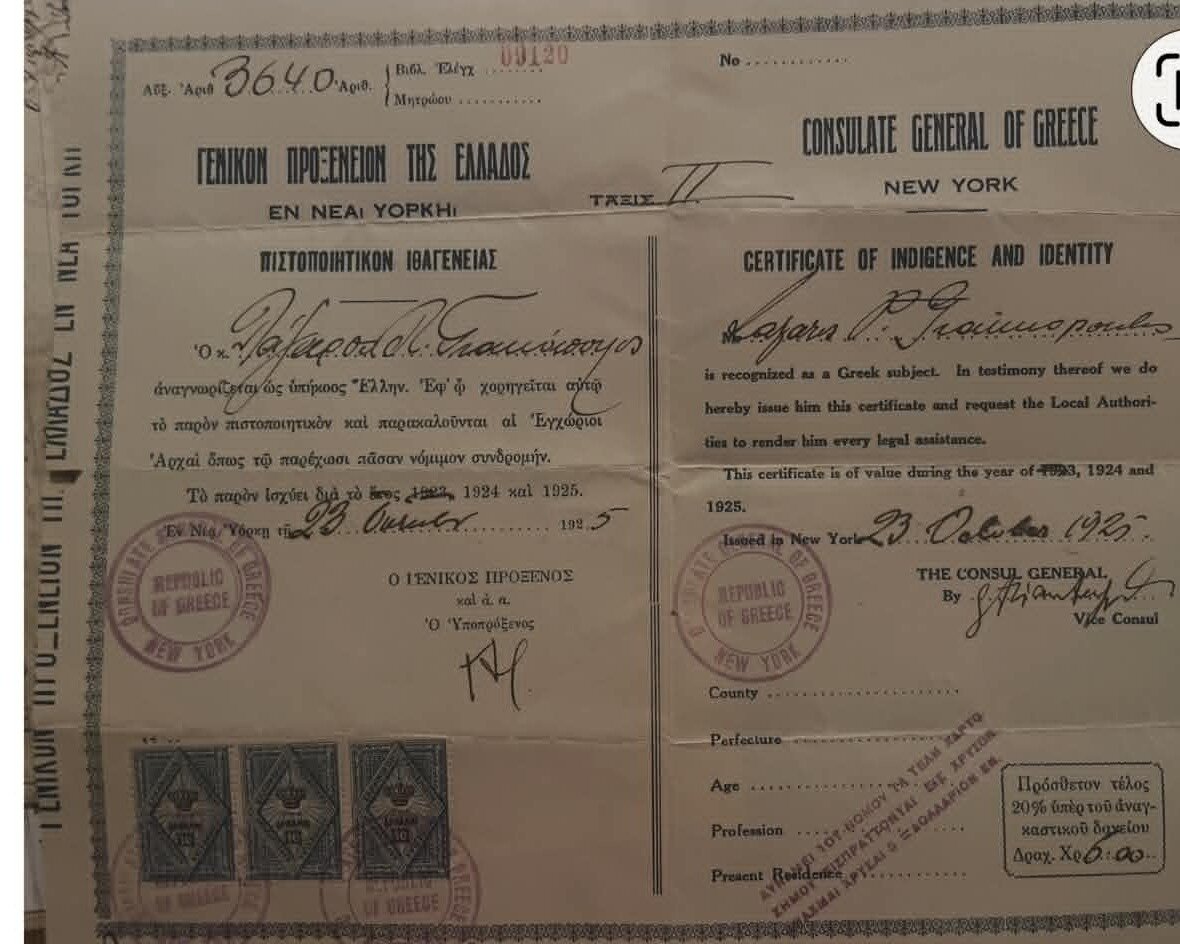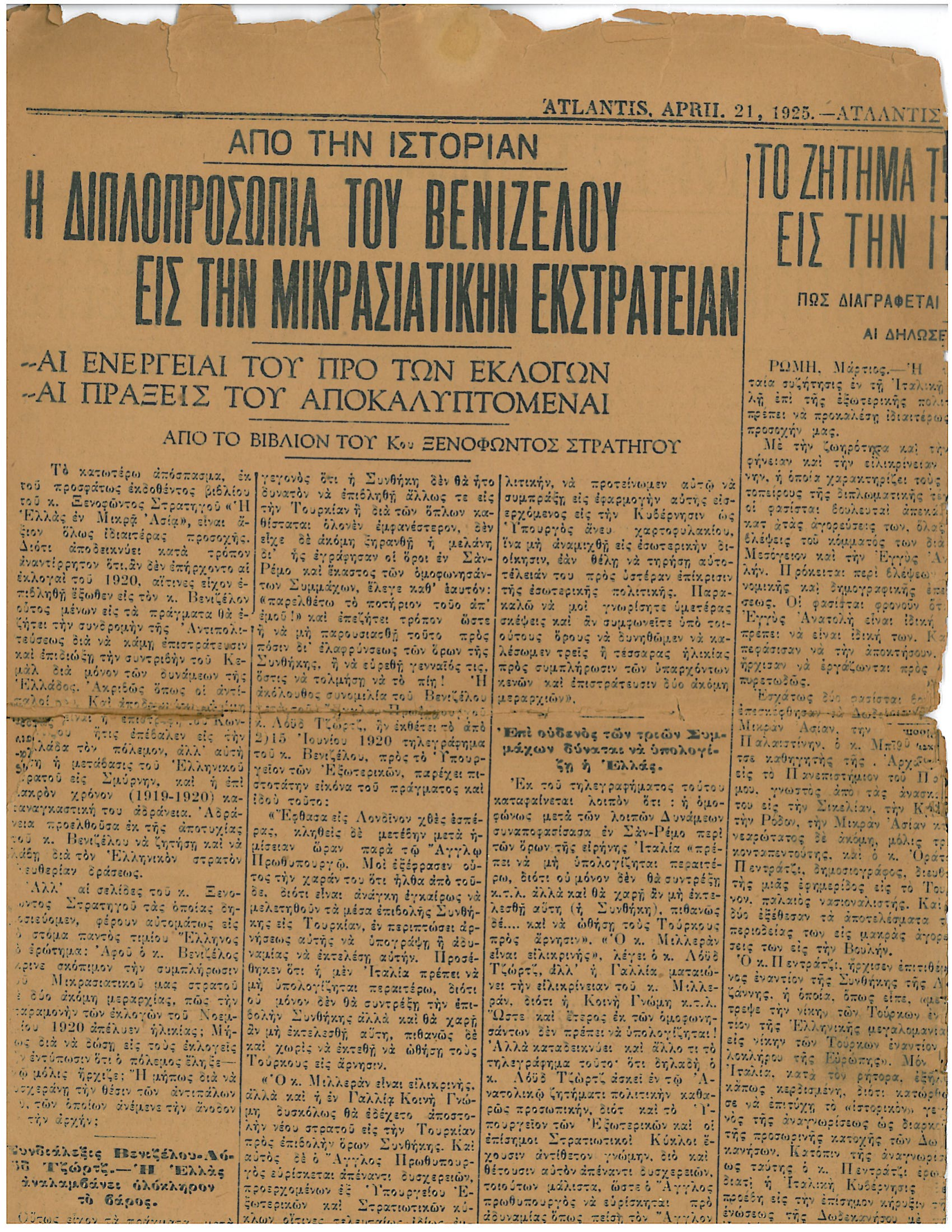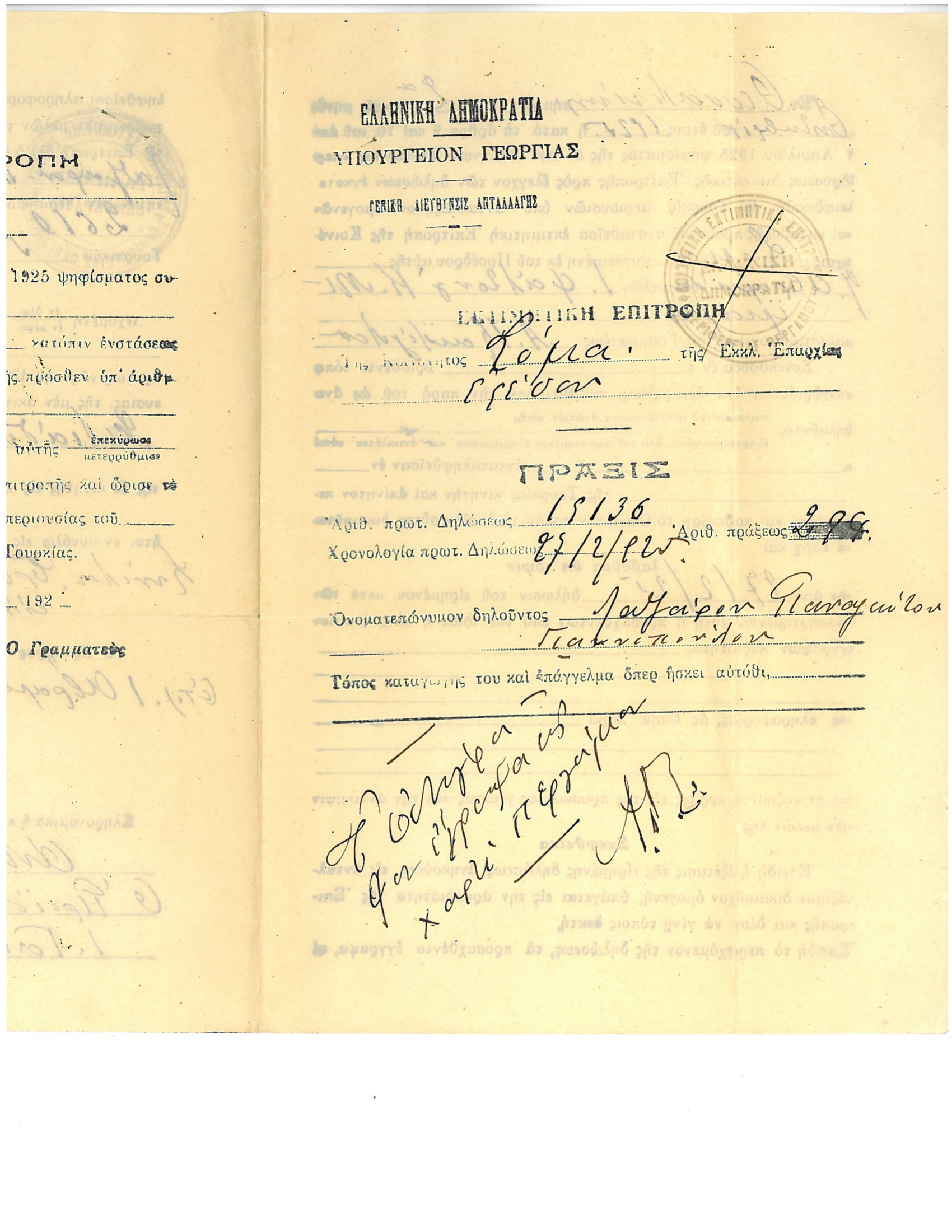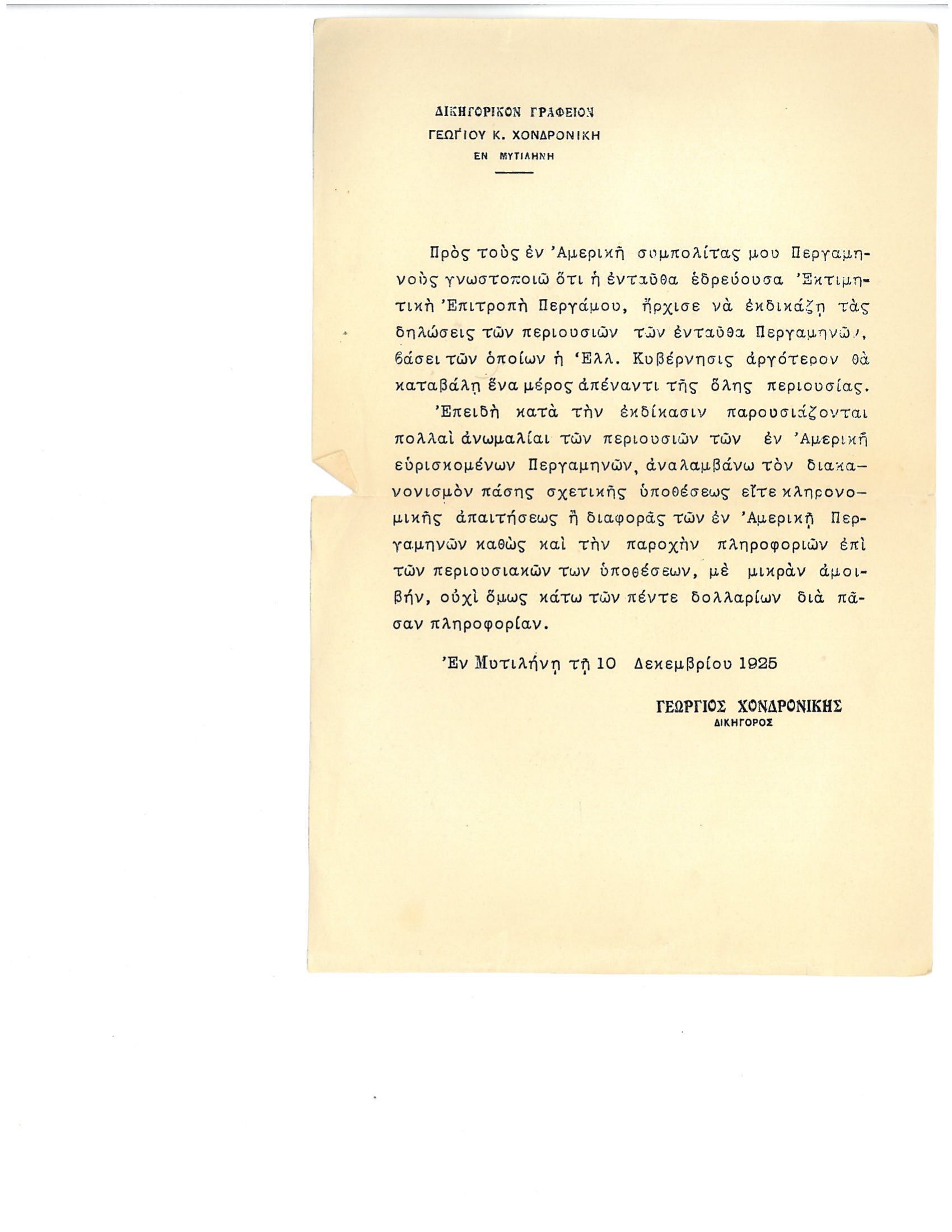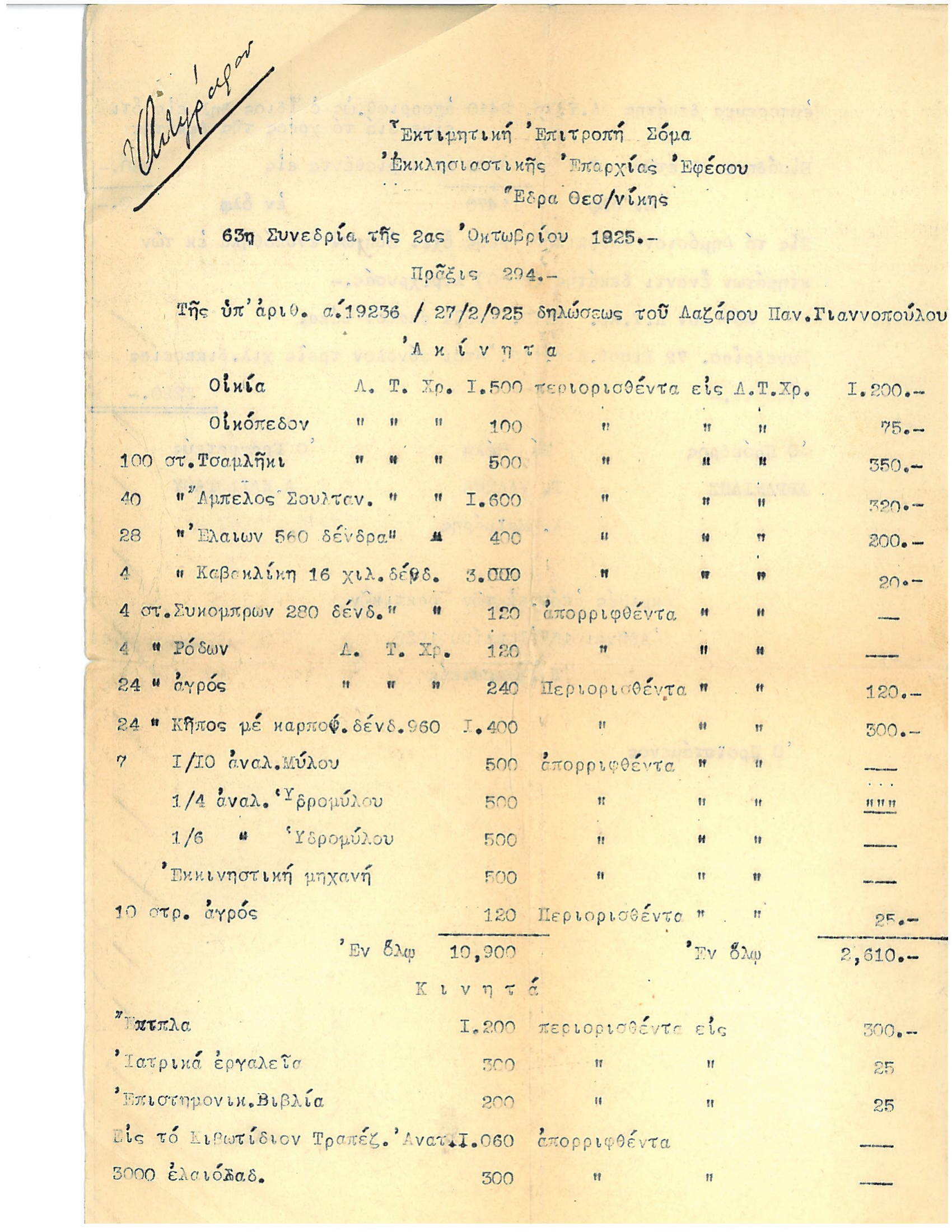
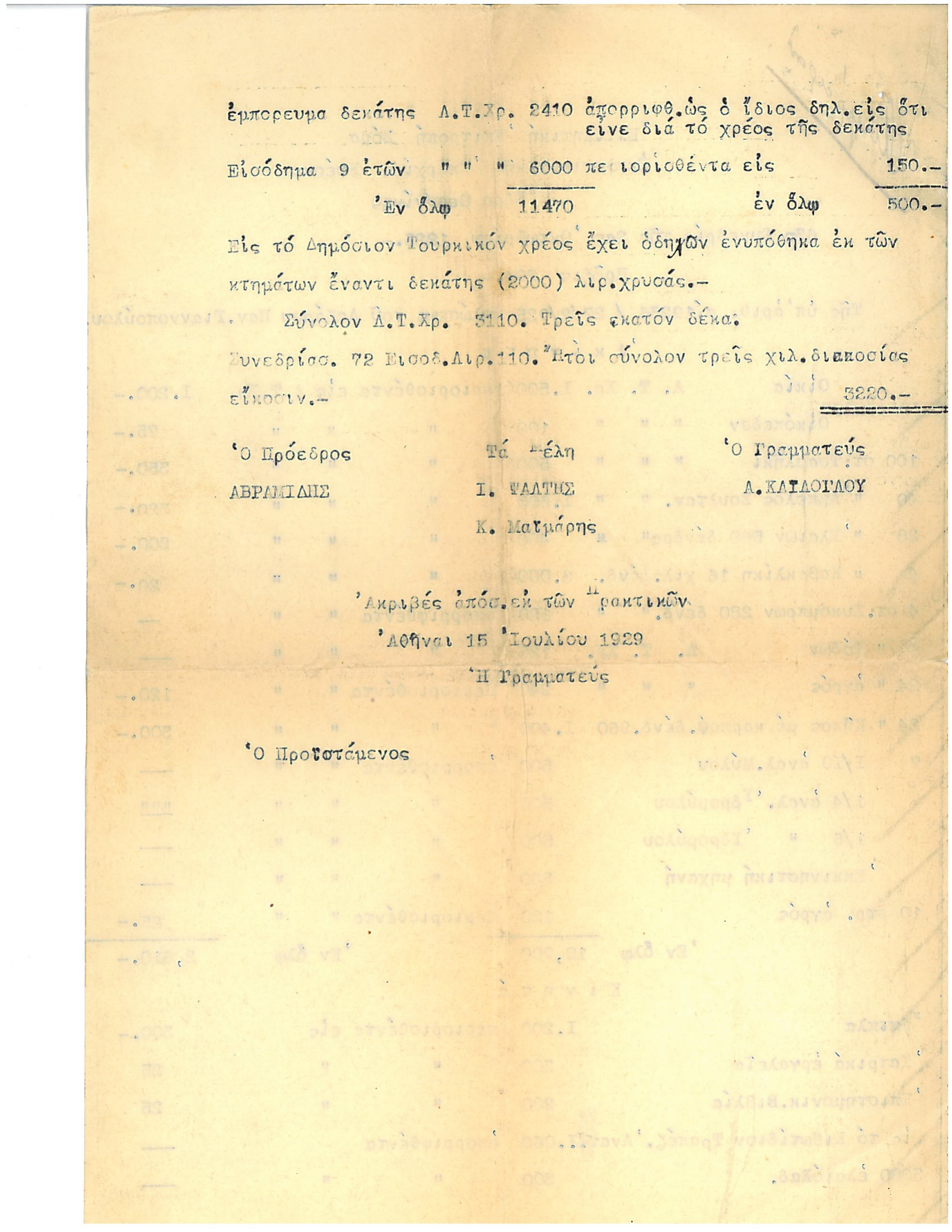
Twelve months after Lazaros filed his refugee-compensation declaration in February 1925, the Greek state’s Assessment Committee of Soma convened in Thessaloniki to itemize what he had lost in the catastrophe. The minutes of their 63rd Session — Act 294, October 2, 1925, dossier No. 19236 — are the most granular reconstruction of his abandoned Soma estate that survives anywhere in the archive. The certified true copy in this archive was issued in Athens on July 15, 1929.
The header identifies the committee’s institutional position: “Εκτιμητική Επιτροπή Σόμα — Εκκλησιαστικής Επαρχίας Εφέσου — Έδρα Θεσσαλονίκης” = “Assessment Committee of Soma — of the Ecclesiastical Province of Ephesus — Headquartered in Thessaloniki.”
The document is a detailed line-item declaration of Lazaros’s lost Soma estate — the granular reconstruction behind the 3,330-Turkish-gold-pound summary determination the committee reached.
What Lazaros lost in 1922
| Property | Original claim (gold lira) | Approved |
|---|---|---|
| House in Soma | 1,500 | 1,200 |
| Lot adjacent to house | 100 | 75 |
| 100 stremmata at Tsarliki | 500 | 350 |
| 40 stremmata Sultan vineyard | 1,600 | 320 |
| 28 stremmata olive grove (560 trees) | 400 | 200 |
| 4 stremmata Kavaklik (16,000 poplar/coppice trees) | 3,000 | 20 |
| 4 stremmata fig + mulberry (280 trees) | 120 | rejected |
| 4 stremmata roses | 120 | — |
| 24 stremmata field | 240 | 120 |
| 24 stremmata orchard (960 fruit trees) | 1,400 | 300 |
| 7/10 share of mill | 500 | rejected |
| 1/4 share of water mill | 500 | rejected |
| 1/6 share of water mill | 500 | — |
| Starter motor (engine) | 500 | — |
| 10 stremmata field | 120 | 25 |
| Furniture | 1,200 | 300 |
| Medical equipment | 300 | 25 |
| Scientific books | 200 | 25 |
| National Bank deposit box contents | 1,060 | rejected |
| 3,000 [units] olive oil | 300 | — |
The picture that emerges is of a prosperous regional physician’s estate: a town house in Soma; multiple farms across ~200 stremmata (about 50 acres) of mixed cultivation — olives, fig and mulberry orchards, rose fields, premium Sultan grape vineyards, poplar coppice for timber; partial shares in three different community water mills; medical practice equipment and a personal scientific library; substantial olive oil inventory; and a deposit box at the National Bank of Greece. The line items “starter motor” / “engine” point to a modern motorized installation (uncommon in early-1920s rural Anatolia) — possibly tied to one of the mills, possibly to his medical practice.
What the numbers translate to in today’s money
At the current price of gold, one 1925 Turkish gold lira (6.6 grams of pure gold) is worth roughly $700 in today’s money. That lets the table read in present-day terms:
- Lazaros’s original claim of ~14,000 lira — call it roughly $10 million in today’s gold-equivalent wealth
- The committee’s approved amount of ~3,330 lira — approximately $2.3 million today
The line items that took the heaviest cuts make a coherent story. The Kavaklik poplar coppice — Lazaros claimed 3,000 lira (~$2.1M today) for four stremmata holding 16,000 trees — was approved at 20 lira (~$14,000), less than one percent of the declaration; the committee evidently did not believe his stand count. The National Bank of Greece deposit box contents (1,060 lira / ~$740,000) were rejected outright. So were the fig-and-mulberry stand (120 lira / $84,000) and the mill shares. The committee paid most generously for the house itself — 1,500 lira claimed, 1,200 lira approved ($840,000 today) — and for the prime Tsarliki field, the olive grove, the orchard, and the furniture. Everything else came in at roughly 20–25 percent of declaration value. The catastrophe had cost the household, in today’s terms, somewhere between $2.3 million (the certified figure) and $10 million (Lazaros’s own count). Either way, the Greek state acknowledged a small fraction and moved on.
The committee members were the same network of Asia Minor Greek refugees who served on the parallel February 1925 general Refugee Compensation Committee: President Avramidis; Members I. Psaltis and K. Matmaris; Secretary A. Katsoglou.
What was supposed to happen — the 1920 Treaty of Sèvres
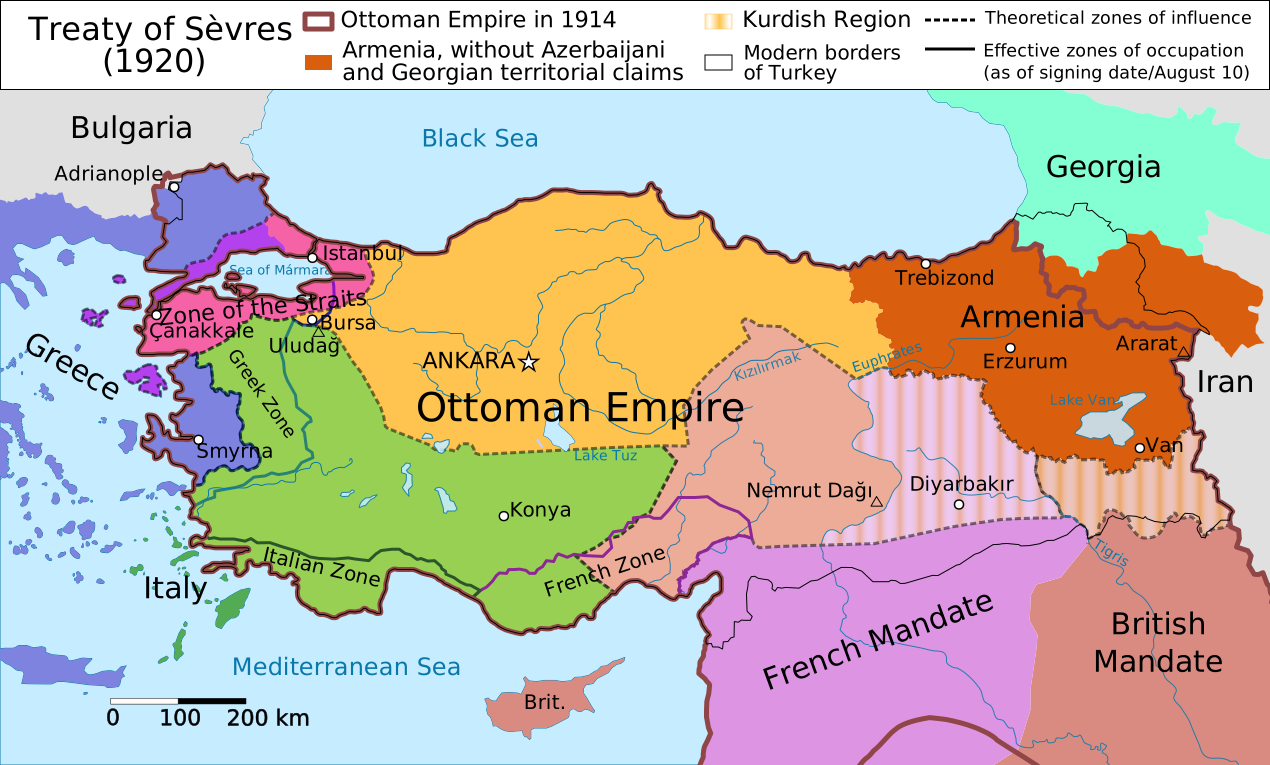
The Treaty of Sèvres, August 1920 — the post-WWI settlement that was meant to fix Greece’s Anatolian gains in international law. The Greek-administered Smyrna zone, which included Soma, was to operate under Greek civilian rule for five years before a plebiscite would decide its long-term status. The treaty never took effect: the war went the other way, Mustafa Kemal’s nationalist forces destroyed the framework on the ground, and the Treaty of Lausanne in July 1923 reversed everything. The 3,330-Turkish-gold-pound Soma estate this committee itemized — about $2.5 million in today’s money — was the personal price of that reversal.