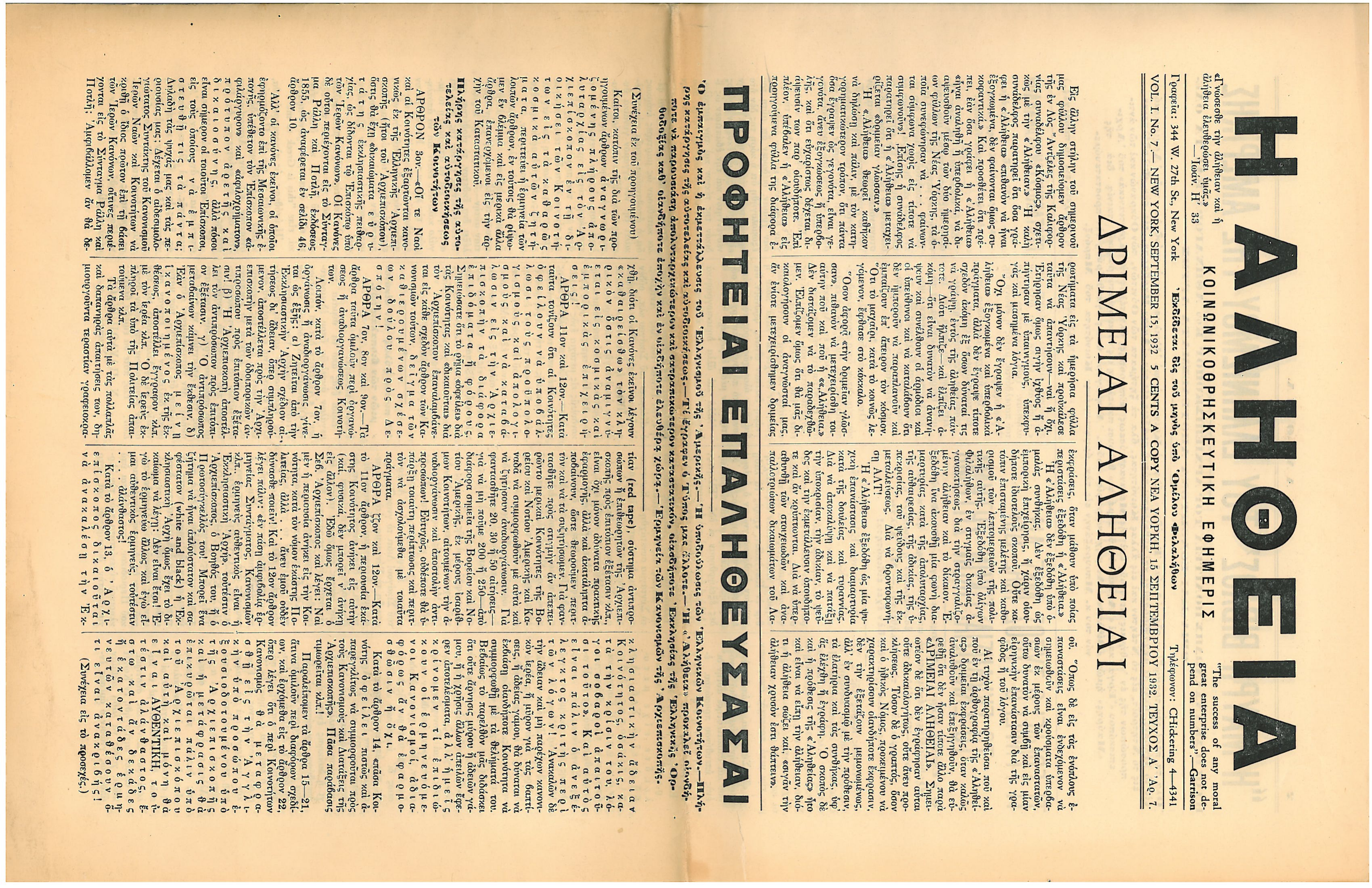
The front page of Η ΑΛΗΘΕΙΑ — ΚΟΙΝΩΝΙΚΟΘΡΗΣΚΕΥΤΙΚΗ ΕΦΗΜΕΡΙΣ — “Aletheia — Social-Religious Newspaper” — Volume I, Number 7, dated September 15, 1932, five cents a copy, edited and published at 344 West 27th Street in the Chelsea / Hell’s Kitchen corridor of Manhattan, where much of the Greek-American press of the era clustered. The same address would, fifteen months later, host the Aletheia Protocol founding charter of December 2, 1933. The masthead carries an epigraph from the abolitionist editor William Lloyd Garrison: “The success of any moral great enterprise does not depend on numbers.” It is exactly the kind of motto a small dissident religious newspaper would want on its forehead.
Why this single front page rewrites the Aletheia timeline
This issue carries the volume designation “VOL. I, No. 7” — meaning the newspaper had already published seven issues by September 15, 1932. At biweekly publication, Volume I Issue 1 would date to approximately mid-June 1932 — fully eighteen months before the December 2, 1933 Aletheia Protocol founding charter at Lazaros’s office.
The Protocol of December 1933 — long understood from the August 1935 Aletheia masthead salutation as the founding moment of Lazaros’s editorial vehicle — was therefore not the newspaper’s birth. It was a re-founding and organizational consolidation of an already-operating publication, twenty-four days after the Chicago Municipal Court arrest warrant against Archbishop Athenagoras Spyrou of November 8, 1933.
The earlier subtitle reveals an earlier political framing
The 1932 masthead subtitle reads ΚΟΙΝΩΝΙΚΟΘΡΗΣΚΕΥΤΙΚΗ ΕΦΗΜΕΡΙΣ (Social-Religious Newspaper) — a more centrist, ecumenical framing than the ΕΘΝΙΚΟΘΡΗΣΚΕΥΤΙΚΗ ΕΦΗΜΕΡΙΣ (National-Religious Newspaper) that the 1935 masthead carries. The early Aletheia was a social-religious reform organ advocating internal Greek-American clerical reorganization, not yet the dissident-faction newspaper it would become after the November 1933 Chicago incident.
The headlines
“ΔΡΙΜΕΙΑΙ ΕΠΑΠΕΙΛΗΣΕΙΣ ΟΥΣΙΑΣΑΙ” (Bitter Threats Are Being Realized)
“The persecution and behavior of ‘Greek America’ — Silence — Aletheia satisfies reply — joyful neo-patriotism, Liberty”
“ΠΡΟΦΗΤΕΙΑΙ ΕΠΑΛΗΘΕΥΣΑΙ” (Prophecies Fulfilled)
The lead column-headers carry the rhetorical register of the 1932-era Aletheia — heavy on prophetic-fulfillment framing, with William Lloyd Garrison’s abolitionist epigraph signaling the editorial line of moral-minority persistence against majority error. The vocabulary is religious, not yet purely ecclesiastical-political — consistent with the broader 1932 “Social-Religious” framing.
Revised Aletheia chronology
| Date | Event | Source |
|---|---|---|
| ~mid-June 1932 | Aletheia Vol I No 1 first publishes (inferred from biweekly cadence) | implied |
| September 15, 1932 | ★ Aletheia Vol I No 7 — this issue | this document |
| 1932–1933 | Editorial position framed as “Social-Religious” reform within the Archdiocese; Lazaros’s Bronx parish (Saints Constantine and Helen) initially aligned with Archbishop Athenagoras’s Archdiocese against the rival Zoodochos Pege parish | archdiocese letter Aug 1933 |
| November 1, 1933 | Athenagoras allegedly assaults Archimandrite Kontogeorgos in Chicago | (referenced in 1933 Chicago filing) |
| November 8, 1933 | Chicago Municipal Court arrest warrant against Athenagoras with $1,000 cash bond | court document |
| December 2, 1933 | Aletheia PROTOCOL re-founding — organizational charter at Lazaros’s office (subtitle remained “Social-Religious” until later) | charter document |
| December 11, 1933 | Palm Garden NYC anti-Athenagoras rally | (1933 NYC press) |
| August 1935 | Aletheia subtitle now “National-Religious” — masthead salutation addresses Lazaros as “Director” — full dissident-faction posture | newspaper front page |
What this implies about Lazaros’s pre-1933 editorial role
If Aletheia was publishing from mid-1932 at 344 W. 27th Street — the same office address that hosted the Protocol founding — Lazaros was almost certainly already in editorial leadership at that point. The 1933 Protocol formally enrolled four clerical co-signatories (Kontogeorgos, Stamos, Leventis, Vassardakis), but the editorial-office continuity suggests Lazaros was running Aletheia as an early-1932 “Social-Religious reform” publication that shifted register and political posture when the Chicago arrest warrant against the Archbishop changed the available organizational terrain in November 1933.
In other words: the 1933 Protocol re-founding was not the start of Lazaros’s newspaper career. It was the moment Lazaros’s existing newspaper, in response to the Chicago incident, pivoted from social-religious reform to dissident-faction politics — gathering canonical clerical co-signatories to the editorial line in the process.