A full-length Greek-language book written by Lazaros himself and printed in New York in 1926 by American-Greek Publishing Co. at the Divry establishments (Τύποις Καταστημάτων Divry) — the major Greek-American printing house of the period, located in the same Chelsea / Midtown Manhattan corridor where Lazaros lived and practiced. The book is his second published work, eleven years and an ocean removed from his 1915 Athens National Tragedy — and the two together form a bracket around the Asia Minor catastrophe: the 1915 book the prelude written from Athens exile, the 1926 book the postmortem written from US exile.
It was reissued in a 2025 modern Greek edition by Ελληνική Πρωτοπορία (Hellenic Vanguard), ISBN 978-618-5383-63-3 — a hundred years on, in print and acquirable.
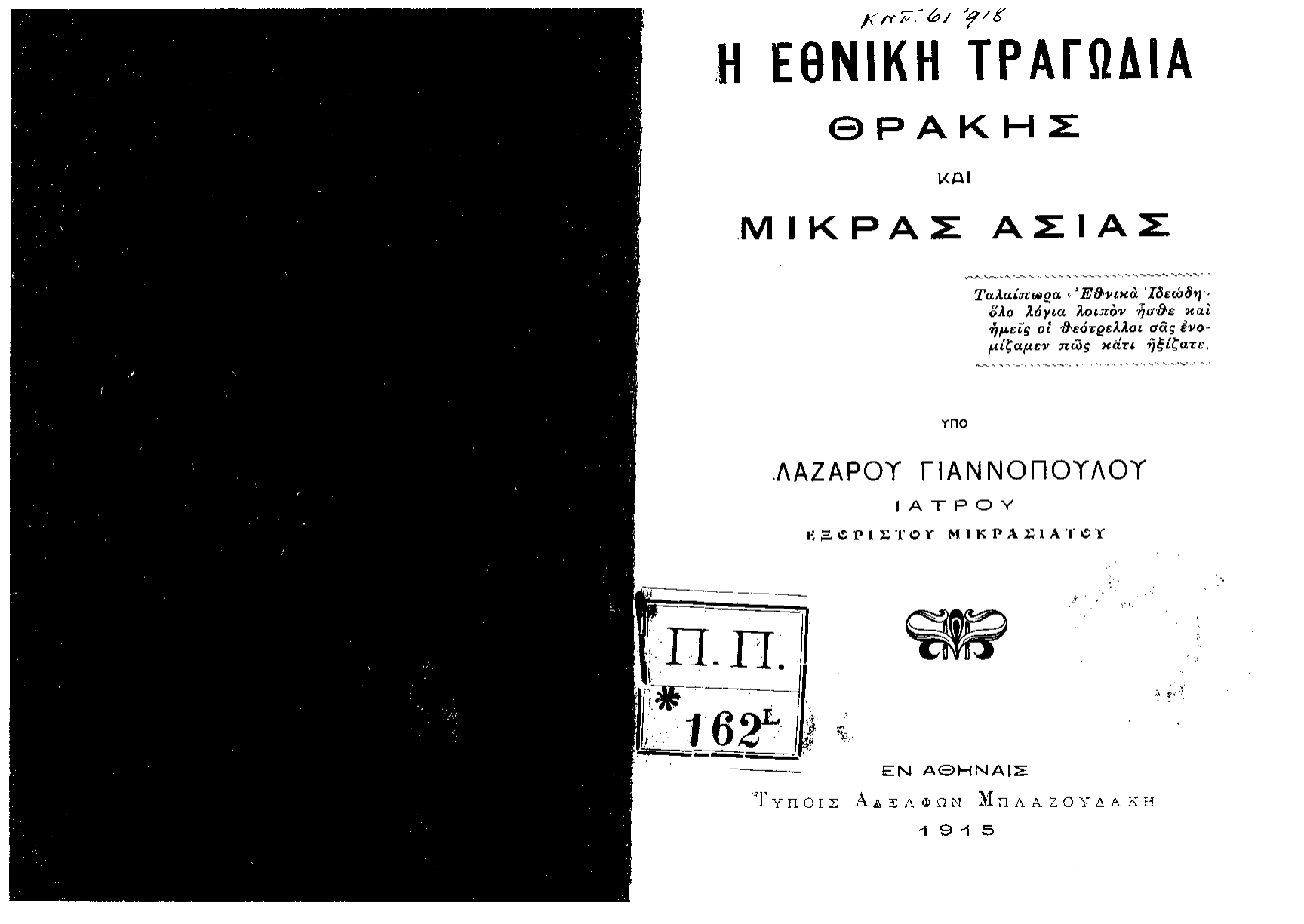
Title page
— Η — ‘ΚΡΥΜΜΕΝΗ ΑΛΗΘΕΙΑ’
Η
ΤΑ ΠΑΡΑΣΚΗΝΙΑ ΤΟΥ ΜΕΓΑΛΟΥ ΜΙΚΡΑΣΙΑΤΙΚΟΥ ΔΡΑΜΑΤΟΣ
(Epigraph from Andreas Laskaratos: “Truth in the chest of one who dares not tell it is like money in a chest one dares not spend it. Both truth and money are of no use unless they are spread and spent.”)
ΥΠΟ ΛΑΖΑΡΟΥ Π. ΓΙΑΝΝΟΠΟΥΛΟΥ, ΙΑΤΡΟΥ ΕΚ ΣΟΜΑ ΤΗΣ ΜΙΚΡΑΣ ΑΣΙΑΣ
ΕΚΔΟΤΑΙ: AMERICAN-GREEK PUBLISHING CO. ΤΥΠΟΙΣ ΚΑΤΑΣΤΗΜΑΤΩΝ DIVRY ΕΝ ΝΕΑ ΥΟΡΚΗ 1926
In translation:
THE HIDDEN TRUTH — or — THE BACKSTAGE OF THE GREAT ASIA-MINOR DRAMA
By LAZAROS P. GIANNOPOULOS, PHYSICIAN, FROM SOMA OF ASIA MINOR
Publishers: American-Greek Publishing Co. — Printed at the Divry establishments — In New York — 1926.
What the title page establishes
-
Surname Γιαννόπουλος (Yannopoulos) — same Demotic spelling Lazaros chose for his 1915 National Tragedy, now carried forward to his 1926 American imprint. By the time he is publishing in New York he has settled on this transliteration consistently across his Greek-language work, even as his US official records carry the Latin-script Jeannopoulos.
-
“Ιατρού” — Physician. Same medical credential, eleven years on. By 1926 the credential is no longer hypothetical: he had passed the New York State medical exam in 1925 and was practicing in Manhattan from offices on West 25th and West 27th Streets.
-
“Εκ Σόμα της Μικράς Ασίας” — From Soma of Asia Minor. Where the 1915 title page named him “Εξορίστου Μικρασιάτου” (Exiled Asia-Minor-Greek), the 1926 title page pins him by place of origin, not by exile status. By 1926 the exile is no longer a contested term — Asia Minor is gone, the catastrophe is complete, and identifying with Soma specifically is the only Anatolian Greek identification left to him. His authorial signature on this book is “the man from Soma.”
-
American-Greek Publishing Co., printed at Divry establishments, New York. The Divry house was the major Greek-American press of the era, located in Midtown Manhattan. Lazaros published this book in the same corridor where he was practicing medicine, organizing the Bronx parish, and (within a few years) would be running Aletheia. The 1926 book is in continuity with the Aletheia directorship that followed in 1932 — same writer, same printing community, same political analysis, expanded across a decade.
Author portrait — page two
The second page of the surviving spread is a studio photograph of Lazaros — the earliest published portrait of him in any preserved source. He sits in a chair in a three-piece suit, one arm resting on the chair back, the other in his lap; he looks straight at the camera with a guarded, formal composure that fits the tone of the title page. Beneath the photograph, a polytonic Greek caption:
“Ἐπικατάρατος οἱοσδήποτε ἤθελε προσφέρει ἔστω καὶ ἕνα λόγον ἐπιεικείας διὰ τοὺς ἐργάτας καὶ προδότας τῆς Μικρᾶς Ἀσίας.”
“Cursed be any who would offer even one word of leniency for the workers-of-ruin and traitors of Asia Minor.”
— Λ. Π. ΓΙΑΝΝΟΠΟΥΛΟΣ, Ἰατρός
This is not a generic dedication. It establishes the book’s register — J’accuse, not memoir — and names the targets the body of the book is about to enumerate: Greek political figures whom Lazaros holds responsible for the catastrophe of 1922, named as traitors.
Preface — the bipartite refusal
The book’s opening foreword (reproduced in the 2025 publisher’s catalog) sets the analytical frame:
“And now, the reader will not see in my present study any service to the Party, nor hymns and incense to the ‘Father of the Nation’ and the ‘Savior of the Homeland,’ nor curses and anathemas for the ‘traitor King.’ He will see simply only one truth, carefully hidden by Partisanship — and that truth is: that Partisanship was the destruction of our Homeland, that we, the refugees, ourselves nurtured and raised this disastrous Partisanship to our own destruction, and that only when, as one body and brothers with the free Greeks, we free ourselves from the claws of Partisanship, then only can we save ourselves as human beings, and then only can we compel the State to execute its obligations to the Refugees as undertaken under international treaty.”
This is not an “anti-Venizelist” book in the conventional sense. The Greek Εθνικός Διχασμός (National Schism) split Greece between Venizelist supporters of an Entente-aligned republican project (who called Venizelos “Father of the Nation” and King Constantine “the traitor King”) and royalists who held the reverse. Lazaros refuses both sides simultaneously. The catastrophe of 1922 was caused not by Venizelos or by Constantine specifically, but by the partisan warfare itself — the institution of factional politics that had eaten the Greek state from inside. And the refugees, Lazaros writes, were not innocent victims of this partisanship — they had nurtured and fed it themselves, to their own ruin.
That position would carry forward unchanged into his 1933 Aletheia writing against Archbishop Athenagoras — Athenagoras was Venizelos’s pick for Archbishop of America, and Aletheia opposed both the appointing power and the appointee on the same anti-partisan grounds the 1926 book had laid out seven years earlier.
The author bio — political CV consolidated
The 2025 reissue’s publisher catalog reproduces a complete biographical paragraph that is itself a major source for Lazaros’s political career. It anchors dates and offices that prior records had only fragments of:
Lazaros Yiannopoulos was a physician from Soma, in Asia Minor. He was elected representative of the province of Ephesus to the National Assembly convened by the Patriarchates in September 1910. In 1915 he was elected representative of the Asia Minor Refugees to the Greek Government for the Asia Minor Struggle. He was co-founder of the Pan-Asia Minor Union in Mytilene (1915), which aimed to support the demands of Asia Minor refugees and the formation of a voluntary military corps for participation in the war with the side of the Entente. He resigned and withdrew with many of their unanimous representatives from the Pan-Asia Minor Union, protesting for “the savagely obligatory recruitment of Refugees” from Eleftherios Venizelos and the use of these Greek volunteers, who formed the core of the so-called National Defense Movement of Thessaloniki, to conduct a guerrilla against the “State of Athens”. Later, he assisted the establishment of Asia Minor Defense as President of the organization in his region. With the prevalence of the Plastiras-Gonatas-Pangalos dictatorship in 1922 and the re-occupation of the principle by Eleftherios Venizelos, Lazaros Giannopoulos fled to the United States of America, where he published the book in hand.
That paragraph is the cleanest single-source biography of Lazaros’s pre-1924 political career. Three things it adds to the prior record:
-
The Patriarchal Ethnosyneleusi role is date-anchored to September 1910 — the National Assembly convened by the Ecumenical Patriarchate to address Greek-Orthodox affairs under the post-Young-Turk-Revolution Ottoman regime. Lazaros sat as the lay representative from the Diocese of Ephesus, the senior delegate-rank in the Patriarchate’s governing body.
-
The Pan-Asia Minor Union (Παμμικρασιατική Ένωσις) of Mytilene, 1915, with Lazaros as co-founder — a new institutional role, distinct from his later Asia Minor Defense presidency. The Pan-Asia Minor Union’s aim was to combine refugee advocacy with the formation of a volunteer military corps that would fight on the side of the Entente. Lazaros walked out of the organization within months, in protest of Venizelos’s “savagely obligatory recruitment” of refugees who were being conscripted into what would become the core of the Venizelist National Defense Movement of Thessaloniki — a guerrilla force directed against the royalist Athens state. This is the documentary anchor for his anti-Venizelist politics for the next two decades.
-
The 1922 US flight has a second proximate cause: not only the Asia Minor catastrophe, but the contemporary Greek-mainland coup. The Plastiras-Gonatas-Pangalos dictatorship of September 1922, with its trial and execution of six royalist ministers, brought Venizelos back to power within months — making mainland Greece itself politically dangerous for a known anti-Venizelist with a published 1915 critique. The United States was a refuge from both the Turkish expulsion and the Greek republican state. It is also why he never returned: there was no Greek government in his lifetime that he was willing to live under.
Where the original book lives
The 1926 original is held in the family archive as a two-page scanned spread covering the title page and the author-portrait page. The full text is not present in our archive — it must be obtained from the 2025 Ελληνική Πρωτοπορία reissue (order here) or from Greek national-library holdings of the 1926 American-Greek Publishing Co. imprint.
Why this book is important to the family record
The 1915 book and the 1926 book together place Lazaros in a category of his own among the family ancestors: a man who wrote down what he saw, twice, in his own voice, in his own language, under his own credentials, in two of the most consequential Greek-diaspora cities of the twentieth century — Athens 1915 and New York 1926. The 1915 book established that he was already an exile years before the catastrophe. The 1926 book establishes that he had a complete political analysis of why the catastrophe had happened — and that he held it consistently for the rest of his life, through the Aletheia years, through the Bronx parish fight, to his death in 1939. It is the kind of intellectual continuity that turns an ancestor on a tree into a person on a record.