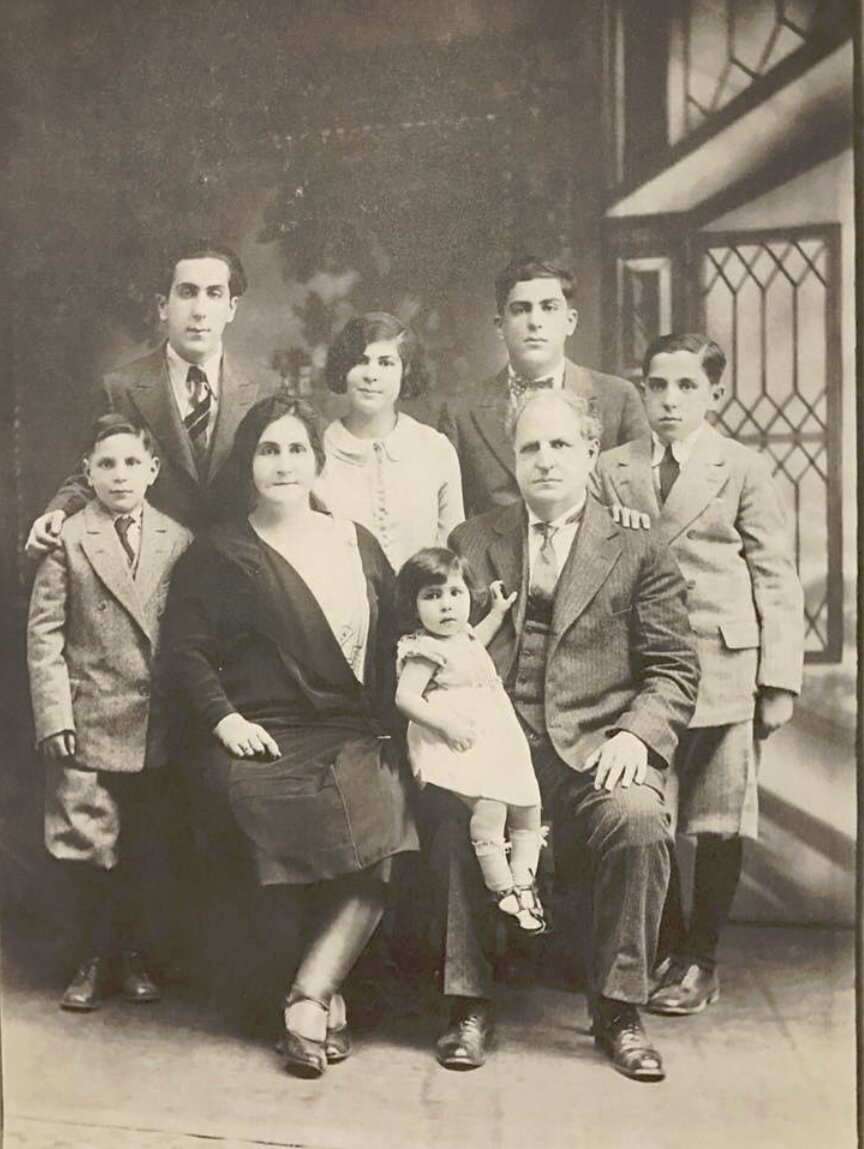
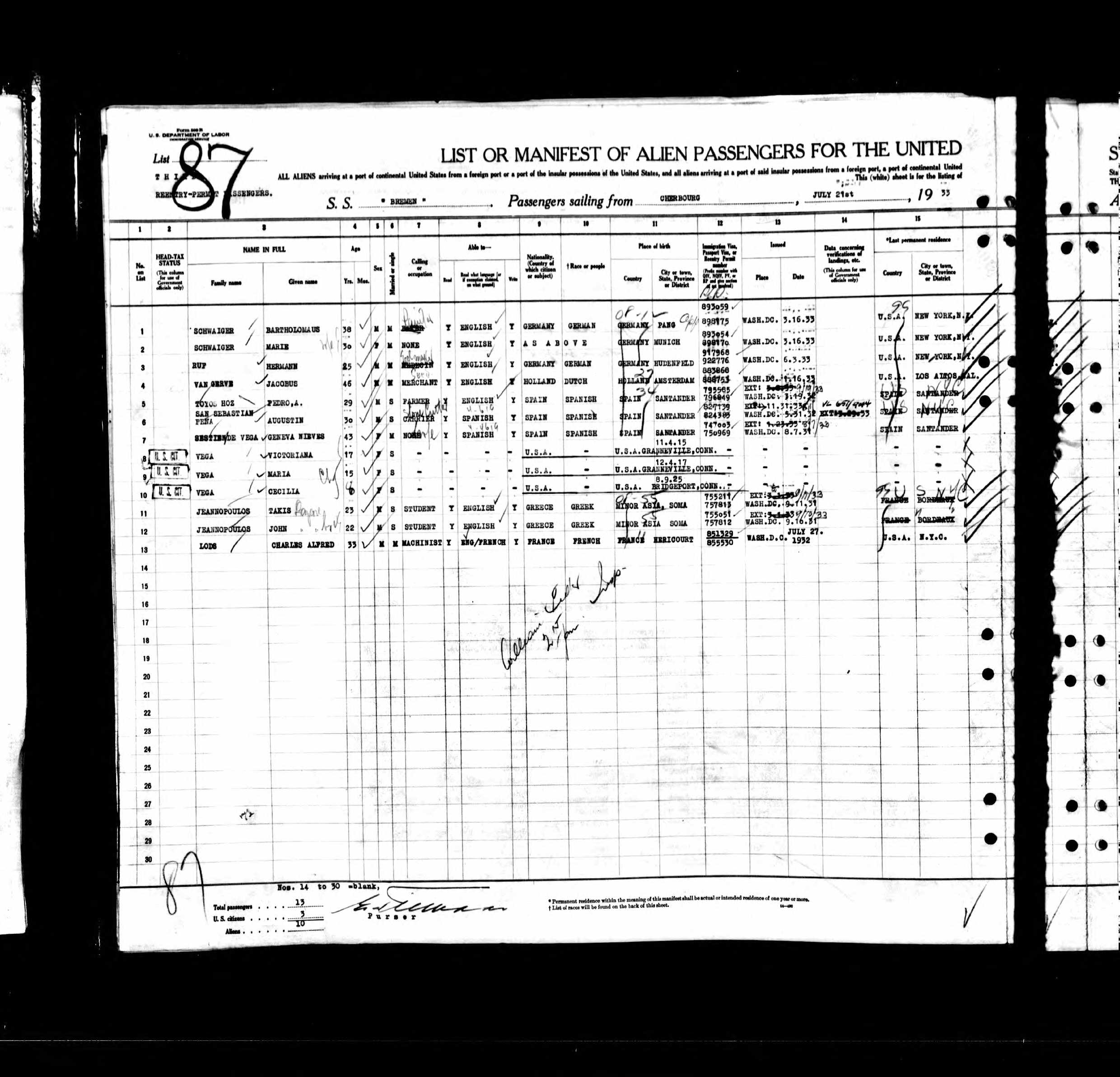
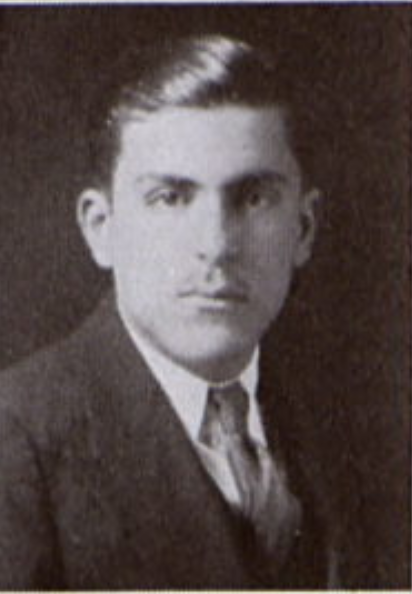
 John Lazare in a 1931 yearbook portrait — age 20. The same styling as his brother Takis’s University of Florida 1931 portrait raises an open question about whether John also attended UF in the early 1930s.
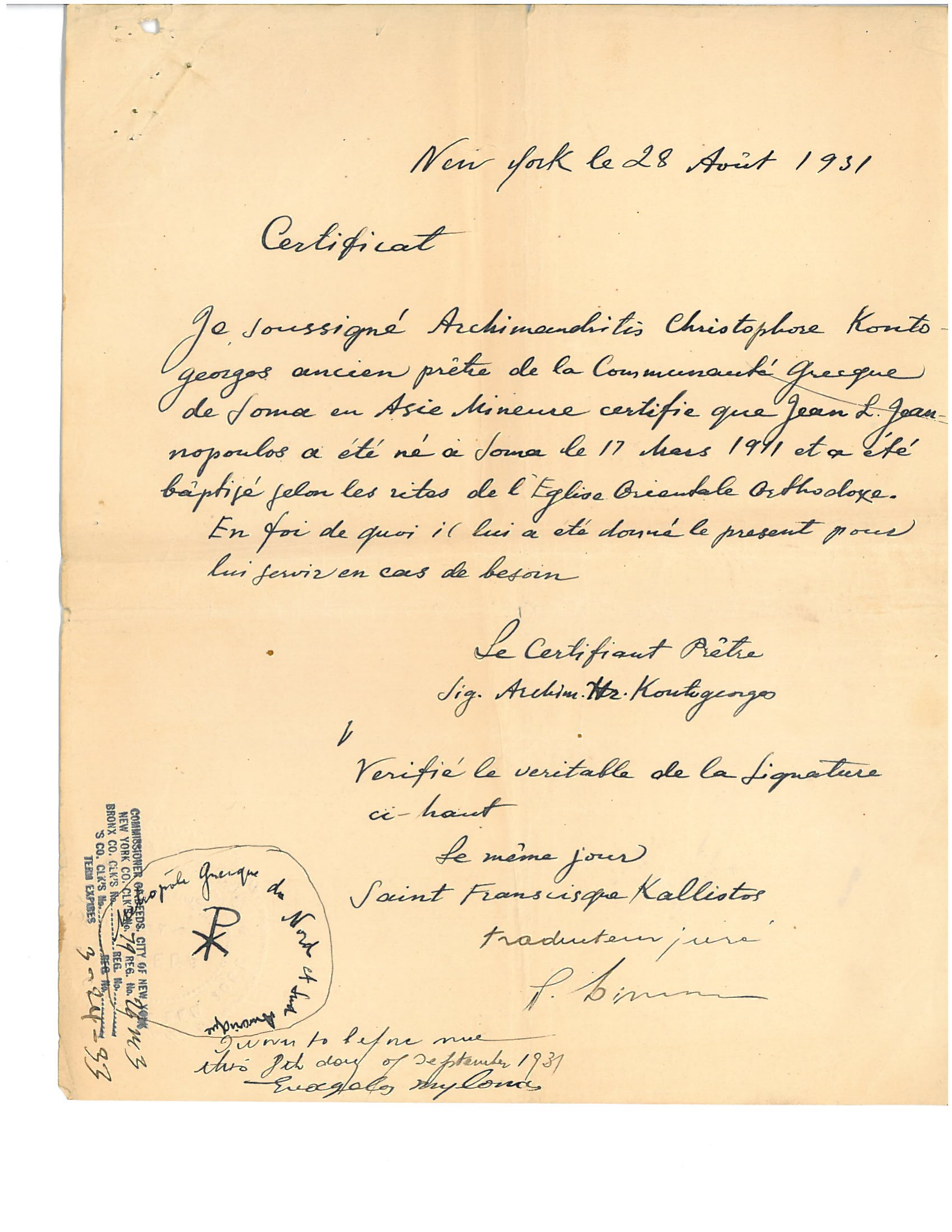
John Lazare was supposed to be born in 1913 — that, anyway, is what every American record says. His daughter Aline, in May 2026, set the family record straight: he was actually born March 17, 1911, in Soma. His mother Eftyhia altered the year by two on every US document so that he wouldn’t be conscripted into a military either Ottoman or Greek. The lie held for ninety years.
The primary-source confirmation came from a 1931 New York City certificate issued by Archimandrite Christophore Kontogeorgos, the former parish priest of the Greek Community of Soma — himself by then a diaspora cleric in NYC. The Archimandrite had had access to the original Soma baptismal register before the 1922 catastrophe destroyed it; his sworn certificate, translated by Saint Francisque Kallistos and notarized by NYC Commissioner of Deeds Evagelos Kylsanee on September 9, 1931, is the contemporaneous record. (Aline’s family-memory date of March 15 was off by two days from the priest’s affidavit.)
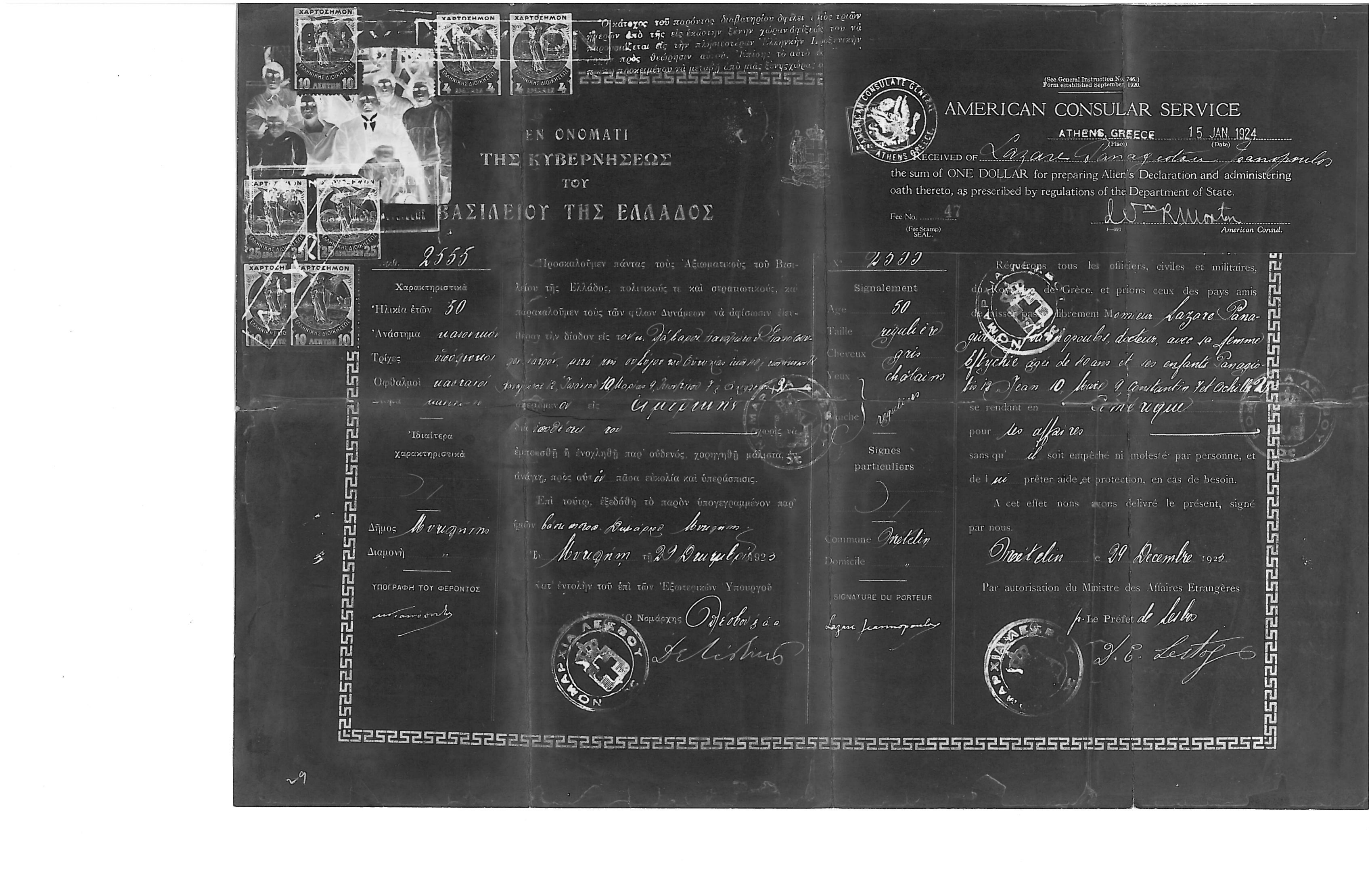
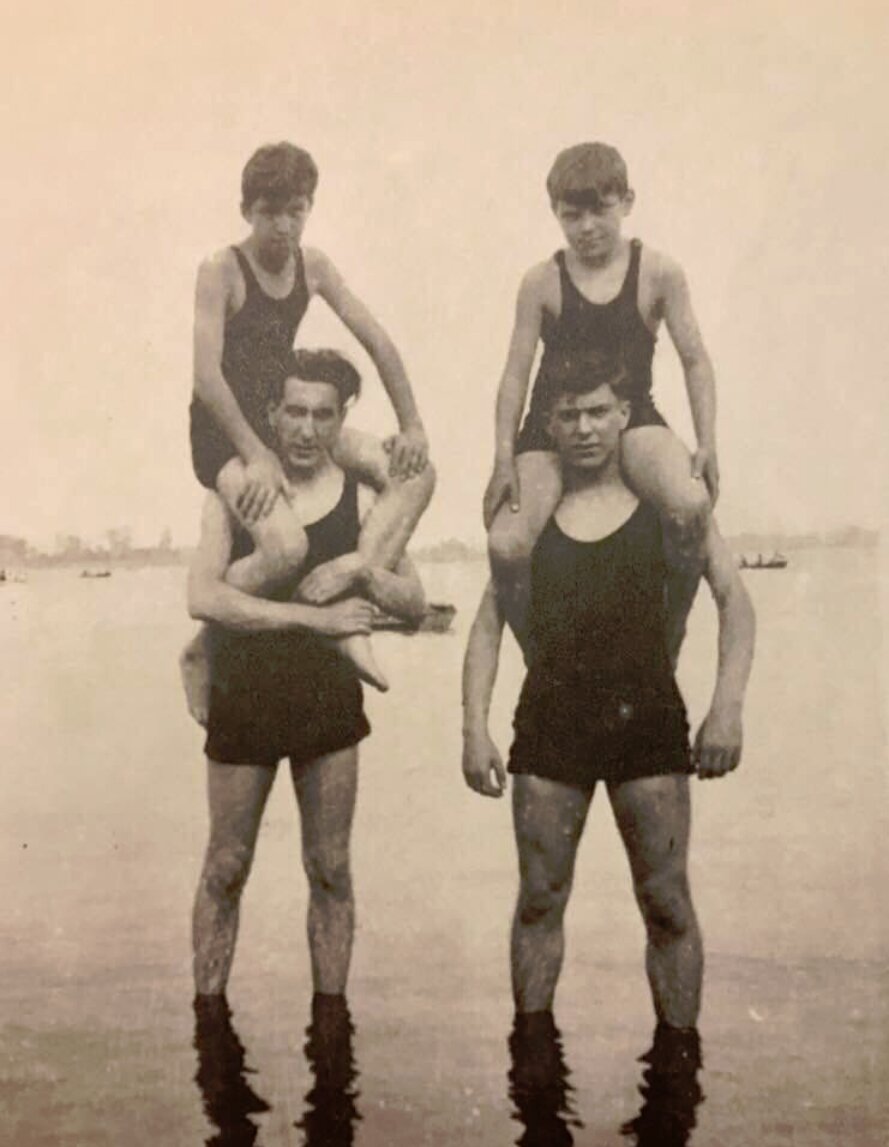
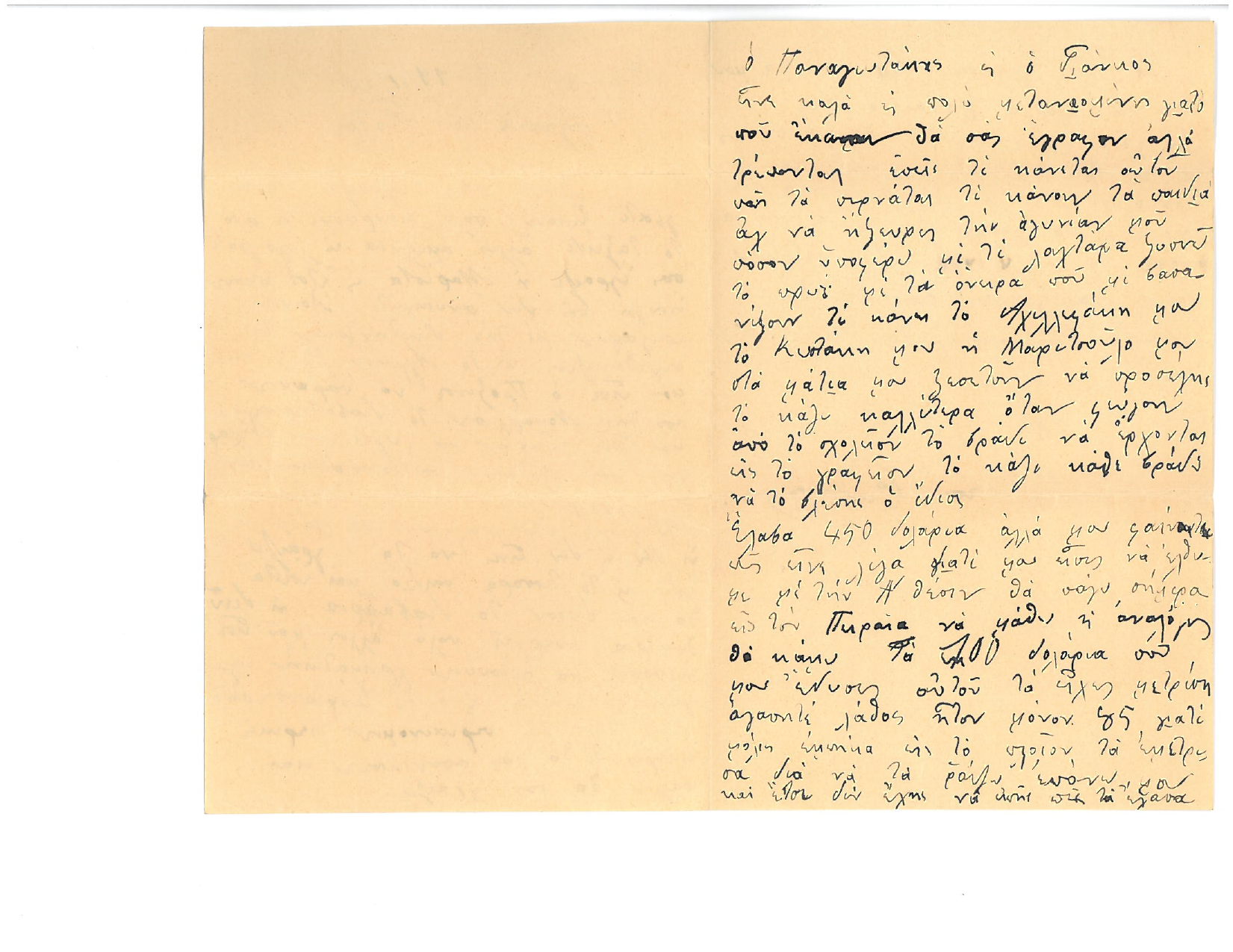
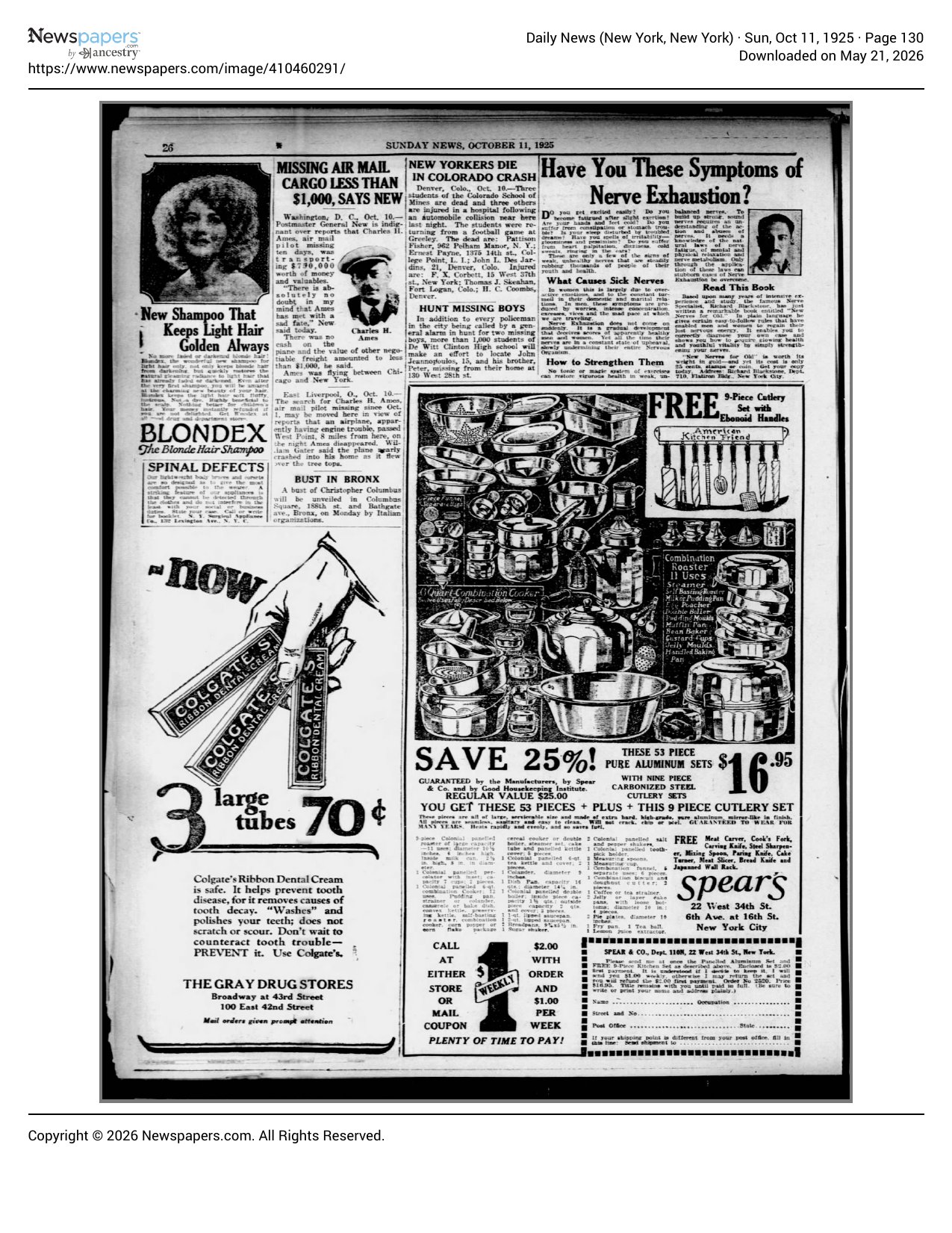
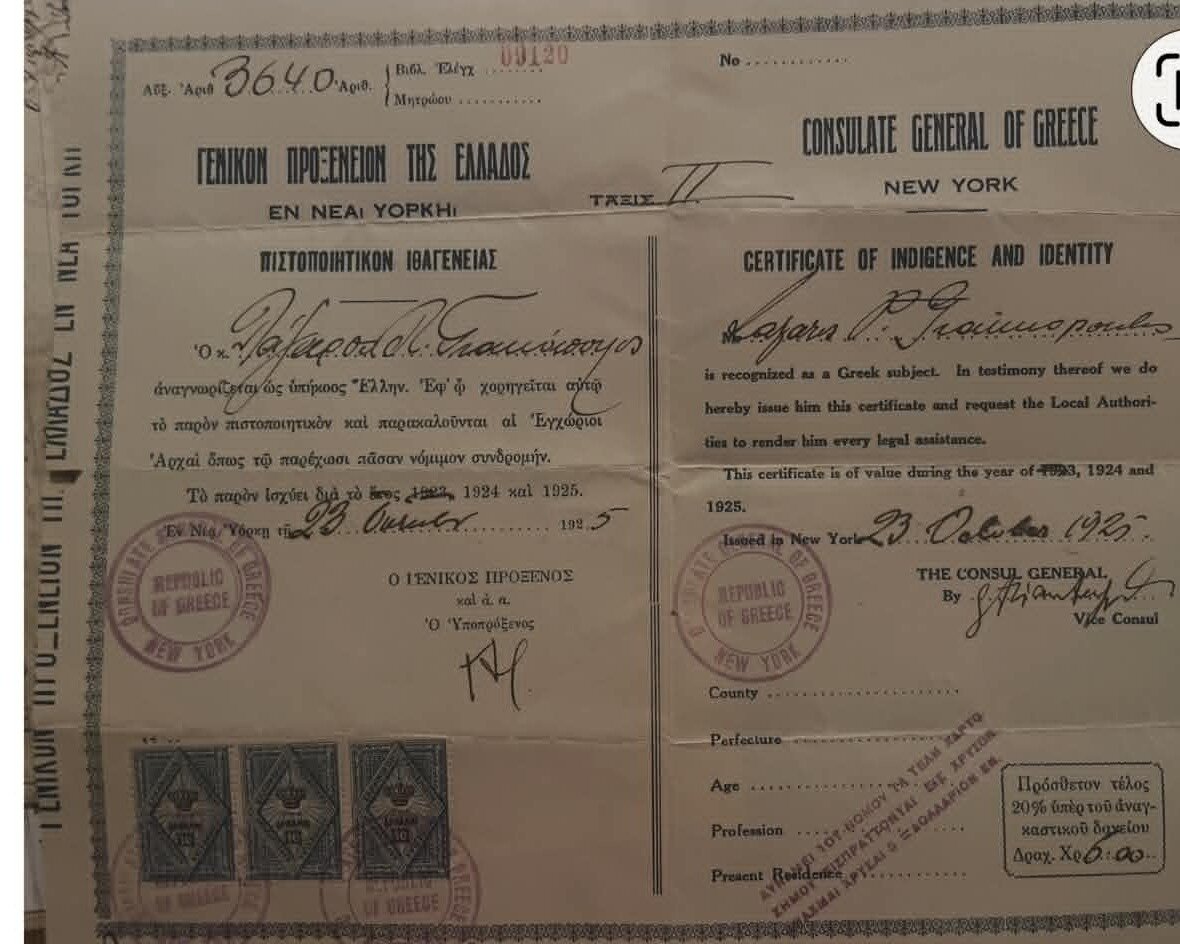
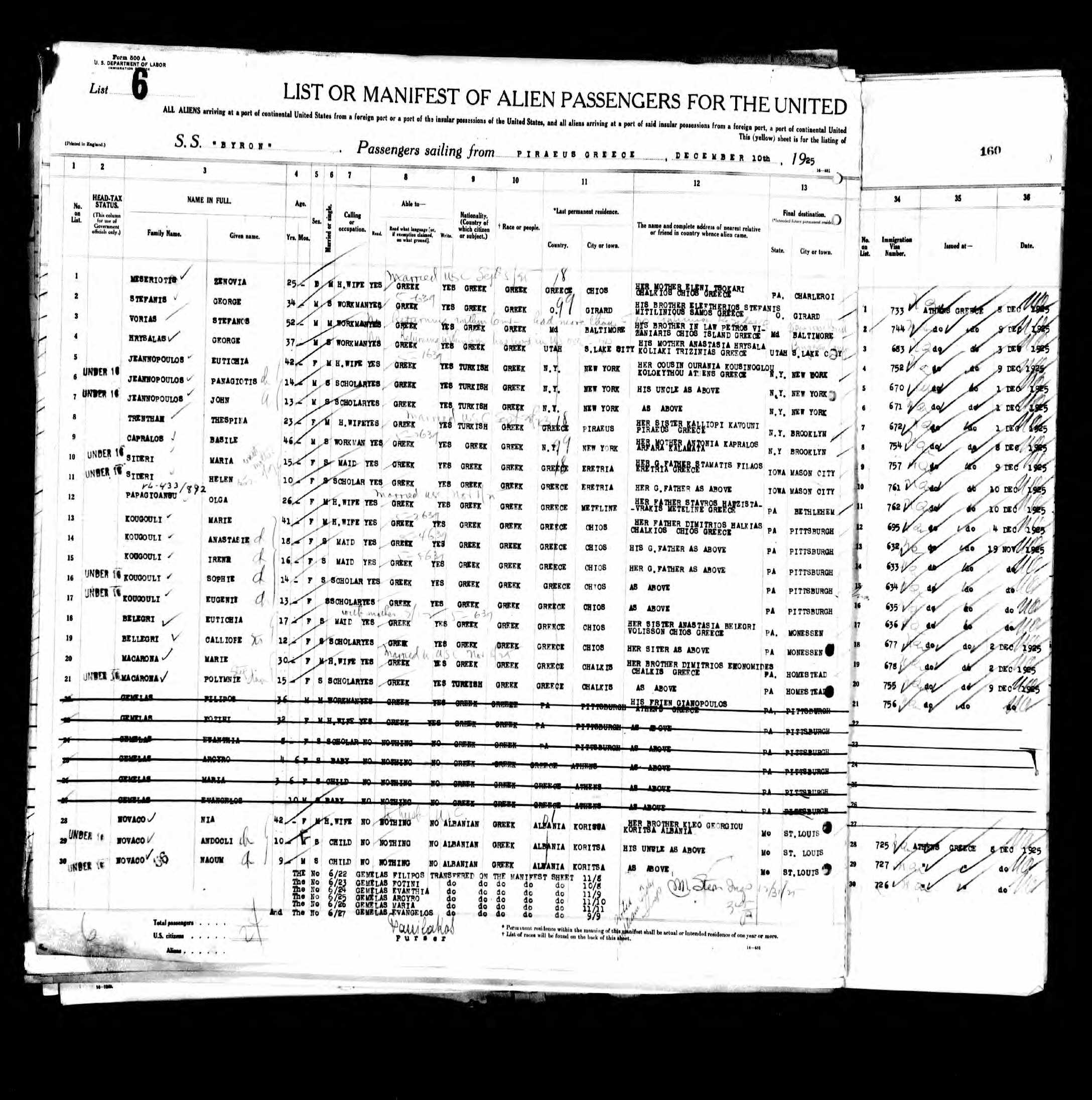
He and Takis ran away together as boys, around 1924–25 when both were thirteen. They forged passports, told the Greek consulate their parents were dead, and got themselves shipped back to Greece. Family in Greece took them in “for a few weeks”; Lazaros and Eftyhia, frantic, posted newspaper notices in New York and dealt with a fake ransom note before finally arranging their return. Takis is the passenger recorded on the SS Byron arriving in New York in 1925; the corresponding return for John has not yet been located.
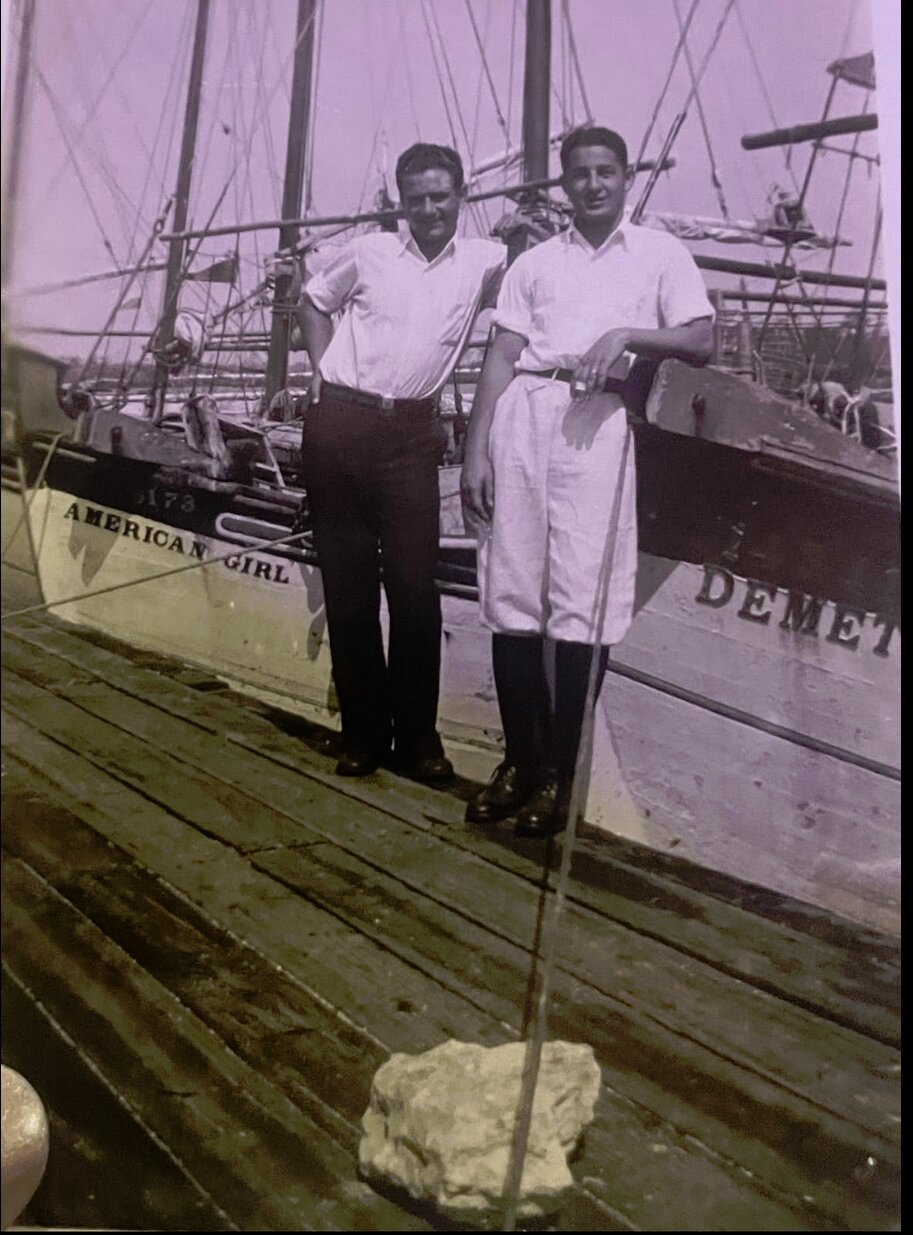 John Lazare (left) and his brother Takis (right) posed against the bow of the Greek sponge boat American Girl (hull No. 173), with another vessel named DEMET[rios] moored alongside — the Tarpon Springs sponge docks, Florida’s Gulf coast. Late 1920s or early 1930s. The first Tarpon Springs photograph in the family archive, and a likely explanation for how Takis ended up at the University of Florida at Gainesville in 1931: the Greek-American Florida network ran through Tarpon Springs, and both Jeannopoulos brothers were clearly moving through it as young men.
The twin-or-near-twin question
The two preserved birth dates — John Lazare on March 17, 1911 (priest’s certificate) and Takis on November 18, 1911 (WWII draft card) — present a biological puzzle. Two children born to the same mother only eight months apart cannot both be carried to term. The narrow possibilities:
- John Lazare was actually born earlier than 1911 — most likely 1909 or 1910 — and the 1911 date in the priest’s certificate reflects what Eftyhia told Father Kontogeorgos in 1931, by which time the family had been using altered dates for years. This would give a normal sibling spacing of 14–24 months between John and Takis. The “both age 13 at the runaway” detail in family memory may itself be a smoothing of slightly different real ages.
- They were twins, both actually born November 18, 1911 or March 17, 1911, with the dates artificially separated in family records. Less likely — there is no other indication that they were treated as twins in family tradition.
- One was severely premature — John as a 5-month preemie of March 1911 leaving Eftyhia capable of conceiving Takis by February 1911 — possible but vanishingly rare in 1911 Soma medicine, and unlikely to have produced a child who lived into 2004.
Eftyhia’s documented pattern of altering John’s dates — the well-attested 1913 falsification on US records to keep him out of military conscription, plus the apparent age discrepancy on her own 1924 refugee-registration form — supports option 1 as the most plausible reading. The discrepancy you see between John’s “1911” and Takis’s “1911” is not necessarily two contradictory truths; it may be one truth (Takis’s) and one date that has been moved at least once. The Kontogeorgos certificate may be authentic as a 1931 NYC affidavit, while still reflecting an upstream maternal narrative that had drifted from John’s actual 1909–1910 birth.
This remains an open research question; resolution would require a Soma δημοτολόγιο record or a contemporaneous Greek Orthodox baptismal-register entry preceding 1922, neither of which has surfaced.
The “John (b. 1899) SS Saturnia 1930” question — likely John Lazare himself
A separate puzzle in the family record concerns a 1930 SS Saturnia arrival manifest that records “John Jeannopoulos, age 31, birth year (estimated) 1899” — an entry that has been carried in the archive as the possible older brother John (b. 1899). The likely resolution: this is John Lazare himself, returning to the US with a falsified age, not a separate older brother.
The case rests on five observations:
-
The “1899” is back-computed from a claimed age of 31 — not an independent birth-year statement on the original manifest. FamilySearch’s index field “Birth Year (Estimated)” is computed by subtracting age-at-arrival from voyage-year. Whatever age the manifest recorded becomes the basis for the estimated birth year. If the claimed age was wrong, the estimated birth year is wrong by the same amount.
-
The family’s pattern of age manipulation is well documented. Eftyhia altered John’s date by two years on US records (1911 → 1913); John and Takis forged passports for the 1924-25 runaway to Greece; on his 1924 SS Themistocles inspection card John appears as age 11 (using the falsified 1913 date, when he was actually ~13). A 1930 voyage claiming age 31 (when he was actually ~19-21) is one more iteration of the same pattern — perhaps to travel internationally as an “adult” without parental signature, or to access different immigration regulations.
-
Peter (Constantine’s son, who knew his uncles personally) enumerated only four Jeannopoulos brothers — Takis, John, Achilles, Kostas (Constantine). If there had been an older “1899 John” who arrived in 1930 and stayed in the US through the 1940s and 1950s, Peter would have known him. He didn’t list him. The only way that’s consistent with a real 1899 John is if that John died before Peter was born in 1943 — but no death record for any older John has surfaced.
-
The 1930 arrival date fits John Lazare’s biography. Between the 1924-25 runaway return (undocumented for John) and his 1931 enrollment at the University of Paris (per his father’s 1937 sworn affidavit), John was somewhere — and the 1930 SS Saturnia arrival into New York fits a “returning home before starting medical school in Paris next year” scenario cleanly.
-
No other documentary trace exists for the “1899 John” — no naturalization, no census entry, no marriage record, no death record, no later immigration trace. He surfaces in one manifest in 1930 and vanishes. That non-trace is more consistent with “this name on this manifest was John Lazare using a fake age” than with “an entire additional brother lived in America for years and left no other record.”
Working resolution: Treat the 1930 SS Saturnia entry as John Lazare’s own undocumented return voyage, with “31 / 1899” as the next layer of the age-manipulation pattern. The standalone John (b. 1899) page carries the document but should be read as a candidate identification, not as evidence of a separate older brother.
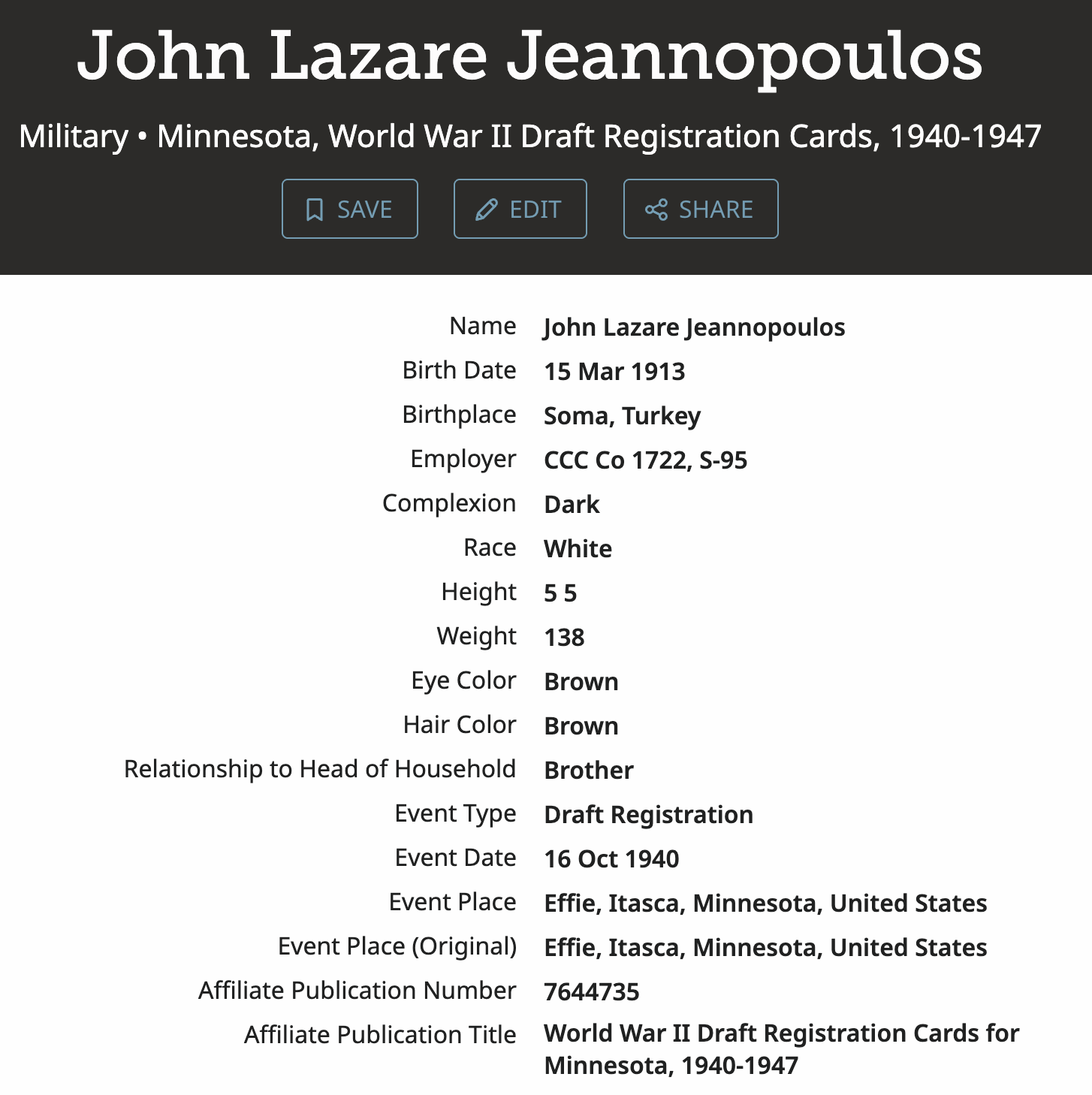
He was at the University of Paris in the 1930s. The 1940 US Census places him in Minnesota with the Civilian Conservation Corps — the New Deal program that put young men to work on public-lands projects through the Depression — and his WWII draft registration card confirms the placement: CCC Camp S-95, Company 1722, Effie, Itasca County, Minnesota — a Civilian Conservation Corps camp deep in the northern Minnesota lake country. The card shows his contact-of-record as his brother Takis at 28 West 69th Street, NYC (the family’s pre-war Upper West Side address). The card is annotated “Rel’d from Active duty 11/14/46” — he was released from his US Army Medical Corps active service on November 14, 1946, at 35.
He was the one who put the other three through medical school
The single most important fact about his Depression years, surfaced in Aline’s May 2026 reading of his obituary: as the CCC Camp Effie physician, he sent his entire salary home — to support his family AND to put his three younger brothers (Constantine, Takis, Achilles) through medical school. Of the four MDs the family produced — Constantine NYU, Takis Paris, Achilles a NYC urology practice, and John himself — three of those medical educations were paid for by a Greek immigrant CCC camp doctor in northern Minnesota sending his paychecks south. The family’s most-recognized brothers were enabled by the one who took the least-recognized assignment.
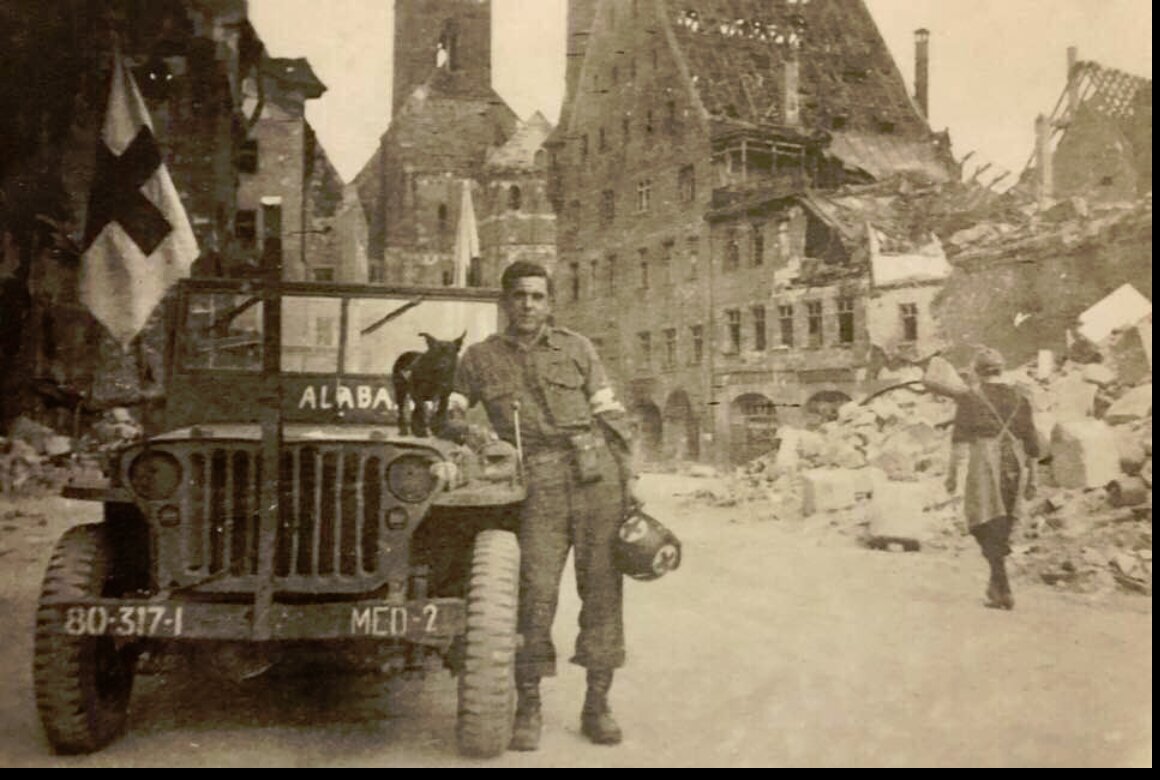 John Lazare in fatigues standing beside his Willys jeep — windshield marked “ALABA,” hood stencilled MED-7, serial 80-3174, US flag and unit pennant flying — in front of a bombed medieval-style cityscape, almost certainly occupied Nuremberg, 1945. He is wearing helmet covers and full kit; the dog “Blackie” (family-named) is in a near-identical second frame of the same scene.
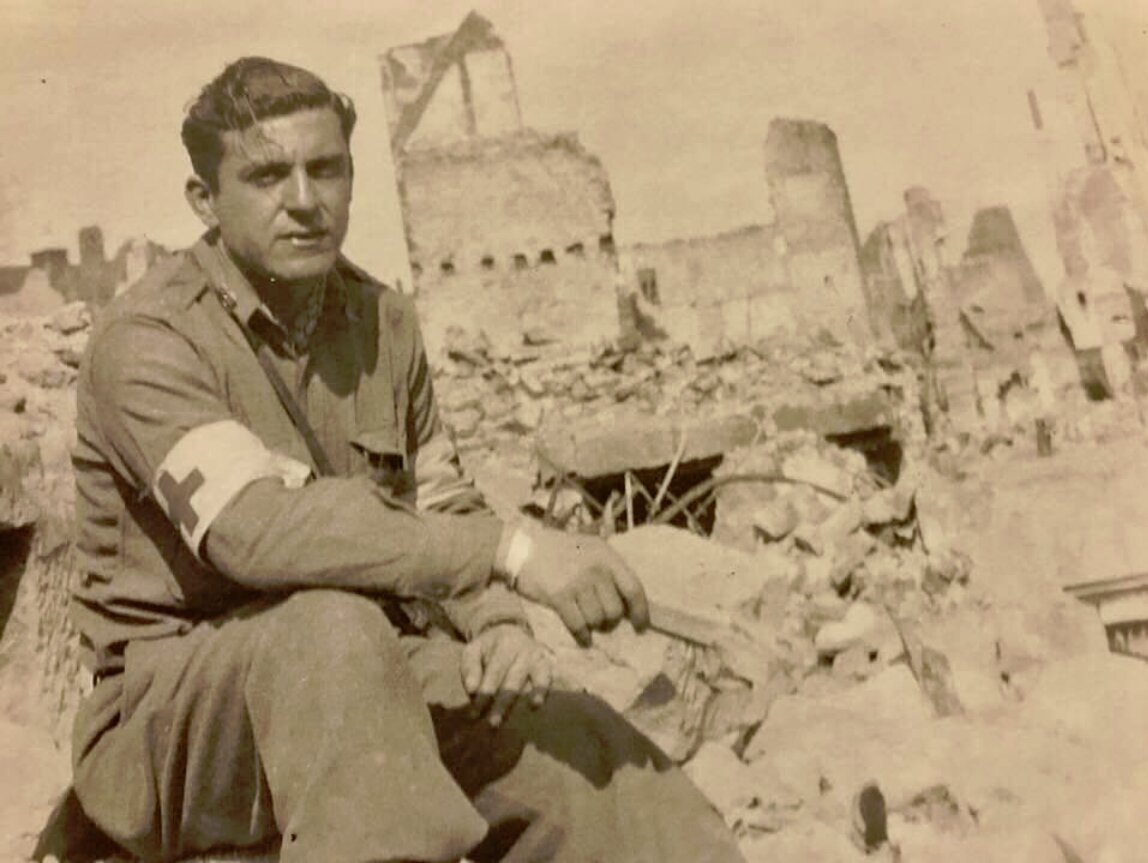 A more candid frame from the same period — John in service uniform with a Red Cross armband, sitting on the rubble of a bombed-out European city. Likely Germany 1945; his five battle stars track the Western Front sweep from Normandy to Central Europe.
WWII — D-Day and five battle stars
His full WWII record, also from the obituary:
Major, US Army Medical Corps · Bronze Star · American Campaign Medal with five battle stars: Normandy, Northern France, Rhineland, Ardennes, Central Europe
He went ashore on D-Day — the June 6, 1944 Allied invasion of Normandy — at 33. The five battle stars track the Western Front campaign sweep from June 1944 to V-E Day — Normandy (June-July 1944) → Northern France (July-September 1944) → Rhineland (September 1944 – March 1945) → Ardennes (December 1944 – January 1945, the Battle of the Bulge) → Central Europe (March-May 1945). He went all the way from Omaha to the Elbe.
Brooklyn Navy Yard — and a fire aboard the Constellation
Postwar, before settling into civilian medical practice, John served as a Medical Officer at the Brooklyn Navy Yard, where his obituary records that he was decorated “for his heroic actions during a fire aboard the Constellation.” The Brooklyn Navy Yard was the largest naval shipyard in the US through the 1950s; the Constellation fire most likely refers to the December 19, 1960 fire on the USS Constellation during fitting-out at the Brooklyn Navy Yard — a major shipyard disaster that killed 50 workers. John was on the medical response.
Director, US Public Health Service Outpatient Clinic
After the Brooklyn Navy Yard closed (1966), he served as Director of the US Public Health Service Outpatient Clinic, Department of Health, Education and Welfare, until his retirement from public service in 1977, at about sixty-six.
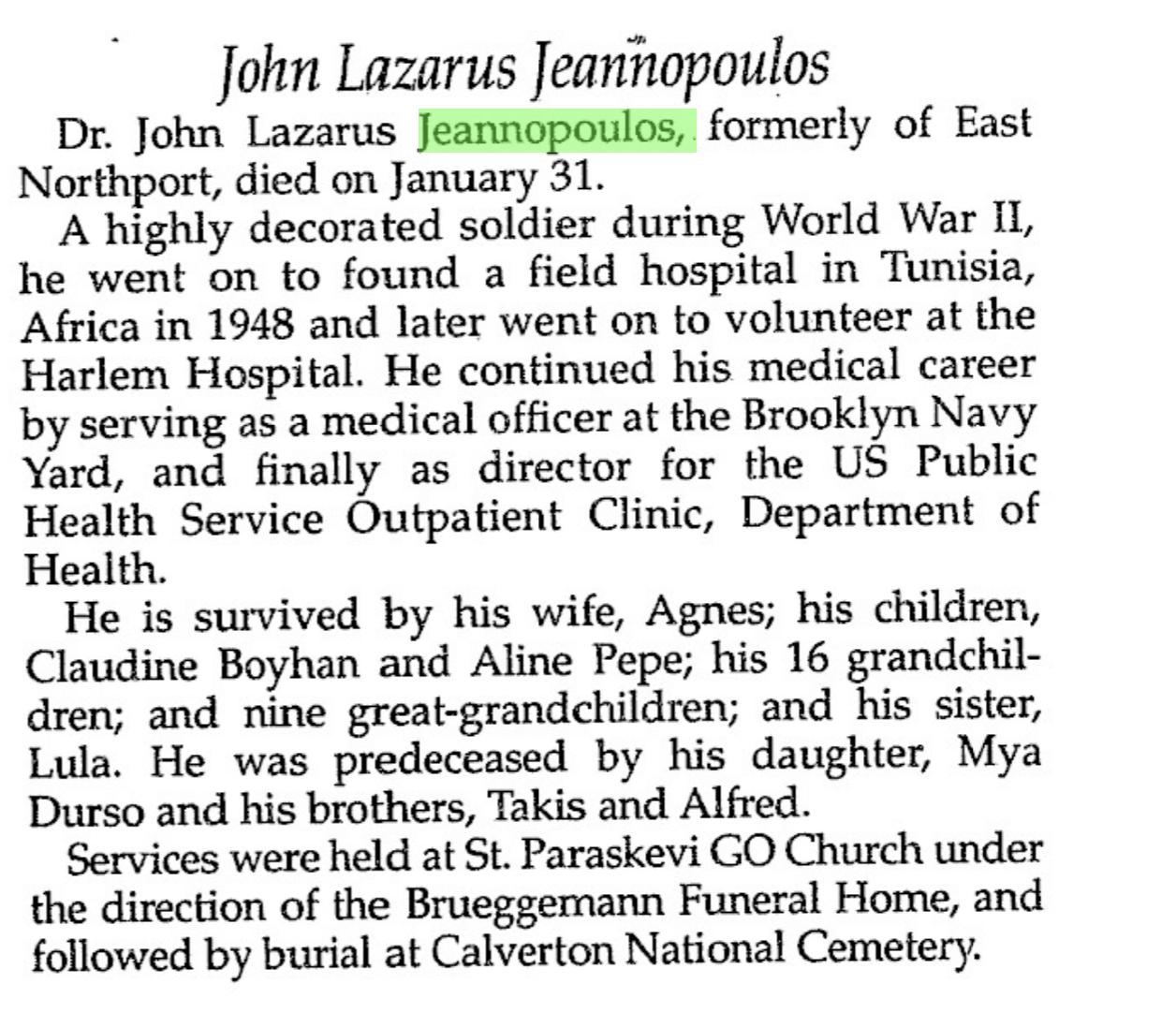
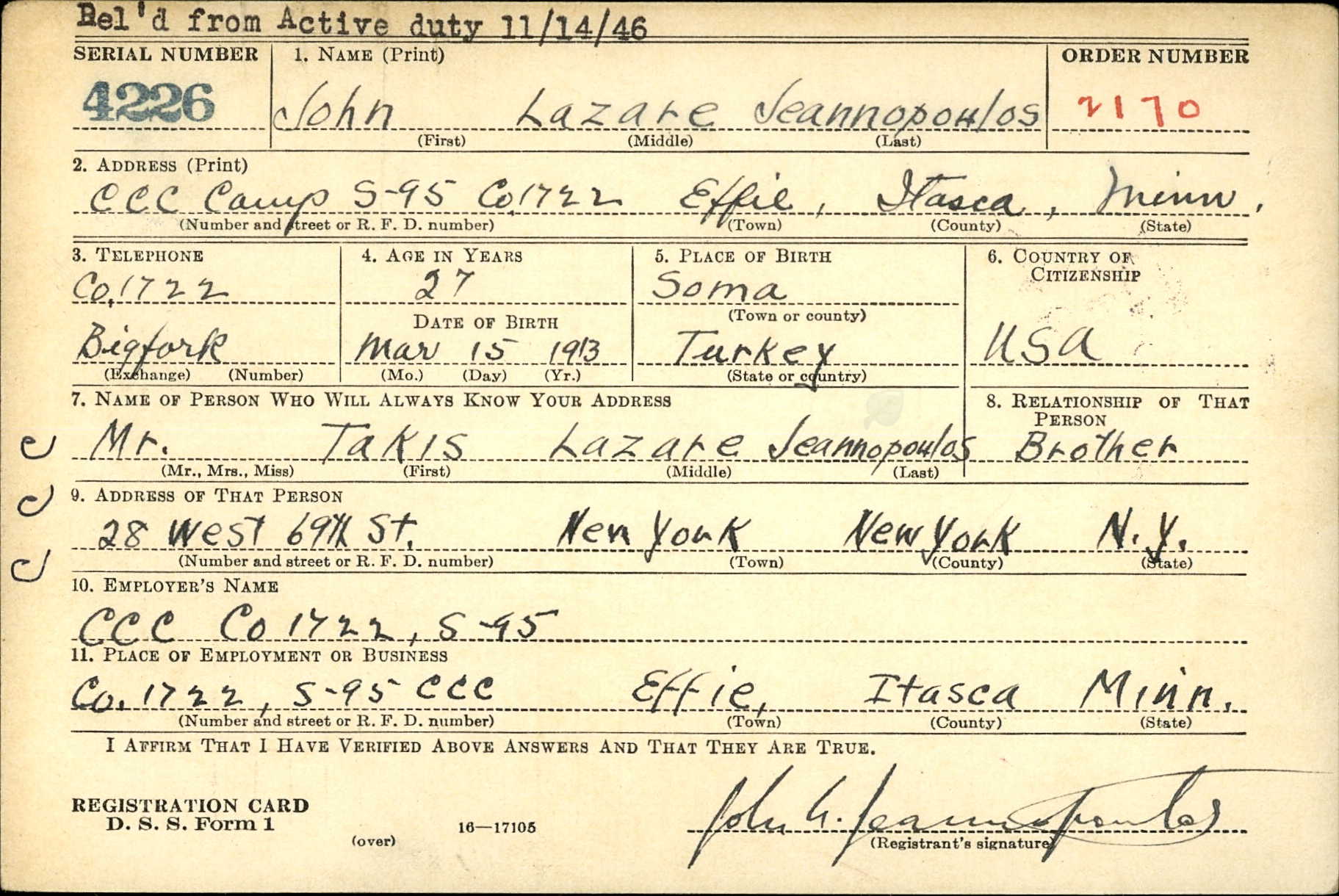 The draft card shows his birth date as Mar 15, 1913 — the falsified date Eftyhia put on every American record to keep him from conscription (real birth: Mar 17, 1911 per the 1931 priest’s certificate). The falsification held through his entire US military service. He was a physician — one of the four Jeannopoulos brothers who all became MDs (Constantine, Takis, John Lazare, Achilles) per Sophie’s FBI file. He served in the US Army Medical Corps during and after WWII; his 2004 obituary describes him as “a highly decorated soldier during World War II.”
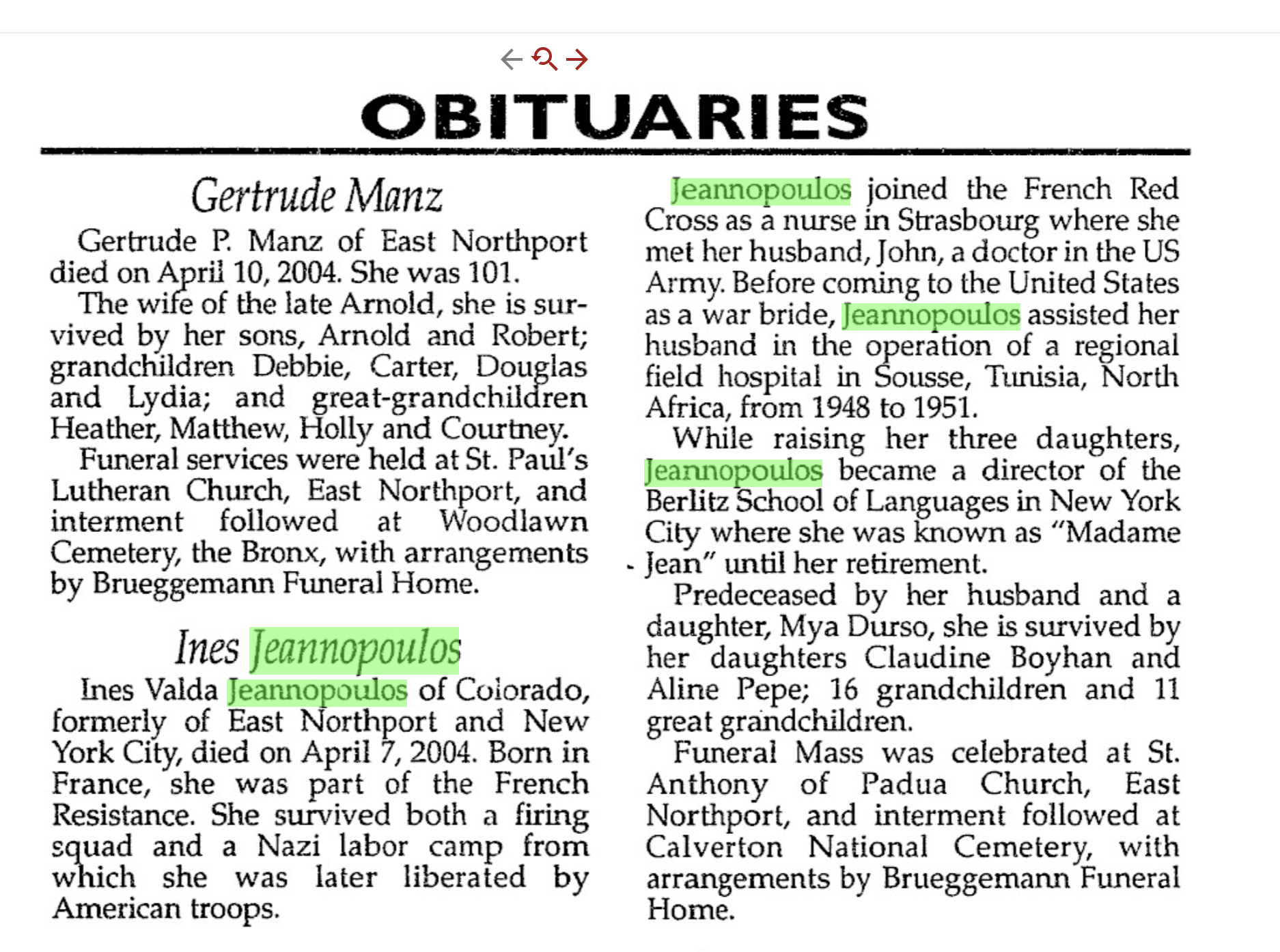
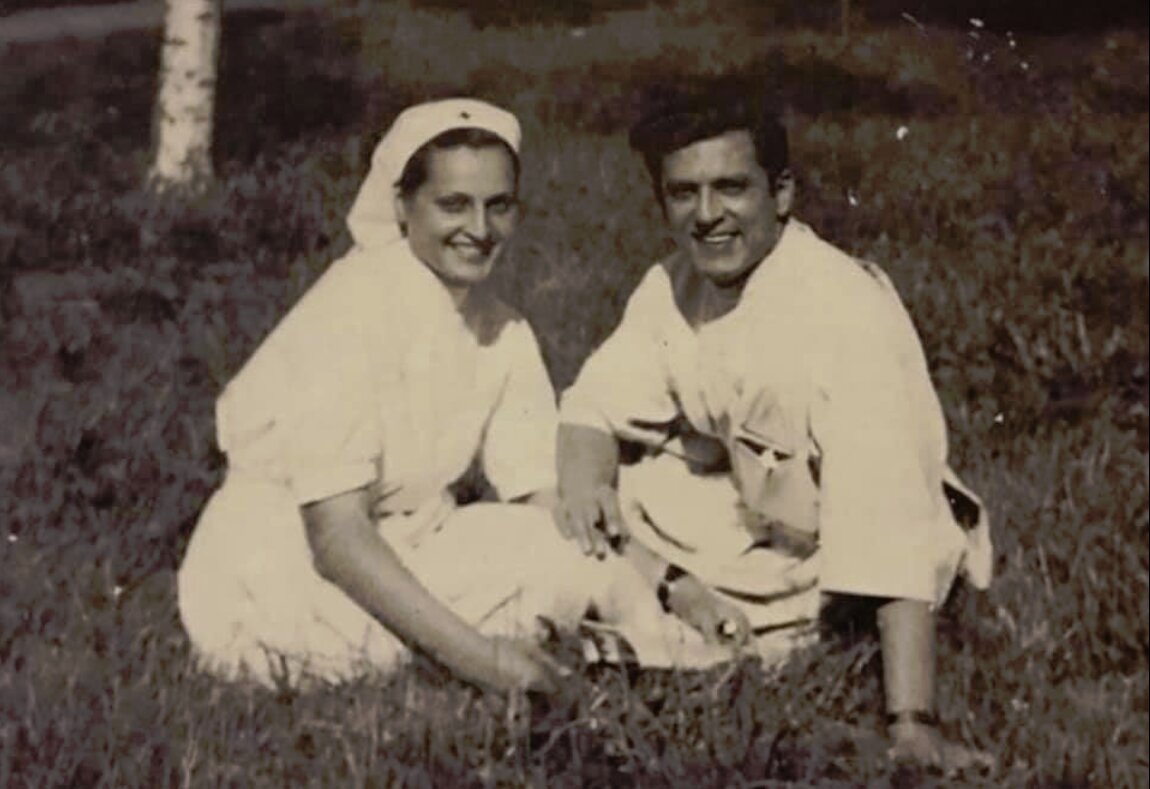 John and Ines together on grass in white clothing — Ines possibly in her French Red Cross nurse whites with a white headpiece — both young and smiling. Either Strasbourg 1945 (where they met) or Sousse 1948 (the field-hospital years). The first romantic-couple photograph of them in the family archive.
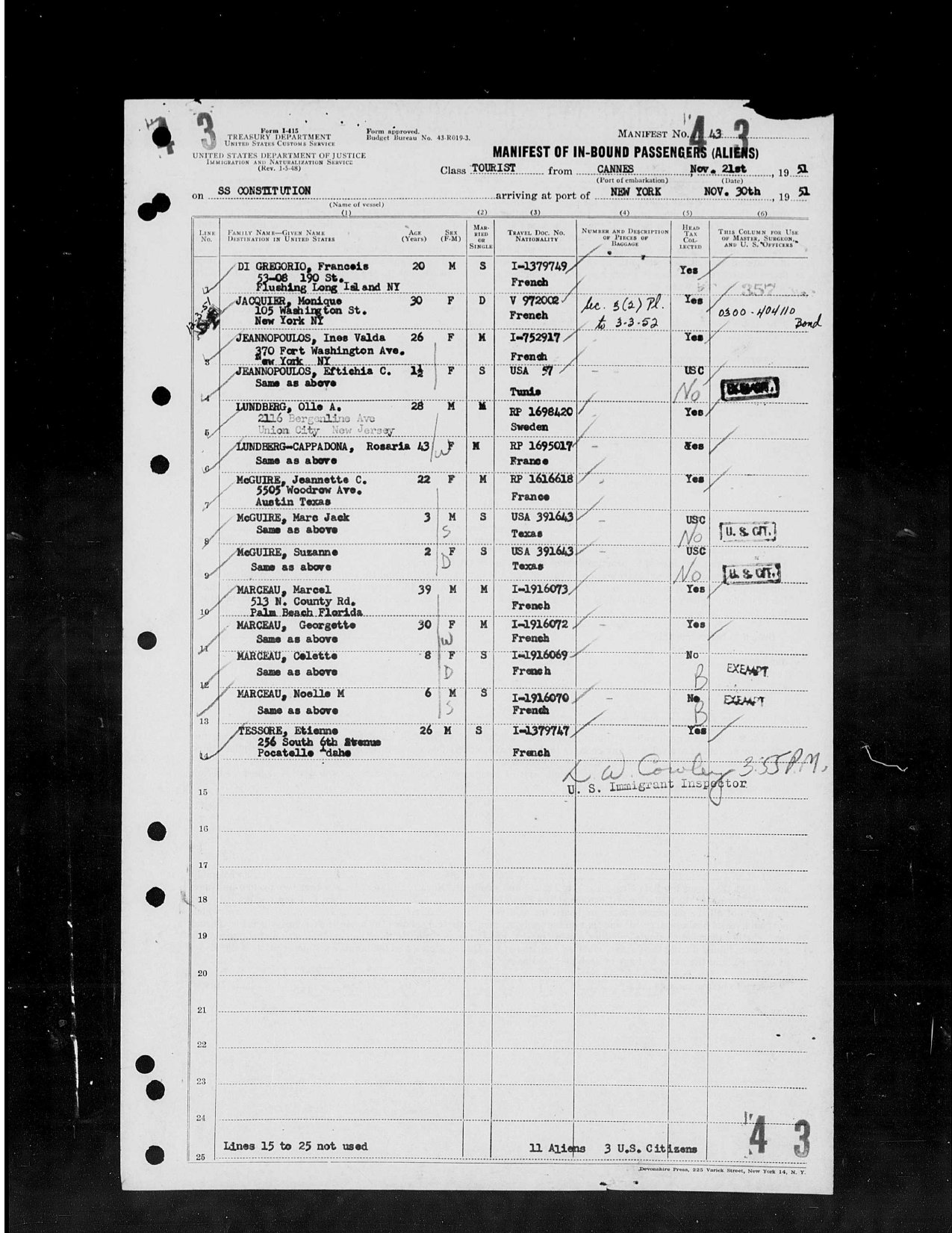
He met Ines Valda in Strasbourg, where she was a French Red Cross nurse just liberated from her Resistance years. They married, and from 1948 to 1951 ran a regional field hospital together in Sousse, Tunisia, in his late thirties. Their three daughters were Eftichia (Claudine), born in Tunis around 1950 — who appears on the 1951 SS Constitution manifest as “Eftichia C.” and went by Claudine in adult American life, then married Patrick Boyhan — Aline Athena (who married Nick Pepe), and Myriam “Mya” (adopted into the family, who married Dominick Durso and predeceased her parents in 2002). Ines and the infant Eftichia/Claudine crossed from Cannes to New York on the SS Constitution on November 30, 1951.
Back in the United States he volunteered at Harlem Hospital, served as a medical officer at the Brooklyn Navy Yard, and finished his career as Director of the US Public Health Service Outpatient Clinic, Department of Health.
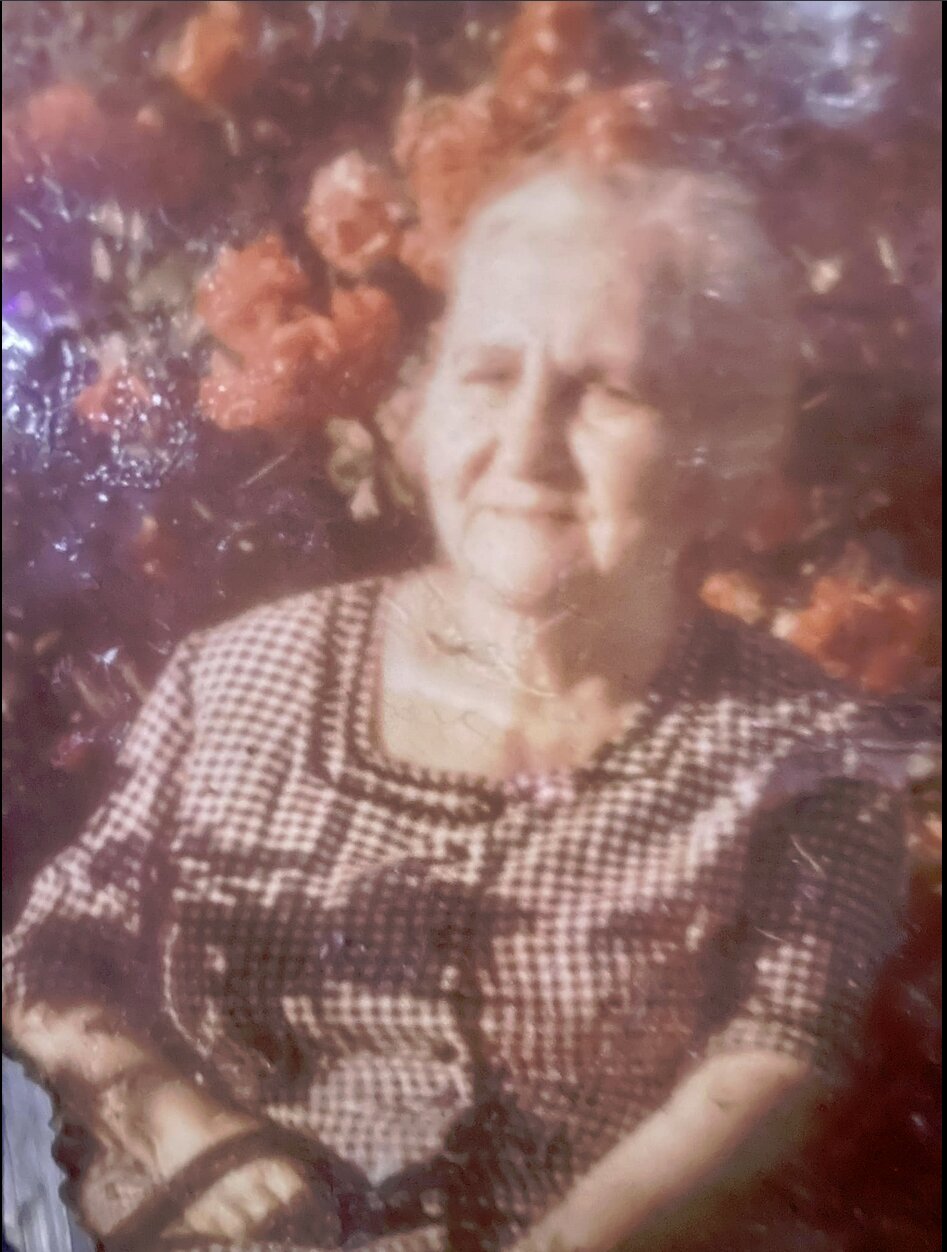
He died January 31, 2004, at 92, ten weeks before Ines (whom the obituary names by her other name Agnes — the two names refer to the same woman, his wife of decades). Predeceased by his daughter Mya (2002) and his brothers Takis (~1980) and Achilles (the latter referred to as “Alfred” in the obituary, having anglicized his name to Alfred A. Johnson; d. Jan 22, 2004). Survived by Ines, daughters Claudine Boyhan and Aline Pepe, sixteen grandchildren, nine great-grandchildren, and his sister Rhea (“Lula”). Services at St. Paraskevi Greek Orthodox Church via Brueggemann Funeral Home; interment at Calverton National Cemetery, New York.