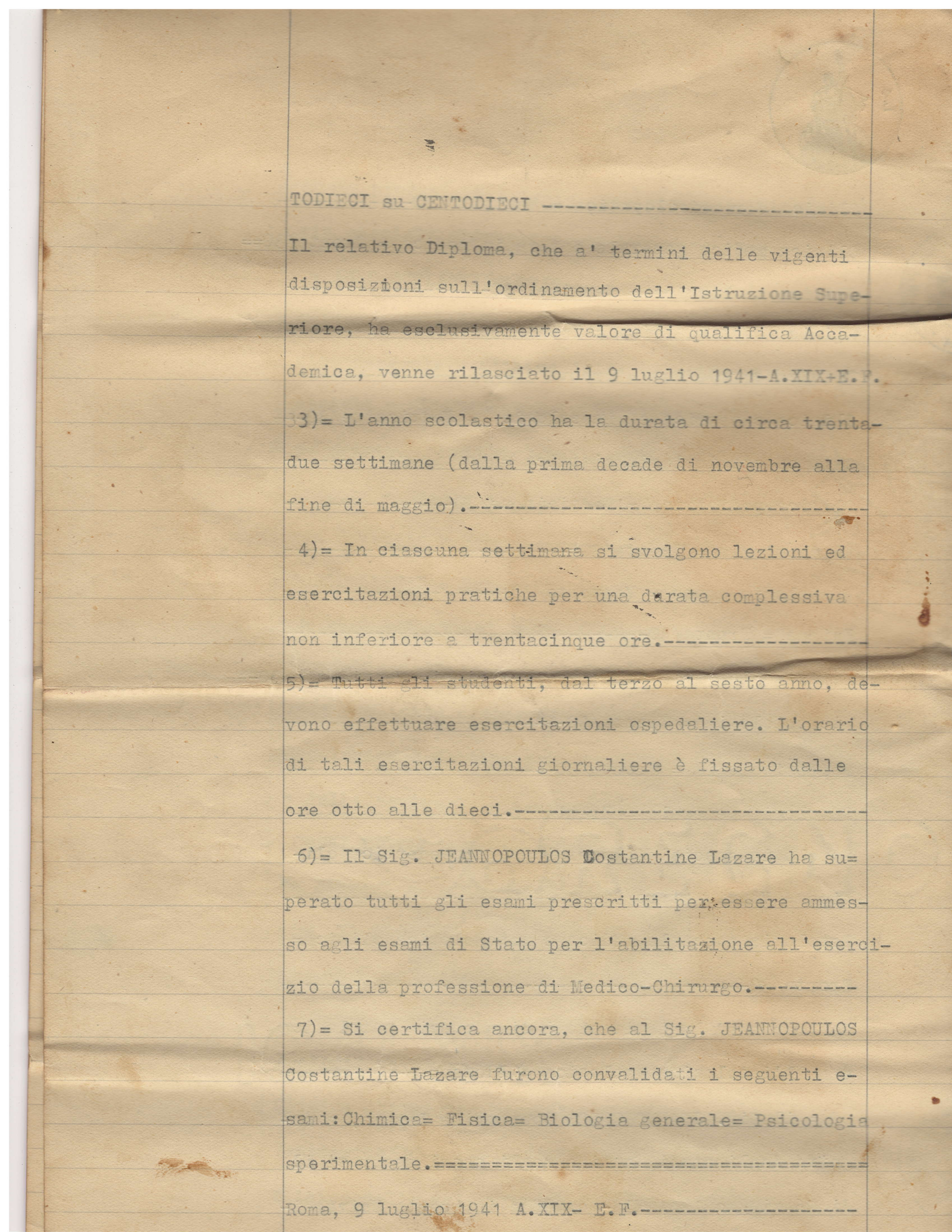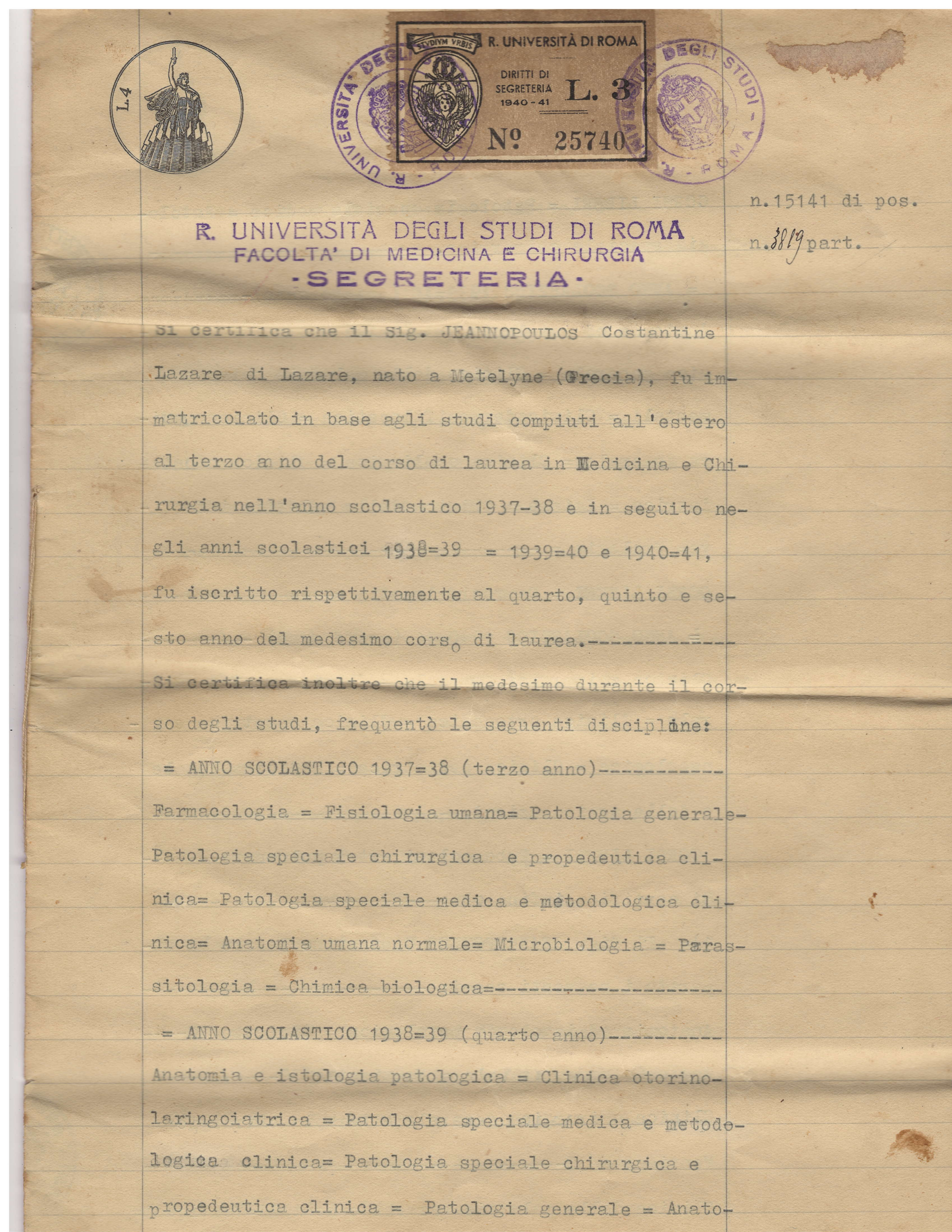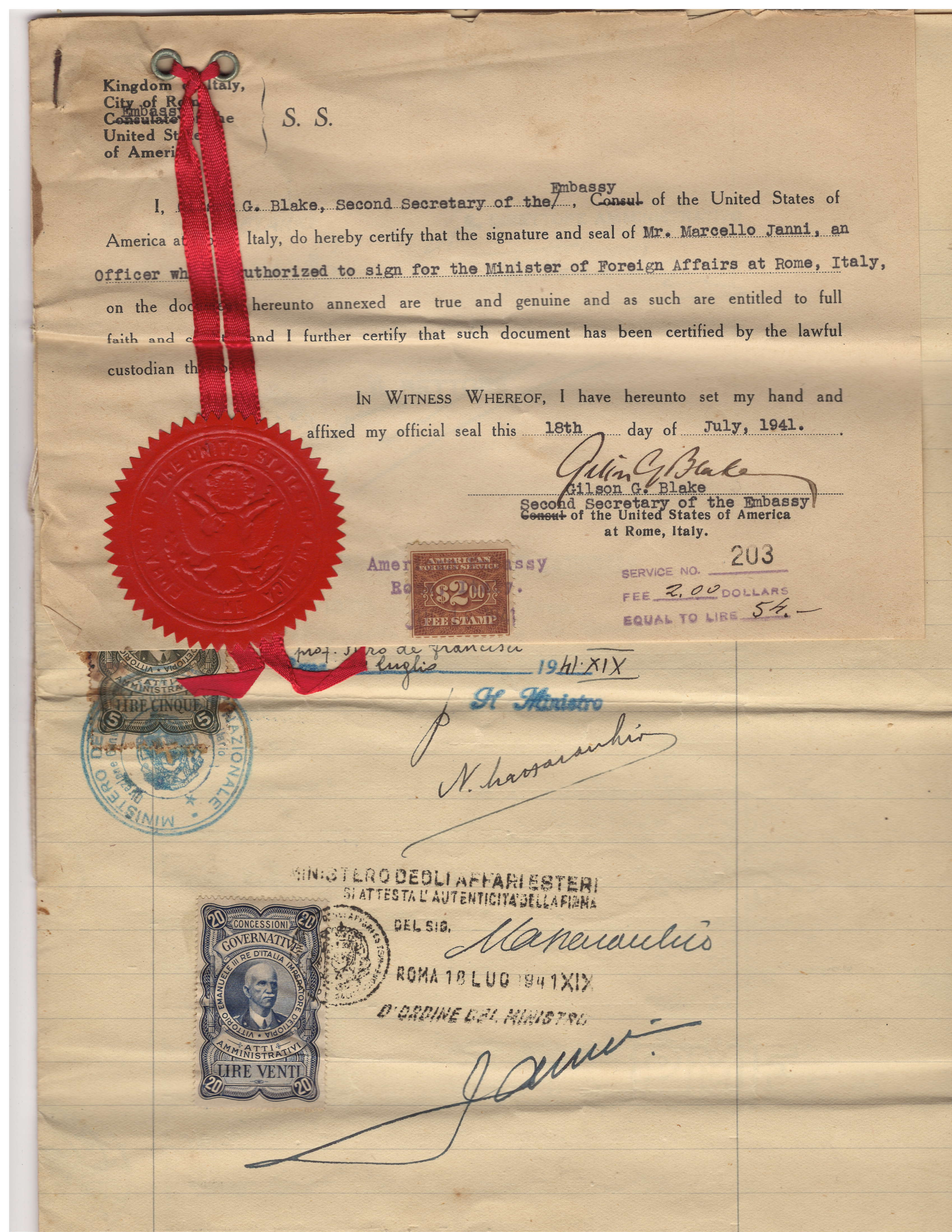
Five months before Pearl Harbor, the US Embassy in Rome was still doing routine diplomatic business — including this single-page legalization of Constantine’s medical diploma for use in the United States. Signed by Gilson G. Blake, Second Secretary of the Embassy, dated July 18, 1941. Service No. 203. Fee $2.00, equal to 54 lire. The page carries the embossed red wax US Embassy seal at the upper left (ribboned), plus two Italian revenue stamps — the brown $2.00 American foreign-service fee stamp at center, and a blue 20-lira “concessioni governative” Italian revenue stamp at bottom — and the green Ministero degli Affari Esteri seal of the Italian Foreign Ministry.
What the document attests
“I, Gilson G. Blake, Second Secretary of the Embassy of the United States of America at Rome, Italy, do hereby certify that the signature and seal of Mr. Marcello Janni, an officer who is authorized to sign for the Minister of Foreign Affairs at Rome, Italy, on the document hereunto annexed are true and genuine and as such are entitled to full faith and credit; and I further certify that such document has been certified by the lawful custodian thereof.”
“IN WITNESS WHEREOF, I have hereunto set my hand and affixed my official seal this 18th day of July, 1941.”
This is a two-step legalization chain for a Constantine document destined for use in the United States:
- The Italian Foreign Ministry (Ministero degli Affari Esteri, Rome) — through its officer Marcello Janni, signing for the Minister of Foreign Affairs — first certified the authenticity of an underlying Italian document (the body of the “annexed” document is the June 1941 Università di Roma medical diploma, and the certification was performed on July 18, 1941, “del Sig. M. Manessulis”).
- The US Embassy at Rome, through Second Secretary Gilson G. Blake, then certified that Janni’s signature and seal were “true and genuine” — making the underlying Italian document admissible as evidence in the United States.
In modern terms this is the apostille-equivalent procedure for the pre-Hague-Convention era: a sovereign-to-sovereign chain that allowed foreign documents to be accepted by US courts and licensing boards.
Why Constantine needed this in July 1941
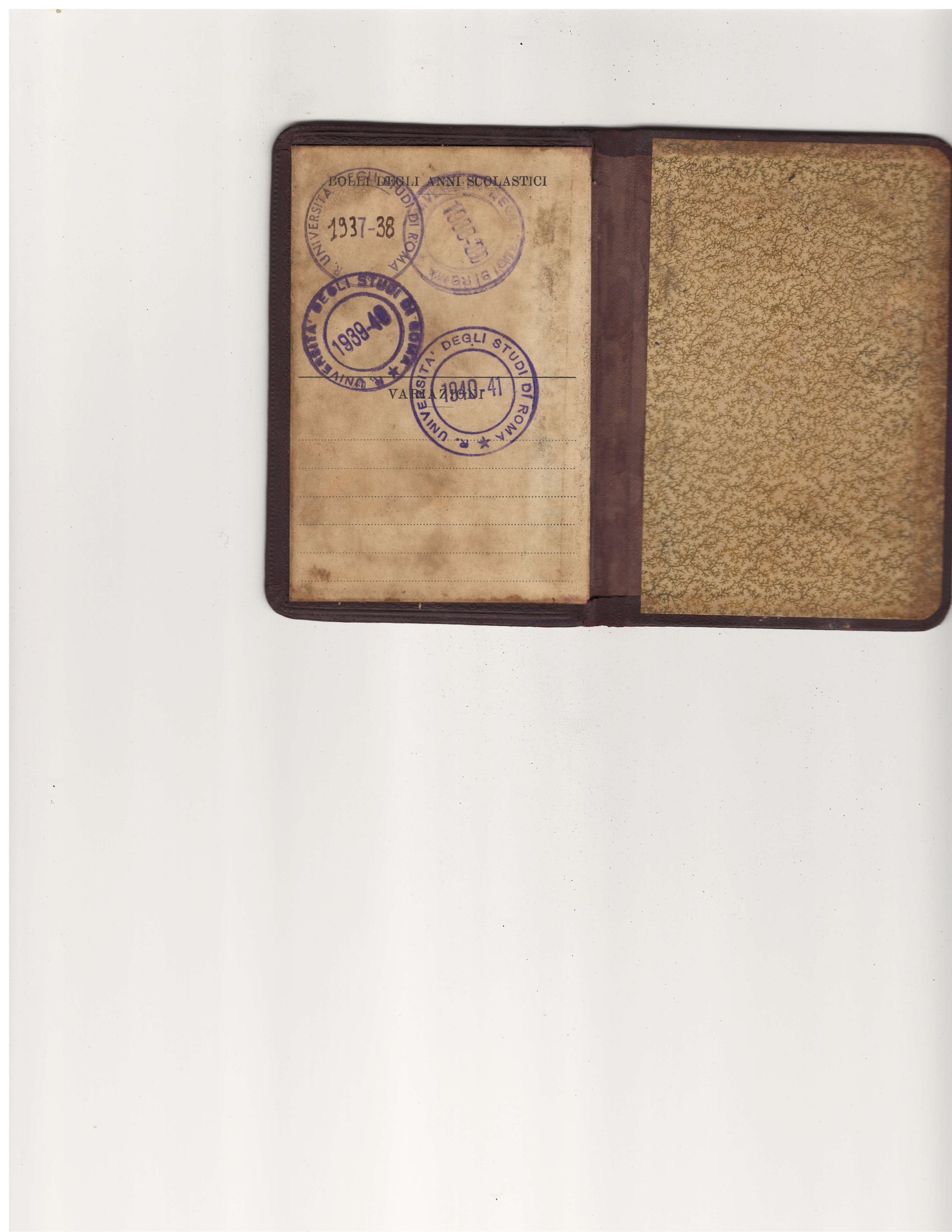
By mid-July 1941, Constantine had graduated from the Università di Roma medical school (110/110, see his June 1941 diploma) and was preparing to leave Fascist Italy for the United States. He needed his Italian medical credentials to be legally usable in New York for licensure, postgraduate residency placement, and eventually US Army Medical Corps commissioning.
The chronology is tight and deliberate:
| Date | Event |
|---|---|
| June 1941 | Diploma in Medicine and Surgery awarded by Università di Roma, 110/110 |
| July 18, 1941 | Italian Foreign Ministry + US Embassy Rome dual legalization (this document) |
| Late July 1941 | Constantine and Sophie depart Rome, travel south through Italy to embark from Lisbon |
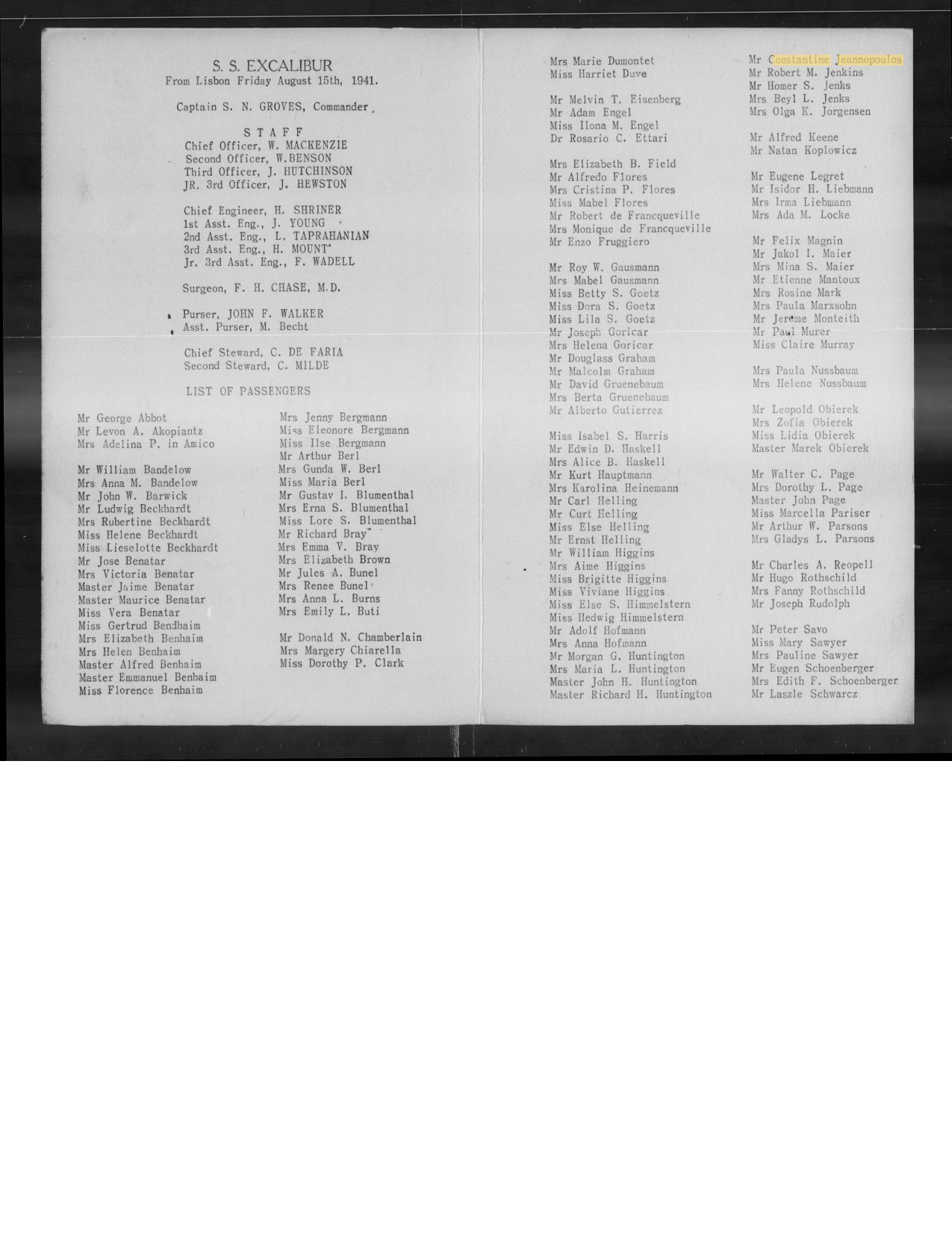
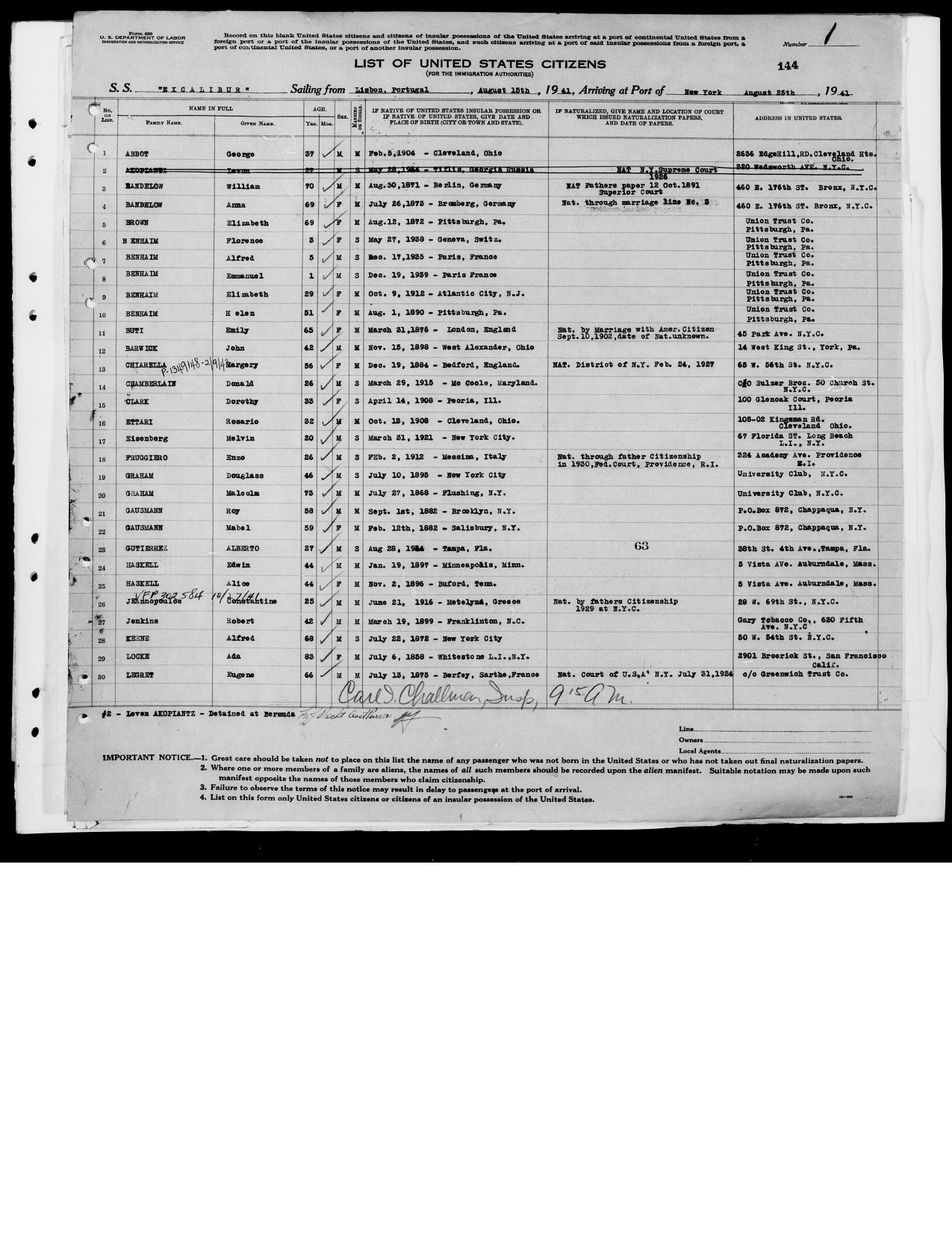
| August 14, 1941 | SS Excalibur sails from Lisbon |
| August 25, 1941 | SS Excalibur arrives at New York |
| 1942 | New York State medical license issued |
Without this Rome legalization, the August 1941 SS Excalibur passage to America would have been a credentialing dead-end. This single sheet of paper made his entire American medical career legally possible.
Gilson G. Blake
Gilson G. Blake (1894–1973) served as Second Secretary of the US Embassy at Rome from 1939 to mid-1941. The summer of 1941 was the final months of US-Italian diplomatic relations before Pearl Harbor — formal diplomatic relations between the United States and the Kingdom of Italy would be severed on December 11, 1941, when Italy declared war on the United States. Constantine’s legalization was completed barely four months before the Embassy shut its doors entirely. Blake’s signature on this document is one of the last batches of routine US-Italian consular legalizations performed before the rupture.
Why the document is preserved with Constantine’s papers
Because the US Embassy and Italian Foreign Ministry certifications were physically attached (the red ribbon and wax seal threaded through the document with the Italian foreign-ministry blue stamp underneath show this), the certificate page traveled with Constantine to America and was preserved with his diploma and other Rome-era documents in the family archive. The visible two-hole punch at the upper left margin suggests it was filed in a binder of his medical credentials.
Bridging document for the citizenship case
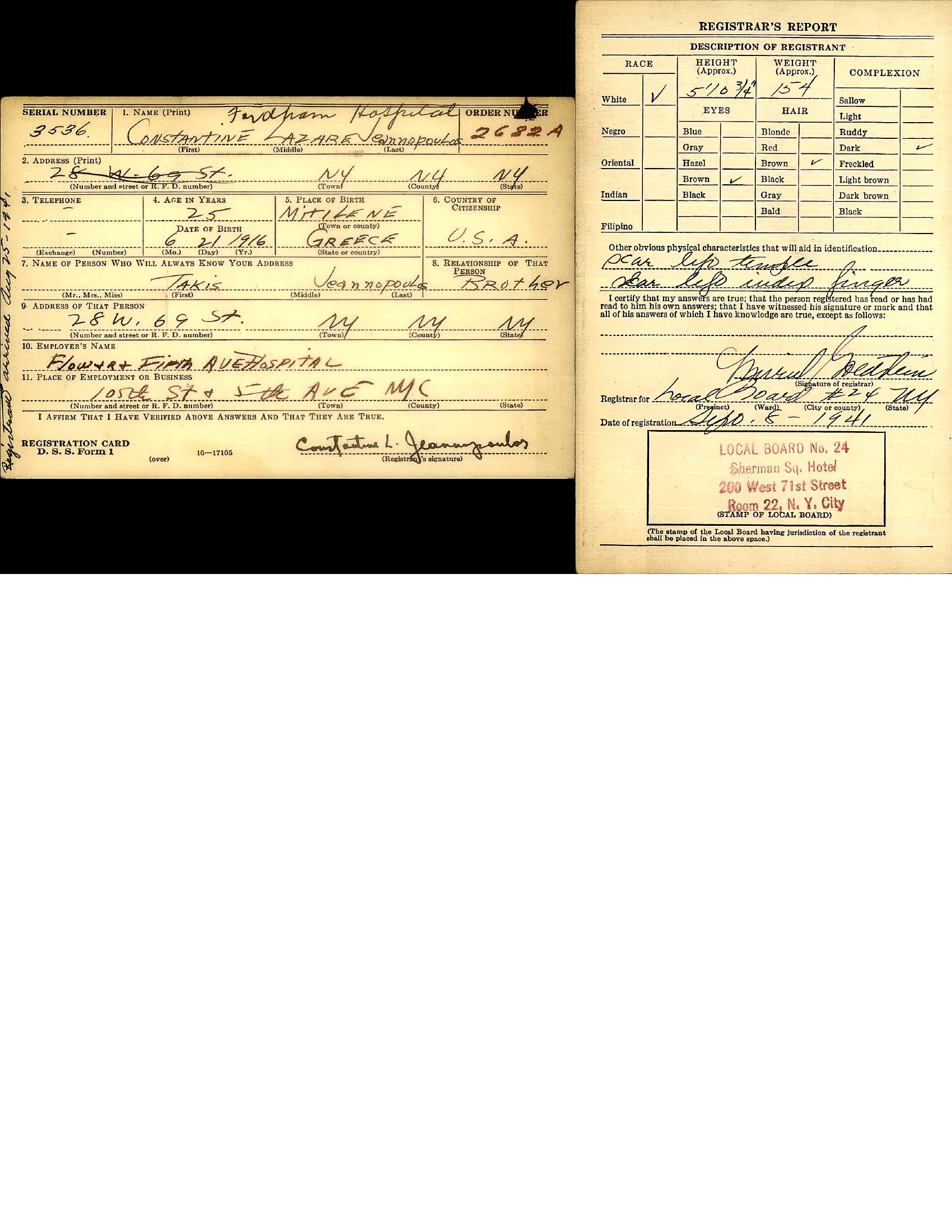
For the Greek citizenship case, this document is not direct evidence of Greek nationality — it is a US-Italian certification chain — but it sits in the timeline immediately after the Italian-state documents that explicitly recorded Constantine as Greek and immediately before his return to American soil as the holder of a US Certificate of Citizenship. In the documentary chain, it confirms the dual operative identity that the Greek-citizenship case rests on: Italian sovereign recognition of Greek nationality, then American sovereign recognition of the Italian credentials, then American naturalized-derivative citizenship status — all simultaneously held by Constantine through July 1941.